Springtime in Purgatory
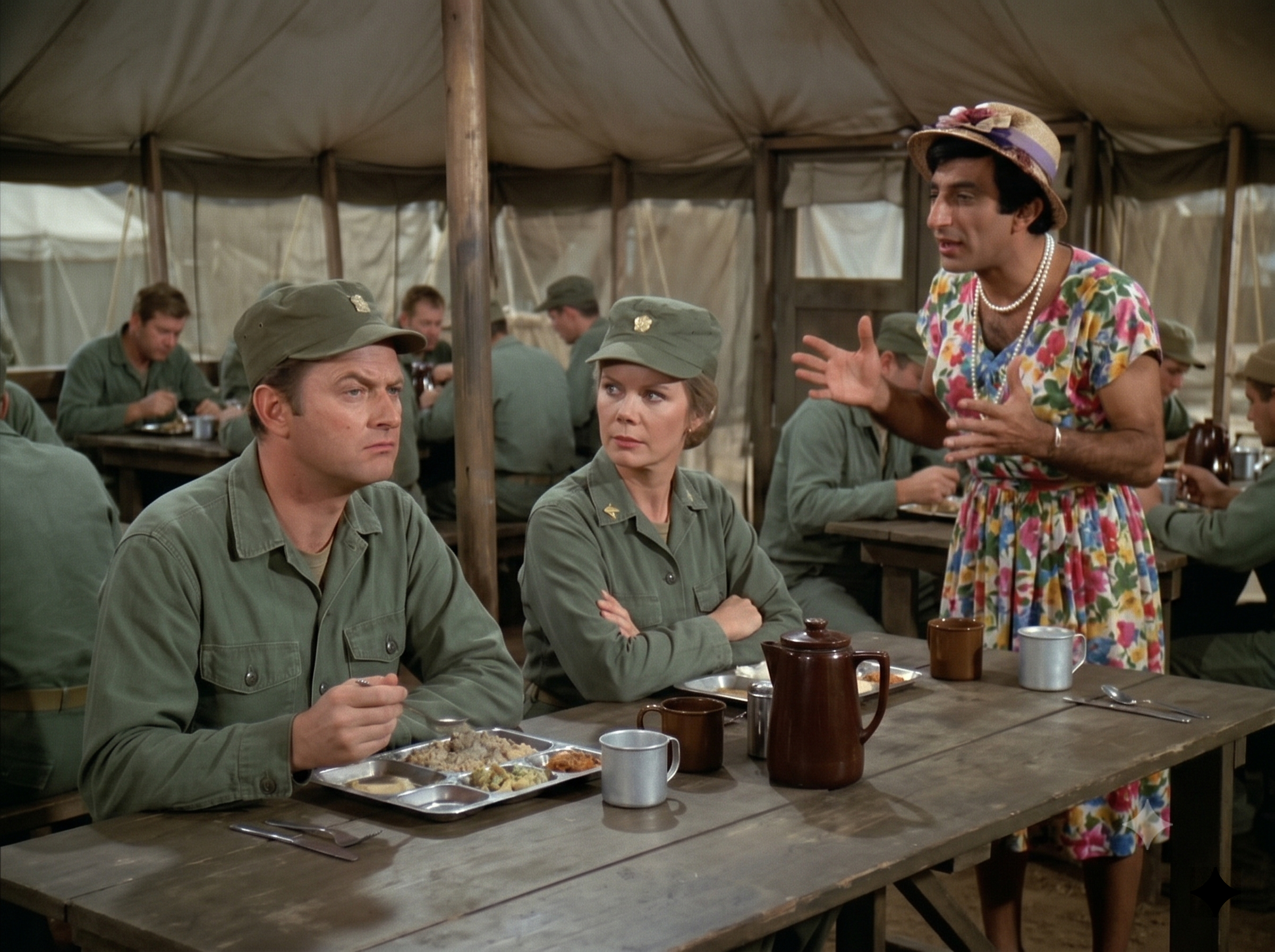
The war always paused for breakfast, though the food rarely made the ceasefire worthwhile.
Inside the mess tent of the 4077th, the morning air was thick with the smell of scorched coffee and whatever culinary tragedy Igor had conjured from powdered eggs and despair.
It was a quiet morning, the kind that usually followed a brutal, endless night in the O.R. The camp was running on fumes, black coffee, and the sheer, stubborn refusal to let the madness win.
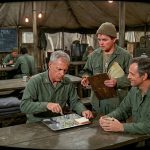
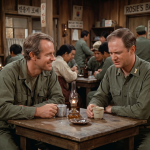
Major Charles Emerson Winchester III sat stiffly on a wooden bench, staring into the abyss of his metal tray.
He held his spoon with the delicate precision of a man holding a scalpel, though his eyes were completely vacant. He looked numb, his normally sharp patrician features smoothed over by an exhausting, profound suffering that had nothing to do with medicine and everything to do with breakfast.
He was trapped halfway across the world, elbow-deep in mud and blood, and now he was expected to consume what the U.S. Army loosely classified as oatmeal.
Across from him sat Major Margaret Houlihan.
Her arms were folded tightly across her chest, a physical barricade against the exhaustion threatening to pull her under. She leaned forward over the table, her posture perfectly composed, but her eyes held the heavy, skeptical weariness of a woman who had spent fourteen hours putting broken boys back together.
She was trying to maintain her dignity, her authority, and her sanity, all while staring at the same gray lump of food on her own tray.
The silence between them was heavy, born of a shared, bone-deep fatigue that required no conversation.
Then, the canvas flaps of the mess tent flew open with the theatrical flair of a Broadway curtain rising.
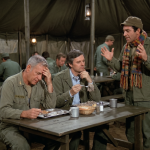
Corporal Maxwell Klinger made his entrance.
He wasn’t just walking; he was arriving. He wore a vibrant, chaotic floral print dress that clashed violently against the endless sea of army-issue green.
A string of faux pearls bounced against his hairy chest, and perched atop his head was a straw hat adorned with a cheerful purple ribbon and silk flowers.
He stopped at the end of their table, throwing his hands wide in a gesture of magnificent, wounded dignity.
“I ask you!” Klinger projected his voice to the very back of the tent, his face a mask of tragic indignation. “I ask you both, as officers and alleged gentle-people, is this the face of a man who belongs in this beige purgatory?”
Margaret didn’t flinch. She just turned her head slowly, her skeptical gaze locking onto Klinger’s floral hat. She had no energy to yell, no strength to cite regulations. She just stared at him, silently begging the universe for five minutes of peace.
Charles slowly blinked, his eyes shifting from his tray to the towering vision of Toledo spring standing before him.
The tension in the air shifted. The dull, thrumming exhaustion of the tent was suddenly pierced by the impending promise of a classic Winchester explosion.
Charles raised his spoon slightly. His posture stiffened further. A perfectly crafted, devastatingly articulate insult was forming behind his lips, ready to cut Klinger’s theatrical display to ribbons.
He took a slow, deliberate breath, his aristocratic jaw setting into a tight line.
“Corporal,” Charles began, his voice dangerously low and dripping with aristocratic venom. “If you do not remove yourself from my sight—”
“It’s the first day of spring, Major,” Klinger interrupted, dropping his hands.
His loud, theatrical voice suddenly vanished. In its place was a quiet, cracked whisper that caught terribly in his throat.
Charles froze, his spoon suspended halfway between his tray and his mouth.
The heavy silence stretched over the dull beige tabletop, broken only by the distant, rhythmic hum of a generator and the clank of a metal mug somewhere in the back of the tent.
Charles lowered his spoon, the devastating insult dying completely in his throat.
He looked at Klinger, really looked at him. Beneath the ridiculous straw hat, the smudged lipstick, and the cheap pearls, Klinger’s dark eyes were shining with an unexpected, naked grief.
His wide shoulders slumped, the chiffon of his dress wrinkling as the Broadway persona melted away into the exhausted reality of a scared kid from Ohio.
“The mud is thawing,” Klinger said quietly, staring down at the dirt floor of the tent. “I woke up this morning and I smelled the mud. It smells just like the banks of the Maumee River when the ice breaks in April.”
Margaret’s tight, folded arms slowly relaxed. The stern, military discipline that held her spine rigid seemed to soften, just a fraction.
She uncrossed her arms and rested her hands flat on the table, her skeptical expression melting into something quiet and deeply human.
“Tony Packo’s is probably opening up their windows today,” Klinger continued, his voice barely a murmur now. “The Mud Hens are out on the field throwing the ball around. And Laverne… Laverne is probably taking her winter coats down to the dry cleaners.”
He swallowed hard, his hands lightly touching the faux pearls at his neck as if they were a lifeline tethering him to a world that felt millions of miles away.
“I put on the dress, Major,” Klinger looked directly at Charles. “Because if I looked in the mirror and saw an olive drab uniform today, I think my heart was gonna stop beating.”
Charles sat perfectly still.
The aristocratic superiority, the defensive sarcasm he wore like a tailored suit, seemed to evaporate into the steam rising from the coffee pot.
He looked down at his metal tray, then back up at the corporal in the floral dress.
In that moment, they weren’t a Boston surgeon and a Toledo corporal. They were just two men, infinitely tired, terribly homesick, and doing whatever it took to survive a Tuesday in a war they desperately wanted to end.
Margaret reached across the table. Her movement was slow, deliberate.
She didn’t say a word. She just wrapped her hand around the heavy brown coffee pot, lifted it, and poured a fresh, steaming cup of the terrible black liquid.
She pushed the ceramic mug across the rough wood, stopping it right in front of where Klinger stood.
“Drink it before it eats through the cup, Corporal,” Margaret said. Her voice wasn’t a bark. It was gentle, carrying the quiet warmth of a sister looking out for a younger brother.
Klinger looked at the coffee, then at Margaret. A small, trembling smile touched the corners of his mouth.
“Thank you, Major,” he whispered.
Charles cleared his throat, a soft, refined sound. He picked up his spoon once more, returning his gaze to his tray.
“For the record, Corporal,” Charles said, his voice returning to its normal cadence, though stripped of its usual bite. “The air in Boston today is likely crisp. The swan boats will be making their first tentative journeys across the pond in the Public Garden.”
Klinger pulled up a metal folding chair, sitting down carefully to avoid wrinkling his skirt.
“Sounds nice, Major,” Klinger said, wrapping his hands around the hot mug.
“It is,” Charles replied softly. He scooped a tiny amount of the gray food onto his spoon. “It is profoundly beautiful. And if we are to ever see it again, or indeed the muddy banks of your beloved river, we must maintain our strength.”
Charles looked at Klinger, offering a rare, genuine nod of solidarity.
“Even if it means enduring this… unholy slop.”
Klinger chuckled, a wet, tired sound that broke the last of the tension in the tent.
Margaret picked up her own fork, pushing the food around her tray with a resigned sigh.
“Eat your breakfast, Klinger,” Margaret said softly, taking a sip of her coffee. “The spring will be there when we get back.”
“Yes, ma’am,” Klinger said. He took a sip of the terrible coffee, the pearls clinking gently against the ceramic mug.
They sat together in the quiet hum of the mess tent, three wildly different people anchored to the same small table.
The war was still outside, waiting for them beyond the canvas flaps, ready to demand more of their blood, their sweat, and their tears.
But for a few quiet moments over bad coffee and cold oatmeal, the 4077th felt a little less like purgatory, and a little more like home.
Some days, survival wasn’t about dodging bullets; it was about sharing a terrible cup of coffee with the only people in the world who truly understood your ghosts.