The Weighted Box and the Weight of Home
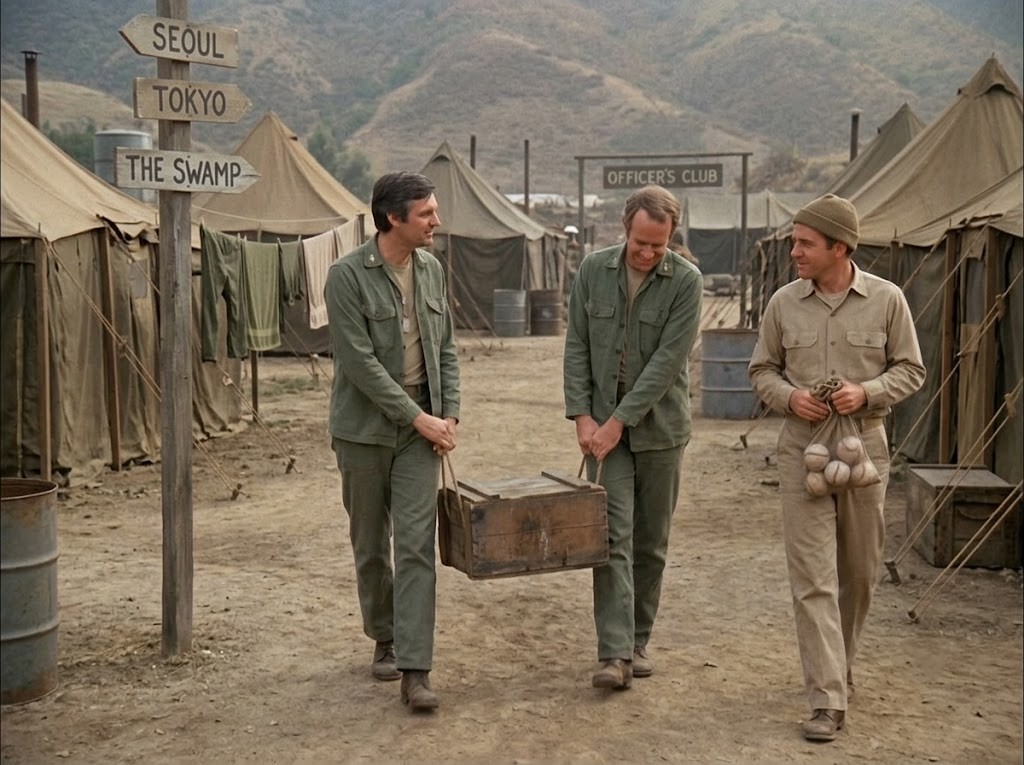
The Korean sun had a way of baking the mud until the camp looked like a faded photograph, bleached of all its color except for the endless, exhausting olive drab.
We had just come off a thirty-six-hour stretch in the Operating Room, the kind of shift where your fingers freeze into the shape of a clamp and your mind plays tricks on you in the silence that follows the choppers’ departure.
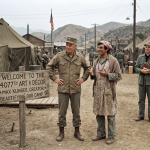
Hawkeye and B.J. were shuffling past the signpost—the one pointing toward Seoul, Tokyo, and the sad little sanctuary they called “The Swamp”—carrying a heavy, battered wooden crate between them, while Radar walked a half-step ahead, clutching a burlap sack of old baseballs like it held the crown jewels.
“I’m telling you, Pierce, if this box contains anything less than a fully functional, self-chilling martini dispenser, I am dropping my half on your left big toe,” B.J. muttered, his knees buckling slightly under the strain as his knuckles turned white around the rope handle.
Hawkeye let out a dry, breathy laugh, his face lined with the deep, shadowed creases of a fatigue that sleep couldn’t quite fix, though his eyes still sparked with that familiar, desperate wit.
“Careful, Beej, that crate holds the fragile remnants of my sanity, or at least whatever was left of it after the third shift of vascular repair,” Hawkeye countered, shifting his grip on the wood. “Radar, be an angel and tell us again why we are hauling this anvil across the compound when we should be face-down on our respective cots.”
Radar stopped, turning back to face them with his usual earnest, wide-eyed innocence, the heavy woolen cap pulled tight over his ears despite the midday glare.
“Because Colonel Potter said it’s a matter of camp morale, Captain,” Radar piped up, his voice cracking slightly as he adjusted his grip on the sack of scuffed leather baseballs. “He said the supply truck from Seoul brought a special delivery, and if it stays out here in the open, the local rats or the thieves from the black market are going to have a field day with it.”
“A field day,” Hawkeye repeated, his voice dropping into a softer, more cynical register. “Out here, a field day usually involves a lot of plaster of Paris and a shortage of penicillin. What’s in the box, Radar? Give us a hint before Hunnicutt’s spine fuses permanently into the shape of a question mark.”
Radar looked down at the crate, then back up at the two surgeons, his face suddenly losing its boyish grin and turning remarkably quiet, a subtle shift that immediately made the two doctors slow their pace.
“It’s from a high school gym teacher in Iowa,” Radar whispered, looking around as if the hills themselves were listening. “He collected stuff from the whole town… things they thought a bunch of tired guys in the mud might need to remember what clean air feels like.”
B.J. stopped dead in his tracks, the sudden halt causing the wooden crate to swing heavily between them, its base scraping against the dry dirt right outside the path to the Officer’s Club.
He looked down at the rough twine, then at Hawkeye, the playful banter draining from his face as a sudden, sharp wave of homesickness caught him square in the chest, the image of his daughter Erin flashing behind his eyes with a clarity that hurt.
“Iowa,” B.J. murmured, his voice thick, his steady gaze locked onto the splintered wood of the container as if he could see right through it to the Heartland.
Hawkeye didn’t make a joke this time; he just stared at the crate, his hands tightening on the rope as the silence of the camp seemed to close in around them, heavy with the collective ache of two hundred people who wanted nothing more than to wake up in their own beds.
The silence stretched between them, thick and heavy, until the distant, rhythmic *thump-thump* of a generator somewhere near Post-Op broke the spell.
“Well,” Hawkeye said quietly, his voice losing its sharp edge and replacing it with a rare, vulnerable tenderness. “We can’t just let Iowa sit out here in the dust, can we?”
B.J. nodded, swallowing hard, and with a shared, silent understanding, they lifted the box again, their movements more deliberate now, more careful, as if they were carrying something made of fine porcelain rather than old pine and canvas.
They carried it into the shade of the Officer’s Club awning, setting it down with a soft thud that stirred up a small cloud of grey dust around their scuffed combat boots.
Radar stepped up, setting his bag of baseballs beside it, and reached into his pocket for a small pocketknife, carefully slicing through the thick twine that bound the top lids together.
As the wooden flaps creaked open, the smell hit them first—not the usual odor of fuel, sweat, and antiseptic that clung to everything in the 4077th, but the scent of cedar shavings, dried lavender, and fresh, unvarnished leather.
Inside lay dozens of small, hand-wrapped packages, each labeled in neat, looping cursive: *For the boys who keep the lights on*, *For the nurses who don’t get enough sleep*, and *A little bit of home for whoever needs it most*.
Colonel Potter emerged from his office across the way, his brow furrowed as he walked toward them, but as he neared the crate and caught sight of the handwritten notes, the stern lines on his face softened into a fatherly, nostalgic warmth.
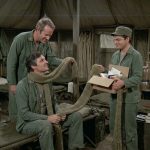
“Well, I’ll be,” Potter said softly, reaching in to pick up a small, hand-knitted woolen scarf, holding it with the kind of reverence usually reserved for a flag. “My Mildred used to knit these for the church drives back in Hannibal… same stitch, same color.”
From the edge of the tents, Major Winchester strolled by, his nose initially turned up at the commotion, but as his eyes fell upon a small, carefully wrapped stack of classical sheet music tucked into the corner of the crate, his aristocratic composure faltered for a fraction of a second, his fingers twitching with a sudden, painful longing for his record player in Boston.
“It appears,” Charles said, his voice unusually subdued as he cleared his throat and stepped closer, “that even the most remote provinces of the American continent possess a modicum of civilized empathy.”
Father Mulcahy joined them, his gentle face illuminating with a quiet joy as he looked at the collection of letters and small comforts, his hand resting reassuringly on Radar’s shoulder.
“It’s a beautiful reminder, isn’t it?” Mulcahy said softly, looking around at the gathered group of tired, dirty, beautiful people who had become a family in the middle of a wasteland. “That even when we feel entirely forgotten by the world, the world is still holding its breath for us to come home.”
Hawkeye reached into the bag Radar had been carrying, pulling out one of the old baseballs, its leather darkened by years of grass stains and small-town doubleheaders, and tossed it gently in his palm.
He looked at B.J., who was already smiling, a genuine, grounded expression that chased away the shadows of the OR, and then he looked out toward the barren hills that surrounded their little valley.
“Hey, Beej,” Hawkeye said, a familiar but lighter grin returning to his face as he tossed the ball toward his friend. “What do you say we find out if that arm of yours is as good as your stitch work?”
B.J. caught the ball with a satisfying slap against his bare hand, his eyes shining with a bittersweet but resilient spirit that no war could ever truly take away.
“You’re on, Pierce,” B.J. said, stepping out into the dirt walkway, his shoulders dropping their tension at last. “Just don’t cry when I strike you out in front of the whole army.”
In a place where tomorrow was never a guarantee, sometimes all it took was an old wooden box and a piece of home to remind the 4077th why they kept fighting to stay alive.