The Creased Comfort of Rosie’s Bar
Sometimes, the loudest thing in Korea was the silence that followed a heavy caseload.
It wasn’t a peaceful silence, either; it was the heavy, sticky kind that pooled in the corners of the mess tent and clung to the wood of the Swamp.
It was the kind that made B.J. Hunnicutt need to see walls that weren’t olive drab.
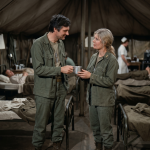
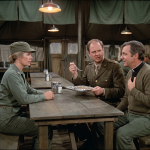
“You okay, B.J.?” Father Mulcahy asked quietly, setting his ceramic mug down on the worn wooden table at Rosie’s Bar.
B.J. didn’t answer immediately. He was busy carefully extracting something from his fatigue jacket pocket.
He smoothed it out with careful, calloused fingers—a black and white photograph, creased and soft at the edges from infinite miles traveled and endless folds made.
It was Peg and Erin.
Mulcahy watched him. He had seen this ritual many times. B.J. was anchoring himself.
The bar was noisy, filled with the blur of other soldiers and the smell of cheap beer, but for B.J. and Mulcahy, the world had shrunk to this single table.
B.J. stared at the faces, his brow furrowed, a silent battle raging behind his eyes.
Mulcahy smiled gently, picking up his glass of beer. He didn’t speak. Sometimes, the best comfort was just being present.
“She wrote that Erin can walk backwards now,” B.J. murmured, his voice sounding distant. “Like a little crab.“
Mulcahy chuckled softly. “A reverse toddler. Ingenious.“
B.J. rubbed the photo. “She looks bigger in this one. Every letter, she seems different.“
The noise around them faded into a dull hum. The warmth of the bar felt like a flimsy shield against the cold reality waiting back at camp.
“I keep thinking… how many more creased lines this photo can take,” B.J. said, his voice dropping to a whisper. He looked up, his eyes glassy, meeting Mulcahy’s kind gaze. He looked ready to finally say it.
“And I keep wondering,” B.J. continued, the unspoken truth spilling over, “how many more times I can look at this and still believe I’m coming home.“
Mulcahy didn’t offer a sermon or a cheerful platitude. He understood that these moments weren’t for answers; they were for acknowledgement.
“A few more folds, B.J.,” Mulcahy said gently. “A few more folds, and then you’ll be holding the real thing. This photo is a bridge, and you are building it with every mile of this road.“
B.J. nodded slowly, staring at the photo. He gently tucked it back into his pocket, treating it like the fragile treasure it was.
“Thanks, Father,” he said, taking a sip of his beer. “You’re a good man. Even if you do sound like a Sunday School teacher sometimes.“
Mulcahy grinned. “I try not to take it personally when it comes from a man with a mustache that can only be described as… strategically placed.“
B.J. barked a genuine laugh. “It keeps my nose warm in the O.R. A vital medical advancement.“
They finished their drinks, the silence between them now feeling lighter, shared.
The background hum of the bar came back into focus: soldiers telling jokes, glass clinking, Rosie herself shouting instructions.
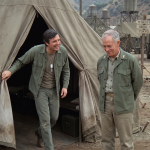
They stood up together. “One day closer, B.J.,” Mulcahy said, adjusting his collar.
“One day closer, Father,” B.J. agreed, patting his jacket pocket.
They walked out of the warm light of Rosie’s into the cool night air. The 4077th was just up the road, waiting with its wounded and its weary.
But B.J. didn’t mind the silence now. He had his anchor, and he had his bridge, and he knew he wasn’t building it alone.
They navigated the dirt path back to camp, two friends surviving the war one crease at a time.
Sometimes the most essential medicine wasn’t found in the O.R., but at a tired wooden table where a simple photo could hold an entire future.