A Moment of Grace, in Spite of Everything
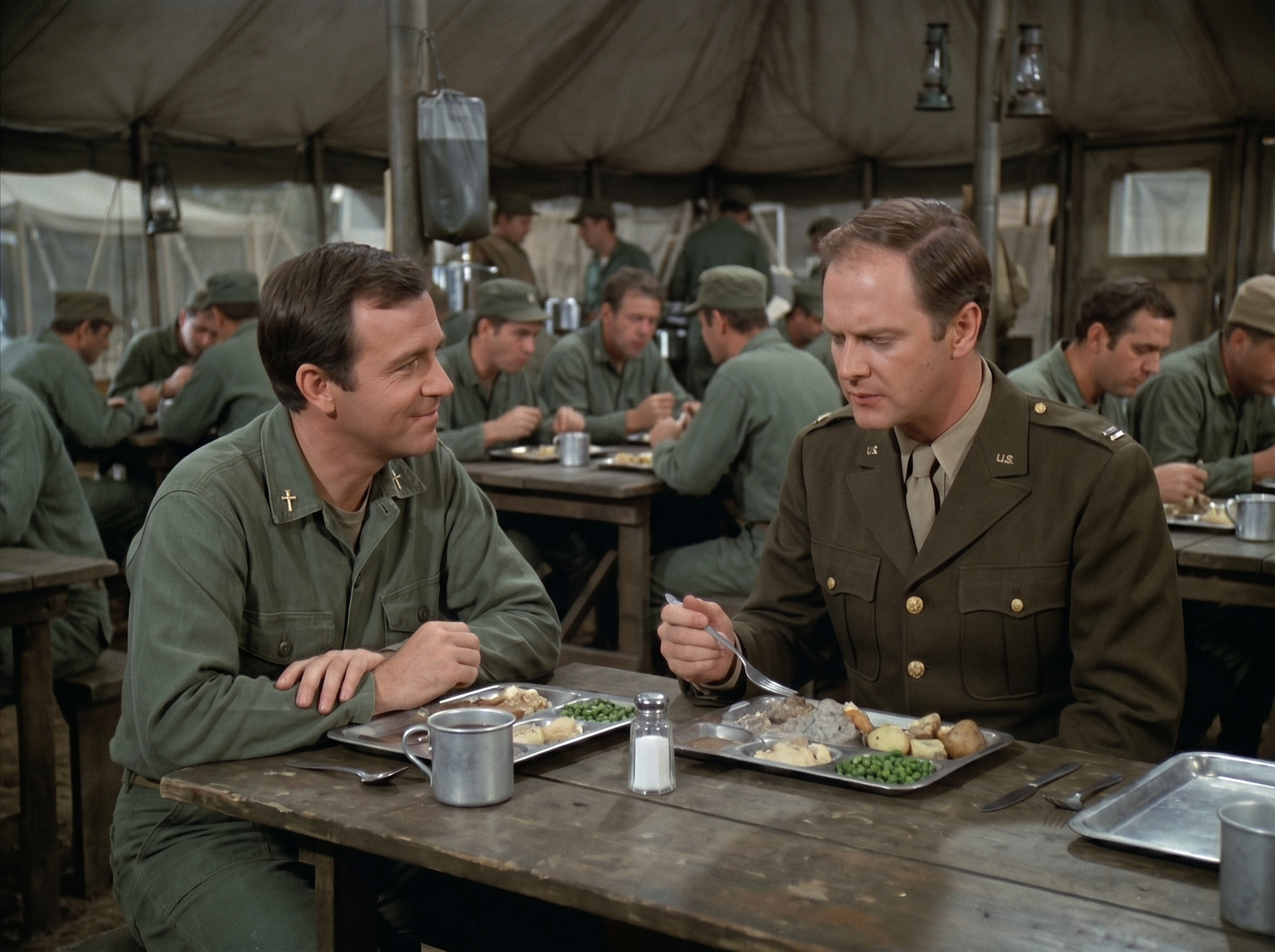
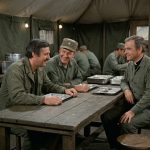
The air in the mess tent always felt ten degrees warmer and fifty percent stickier than anywhere else in the camp. It wasn’t just the steam from the cooking pots—it was the combined exhaust of a hundred tired souls, gathered for their daily encounter with an enemy that had yet to retreat: the food.
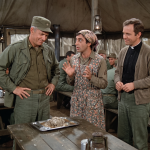
“I believe this ‘mystery meat’ is no longer a mystery, Major,” Father Mulcahy said softly, his voice a balm on the rough, metal clatter of the tent. He sat across from Charles Emerson Winchester III, his expression serene as always, a stark contrast to the man opposite him.
Winchester was in full uniform, including his meticulously pressed Class-As, a choice that made the rest of the unit look like they’d been pulled from a mud puddle. But even that fine wool couldn’t shield him. He was currently dissecting his tray as if performing a delicate neurosurgery. He paused, his fork poised over a particularly stubborn gray lump, and peered at the chaplain over his small, wire-rimmed spectacles.
“I’m almost afraid to ask,” Charles replied, his patrician drawl thicker than the gravy. “But do enlighten me, Father. What is the diagnosis?”
The young chaplain’s smile was small, patient. “A prayer, I should think. Perhaps if I ask for a slight alteration? It is a ‘mystery’ that defies understanding, so let us simply bless it into… coherence.”
A low-level ripple of humor always seemed to follow Mulcahy’s gentle wit, a kind of humor that didn’t bite, but soothed. He was just reaching for his own fork, but his hands remained clasped in front of him, resting lightly on the table, as if holding onto a deep, personal peace. He glanced around the tent, his eyes soft. Other soldiers watched them, or simply bent their heads over their own trays. For a moment, the whole tent felt less like a feeding ground and more like a shared, quiet space.
Winchester let out a small huff. It was a sound that was half-indignation, half-weariness. It was the sound he always made when he wanted to argue, when he felt the sheer, *unrefined* reality of this war closing in, but couldn’t quite find the words that wouldn’t sound small in the presence of this good man. He just stared at the food, his fork trembling slightly. He wasn’t looking at a meal. He was looking at his daily failure to find civilization in a canvas tent.
Father Mulcahy, watching the Major’s micro-expressions, knew the feeling well. His own stomach, which he was convinced had developed a personality all its own, gave a quiet, insistent grumble, a tiny protest in the face of his spiritual resolve. He tried to ignore it, his gaze holding the Major’s frustrated one.
It was in this quiet standoff—the priest’s quiet patience against the Boston aristocrat’s despair—that the true battlefield was drawn. It wasn’t on a operating table. It was right here, over two metal trays and a single salt shaker. And as Charles slowly, deliberately lowered his fork towards his tray again, a look of profound, silent defeat washing over him, a small gasp left the Father’s lips. Not because of the food, but because, for the first time that day, the priest looked directly at the Major’s hand, and his heart broke a little.
Directly from that high point, Father Mulcahy saw it. Below the meticulous uniform sleeve, on the finger that wasn’t holding the fork, was a ring—just a simple band of gold, a stark, private thing that Winchester never, *ever* let show. He’d clearly slipped his sleeves down in a futile attempt to maintain some dignity while using his bare hands to inspect his lunch, and in doing so, he had forgotten the ring.
“Charles,” the Father said, his voice lowering to an intimate whisper, cutting through the tent noise. He reached across the small distance and gently covered the Major’s fork-hand with his own. He didn’t want the dining area to see. He only wanted Charles to see.
Charles froze. His eyes, already weary, went instantly defensive. He pulled his hand back, and the silver ring flashed in the overhead light, a sudden, bright signal flare of a private life. “Is something… wrong, Father? Have I committed some faux pas I am unaware of in this… canteen?” He tried to regain his composure, his jaw tightening.
Father Mulcahy looked him in the eye, his expression all compassion. “You haven’t, Major. You have done quite the opposite.” He didn’t look at the hand, or the ring. He just looked at the man.
“What do you mean?” Charles’ voice was a bare murmur, the aristocratic shield cracked.
“This is not civilization,” Mulcahy said, gesturing broadly to the tent, the metal trays, the noise. “You are right. It is not home. It is a world where even the most basic of humanities can be forgotten. But you… you wear that ring, Charles.” He nodded towards the hand that Charles was now desperately trying to tuck under his leg. “You hold onto it. Not for yourself. But because it *is* home. It is dignity. It is why you must try. Even with this… meal.”
Charles was still, a profound silence seeming to bloom around him. His shoulders, usually set with the rigid pride of his upbringing, seemed to relax, just a little. The fight with the gray lump on his tray was forgotten. He wasn’t in Korea anymore. He was in Boston, at a perfectly set table, with a woman whose name he never spoke, whose face he only allowed himself to remember in the quietest hours of the night.
Father Mulcahy didn’t look away, nor did he offer a pious platitude. He just let the silence sit there, warm and full, protecting the Major’s private moment. He watched as a complex set of emotions passed over Winchester’s face: surprise, a quick flash of deep pain, and then, finally, a quiet, almost fragile kind of resolve.
Slowly, Charles’ hand reappeared. He did not pull his sleeve down to cover the ring. He adjusted his grip on the fork. He looked down at his tray, his posture now holding a kind of solemn grace, no longer the stiffness of denial. With a quietness that was far more powerful than any loud complaint, he carefully cut a piece of the meat and raised it to his mouth. He ate.
His face didn’t change into an expression of joy, but the visceral disgust was gone. It was a simple act. It was a man choosing to accept the reality that confronted him, and in doing so, reclaiming a piece of his own dignity. It was an act that said, ‘This is my lot, and I will endure it with the dignity I have fought to maintain.’
A tiny smile played on the Father’s lips. The noise of the mess tent seemed to rush back in, louder now, full of life and the clatter of a hundred people getting on with the day. He reached for his own fork, a deep sense of peace washing over him. It wasn’t about changing the world, or even the food. It was about seeing the grace in the heart that fought to hold onto it, even when everything else seemed to scream that it was lost. And here, in a tent full of the tired and the hungry, that small gold ring was a cathedral.
“Bon appétit, Major,” Father Mulcahy said softly, and the two men sat, eating their quiet meal, their bond now forged not over a shared complaint, but over the shared, silent understanding of a simple human truth.
They didn’t solve the problem, they just found the strength to sit with it, together.