The Unwritten Ledger of the 4077th
In a war that constantly took things away, keeping track of what was left felt like a desperate act of survival.
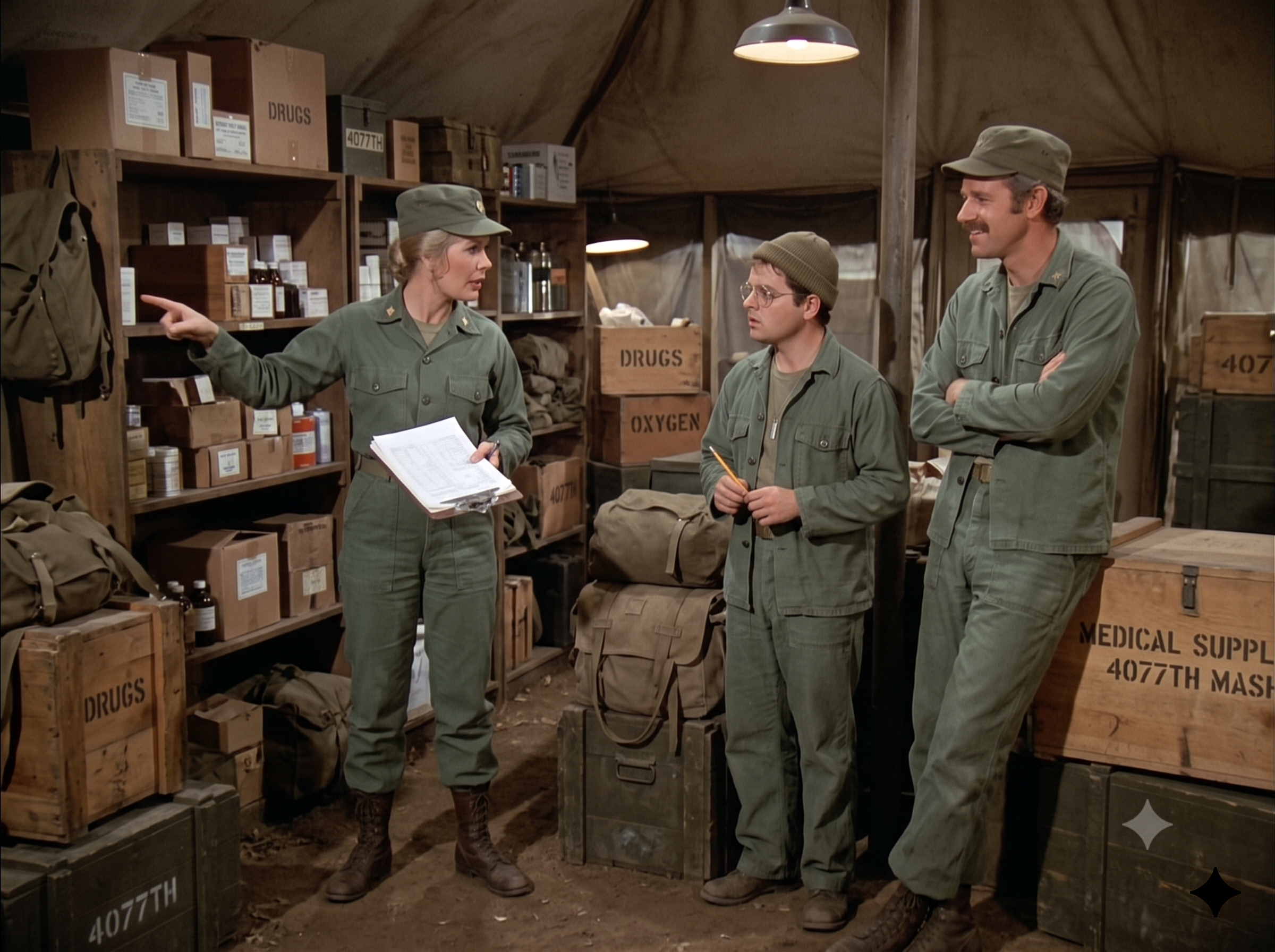
The Supply Tent of the 4077th was a canvas cathedral of organized chaos. It smelled of canvas dust, aged wood, iodine, and the lingering dampness of the Korean soil. Wooden crates stamped with “DRUGS,” “OXYGEN,” and “MEDICAL SUPPLIES” were stacked high against the sloping olive-drab walls. It was Radar’s sanctuary, the one place where the madness of the war was supposed to be neatly categorized and filed away in triplicate.
But today, the sanctuary had been breached.
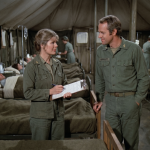
Major Margaret Houlihan stood in the center of the dirt floor, her posture as rigid as a newly polished bayonet. She was in her standard green fatigues, clutching a metal clipboard like it was the only thing keeping the world from spinning off its axis. Her face was set in a mask of controlled, professional frustration, but the sharp dignity in her eyes betrayed the deep exhaustion they all shared.
With a crisp, unyielding motion, Margaret raised her arm and pointed a perfectly steady finger at a hanging canvas bag and the half-empty wooden shelf beside it.
“I am looking at the manifest, Corporal,” Margaret said, her voice tight, echoing slightly in the quiet tent. “And I am looking at that shelf. The United States Army dictates that there should be twelve boxes of surgical adhesive and four spools of high-tensile suturing wire exactly in that spot. And yet, I see empty space.”
Radar stood a few feet away, clutching a yellow No. 2 pencil in both hands as if it were a life preserver. He wore his oversized olive knit cap pulled down low, framing a face twisted into a picture of earnest, innocent panic.
He looked from Margaret’s pointing finger to the empty shelf, then down at his own boots. He swallowed hard, his Adam’s apple bobbing nervously. “Well, uh, Major… you see, the thing about the wire is…”
A few feet behind them, leaning effortlessly against a large wooden shipping crate, stood Captain B.J. Hunnicutt.
B.J. was the picture of relaxed amusement. His arms were loosely crossed over his chest, his weight shifted casually onto one leg. He watched the interrogation with an easygoing, quiet irony, a gentle smile playing at the corners of his mustache. He wasn’t interfering. He was simply observing the clash between Army regulation and camp reality, providing a quiet, grounding presence in the dusty room.
“I don’t want to hear about the ‘thing’ about the wire, Corporal O’Reilly,” Margaret interrupted, taking a step forward. The warm, practical light from the single overhead bulb caught the fierce dedication in her eyes. “This isn’t a misplaced tin of creamed corn in the mess tent. These are critical medical supplies.”
Radar shrank back slightly, his shoulders hunching up toward his ears. “I know, Major. I really do. It’s just that… sometimes the inventory, well, it gets a little fluid.”
“Fluid?” Margaret’s voice went up half an octave. “The United States Army is not fluid, Corporal! It is solid. It is documented. It is accounted for. If those supplies are not in this tent, they are missing. And if they are missing, someone took them without proper authorization.”
She tapped her pen sharply against the metal clip of her board. The sound cracked through the tent like a tiny gunshot.
“So, I will ask you one more time,” Margaret said, leaning in, the weight of a hundred grueling shifts in the O.R. bleeding into her tone. “Where are my supplies, Radar? Because if I don’t get an answer in the next ten seconds, I am taking this discrepancy straight to Colonel Potter, and heaven help us all when he sees this.”
Radar’s eyes darted wildly around the room, finally landing on B.J. in a silent, desperate plea for help. The silence stretched tight, heavy with the threat of court-martials, endless paperwork, and the crushing weight of military discipline.
The heavy silence in the tent was finally broken by the soft scuff of a boot.
B.J. pushed off the large wooden crate, uncrossing his arms and sliding his hands casually into his pockets. His gentle smile hadn’t faded; if anything, it had grown a little warmer. He took a slow, deliberate step into the space between Margaret’s righteous anger and Radar’s crumbling nerves.
“He didn’t lose them, Margaret,” B.J. said softly. His voice was an anchor, low and steady, instantly grounding the rising panic in the room.
Margaret whipped her head around, her eyes narrowing as she fixed her glare on the captain. “Then perhaps you’d like to explain why the ledger is short, Captain Hunnicutt? Did they just walk out of the camp on their own?”
“In a manner of speaking,” B.J. replied, his tone devoid of his usual biting sarcasm. He looked at Radar, giving the terrified clerk a subtle, reassuring nod. “Hawkeye and I took them last night. Around 0300 hours.”
Margaret’s grip on her clipboard tightened until her knuckles turned white. “You and Pierce? For what? There were no surgeries scheduled after midnight. The post-op ward was fully stocked. What on earth could you possibly need with suturing wire and adhesive in the middle of the night?”
Radar looked down at his yellow pencil, his shoulders dropping in quiet relief. He knew the story, but he would never have betrayed the doctors. He’d rather face Margaret’s firing squad than give up his friends.
“A local farmer came to the edge of the compound,” B.J. explained, his voice dropping to a quiet, reverent register. “His cart had hit a patch of rough road trying to outrun a convoy heading south. His ox got spooked, tipped the cart. His youngest daughter took a bad spill. Deep laceration on her leg. Bleeding pretty heavily.”
Margaret froze. The rigid, military set of her jaw faltered for just a fraction of a second.
“She wasn’t military personnel,” B.J. continued gently, his eyes locked on Margaret’s. “She wasn’t an official casualty of war. Bringing her into the O.R. would have required forms, approvals, and a whole lot of red tape we didn’t have time for. So, Hawk and I patched her up in the back of the jeep. Radar here saw us. He unlocked the supply tent, handed us the wire and the tape, and stood guard so we wouldn’t get caught.”
B.J. paused, letting the reality of the midnight triage settle into the dusty air of the tent. “She’s going to be fine, Margaret. But we used the supplies. And since she doesn’t exist on any official Army roster, Radar couldn’t exactly write her down in his ledger.”
Radar shifted his weight uncomfortably. “I tried to figure out a way to code it, Major. I really did. I thought about putting it under ‘miscellaneous damage by local wildlife,’ but…” He trailed off, looking miserable. “I’m sorry. I messed up the book.”
Margaret stood completely still. The single overhead light cast soft shadows across her face, highlighting the deep lines of fatigue around her eyes. She looked at the empty space on the shelf, then down at Radar’s nervous, earnest face.
She lived by the rules. The rules were the only things that kept the chaos of the Korean War from swallowing her whole. If she let the rules slip, the blood and the noise and the endless stream of broken bodies would win.
But as she looked at B.J., standing there with his quiet, unshakeable decency, and Radar, who would risk court-martial for a wounded child, her heart betrayed her uniform.
Margaret slowly lowered her pointing hand. She looked down at the clipboard. The crisp white paper suddenly seemed very small, very insignificant, compared to the vast, messy humanity of the people she served with.
She clicked her pen.
“It is a known fact,” Margaret said, her voice entirely stripped of its earlier venom. She spoke loudly and clearly to the empty tent. “That the dampness in this region is absolutely detrimental to medical supplies.”
Radar blinked, confused. “Ma’am?”
Margaret didn’t look up. She began writing deliberately on the official form. “Four spools of suturing wire, rusted beyond use due to tent condensation. Twelve boxes of adhesive tape, ruined by mold. I am signing off on the destruction of these contaminated materials.”
She finished writing with a sharp flourish and handed the clipboard back to Radar.
Radar stared at the paper, his mouth hanging slightly open. “You’re… you’re authorizing it?”
“I am correcting a tragic environmental loss, Corporal,” Margaret said smoothly, though a tiny, almost imperceptible smile tugged at the corner of her lips. She looked up and met B.J.’s eyes. “See that you requisition replacements immediately. We run a hospital, not a charity ward. We need to be prepared.”
B.J. smiled fully now, his eyes crinkling at the corners. He reached out and lightly tapped the edge of the clipboard. “Yes, Major. We’ll be much more careful with the… condensation… from now on.”
Margaret straightened her tunic, her professional armor sliding back into place, though the fit was much softer now. “See that you are, Captain.”
She turned on her heel and walked out of the tent, her boots crunching softly on the dirt. As the canvas flap fell shut behind her, the heavy atmosphere in the room completely evaporated.
Radar let out a massive breath, slumping back against the stack of canvas bags. “Wow,” he whispered, wiping a bead of sweat from his forehead. “I thought I was a goner. I really thought she was going to have me painting rocks until 1955.”
B.J. chuckled softly, walking over and resting a warm hand on Radar’s shoulder.
“Don’t worry, Radar,” B.J. said kindly, looking at the spot where Margaret had just stood. “The Major barks a lot about the rules, but deep down, she knows that some ledgers are kept in ink, and some are kept in the heart.”
Radar smiled, a small, tired, but genuinely happy grin. He carefully tucked his yellow pencil behind his ear and hugged the clipboard to his chest. In a world that made absolutely no sense, they still had each other, and for today, that was inventory enough.
In a war that measured success by what was lost, the 4077th survived by counting what they managed to save.