The Fragile Sounds of Home
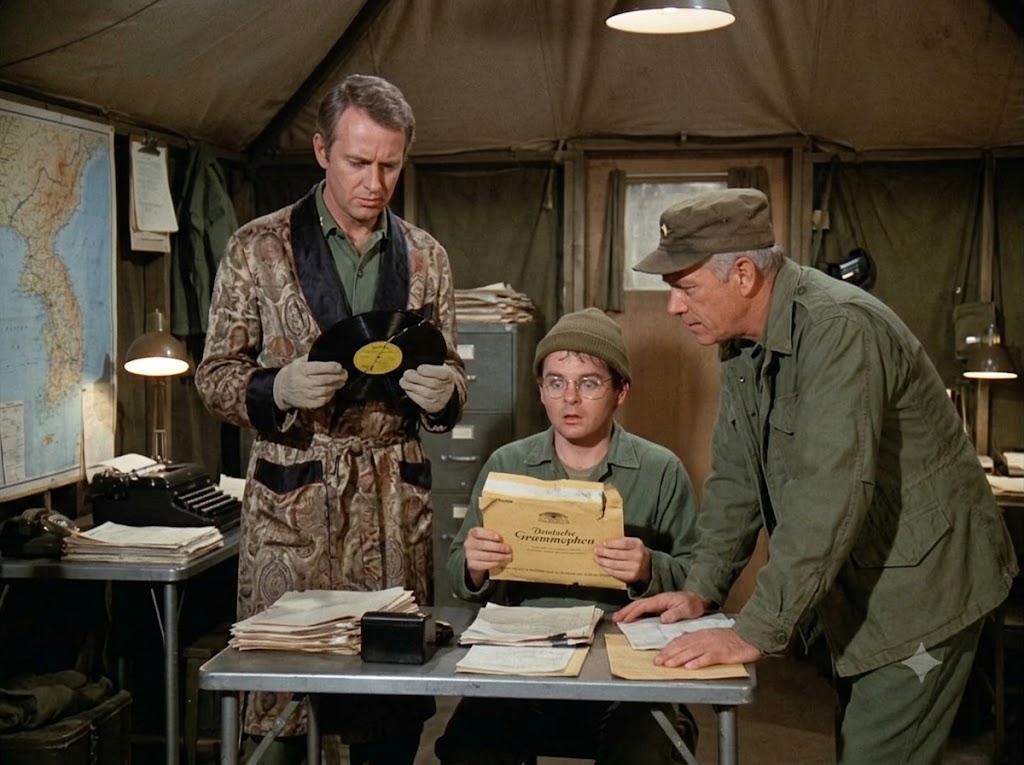
Some days in Korea, the mud didn’t just stick to your boots; it settled deep inside your bones. The 4077th had just survived a grueling seventy-two-hour shift in post-op, the kind that left every doctor, nurse, and corpsman moving like ghosts through the encampment.
In the quiet, drafty confines of the clerk’s office, the air smelled faintly of stale coffee, mimeograph ink, and damp canvas. A single overhead bulb cast a harsh, clinical glow over the metal desks, throwing long shadows against the map of the peninsula tacked to the wall.
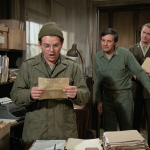
Radar O’Reilly sat frozen at his desk, his eyes wide behind his round spectacles, his breath hitched in his throat. In his trembling hands, he held a torn, brown paper envelope bearing the elegant, printed letters of the *Deutsche Grammophon* label.
Standing beside him, looking as though the earth had just cracked open beneath his feet, was Major Charles Emerson Winchester III. He was still wearing his trademark patterned silk bathrobe over his olive drabs, his hands clad in pristine white gloves—gloves he had put on specifically to handle a masterpiece.
Instead, those gloved hands were holding two jagged, broken halves of a vinyl record. The pristine black disc, which had traveled thousands of miles across the ocean to bring a piece of Boston luxury to the wilderness, was completely shattered.
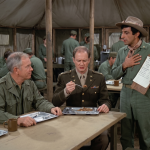
Colonel Sherman Potter leaned heavily over the desk, his hands planted firmly on the paperwork, his weathered face etched with a deep, sympathetic frown. He stared at the ruined plastic, knowing exactly what a loss like this meant to a man like Winchester.
“I… I didn’t mean to, Major,” Radar stammered, his voice dropping to a fragile whisper that barely carried across the room. “The mail jeep took a bad bounce near the supply depot, and the sack must’ve shifted.”
Charles didn’t yell, which was far more terrifying than if he had thrown a standard Winchester tantrum. His aristocratic face was completely blank, his eyes fixed on the yellow center label of the fractured record as if staring into an open grave.
For a man who used Mozart and Beethoven as an armor against the horrors of the swamp, this wasn’t just a broken piece of plastic. It was a lifeline to civilization, snapped clean in two.
The silence in the office grew heavier, thick with the exhaustion of the war and the sudden, sharp weight of a grown man’s unspoken heartbreak. Potter opened his mouth to offer a word of comfort, but the utter devastation on Charles’s face stopped him cold.
—
Charles slowly lowered his hands, the two jagged pieces of the record clicking together with a hollow, mocking sound. He didn’t look at Radar, nor did he acknowledge Colonel Potter’s steady, fatherly presence.
“Mozart’s Clarinet Quintet in A major,” Charles said, his voice terrifyingly quiet, devoid of its usual pompous bluster. “Recorded by the finest musicians in Europe, meant to provide a momentary respite from this… this abysmal swamp.”
He looked down at his gloved fingers, then carefully placed the broken fragments onto the metal desk, handling them as gently as a surgeon dealing with exposed tissue. “It survived the Atlantic, the rail lines of America, and the Pacific shipping lanes… only to perish in a ditch outside of Uijeongbu.”
“Major, I can write a report to the postal authorities,” Radar offered quickly, his eyes pleading for forgiveness as he clutched the torn paper sleeve. “We can get a claim form, file for a replacement…”
“A replacement, Corporal?” Charles turned his gaze to Radar, his voice tight with a mixture of anger and profound sorrow. “By the time a replacement navigates the bureaucratic labyrinth of the United States Army, this war will either be over, or it will have claimed what little remains of our sanity.”
The door to the office creaked open, and Hawkeye Pierce walked in, flanked by B.J. Hunnicutt. Both doctors looked exhausted, their eyes ringed with dark circles, their fatigue jackets stained with the remnants of the long shift.
“Hey, Radar, did the mail call bring anything besides bills and—” Hawkeye stopped, sensing the heavy atmosphere in the room immediately. He looked from Radar’s terrified face to Potter’s grim expression, and finally to the broken vinyl on the desk.
B.J. walked over, stepping up beside Colonel Potter to look at the wreckage. “Oh, no. Charles, I’m sorry. Is that the one you’ve been talking about for three weeks?”
Charles didn’t answer; he simply turned his back to the desk, his arms crossed over his chest as he stared out the small window of the tent into the muddy compound. The theatricality was gone, replaced by a raw, human vulnerability that none of them were used to seeing from the Boston Brahmin.
Hawkeye picked up one of the broken halves, looking at the clean fracture. The usual witty remark died in his throat; he knew how much those nightly classical sessions in the Swamp meant to all of them, even if they constantly complained about the volume.
“You know,” Hawkeye said softly, his voice losing its sarcastic edge, “it’s a clean break. No missing pieces.”
“It is garbage, Pierce,” Charles snapped, though his shoulders sagged. “You cannot play a fractured soul, and you certainly cannot play a fractured record.”
Colonel Potter stood up straight, taking off his cap and rubbing his gray hair. “Charles, nobody knows more about losing pieces of home out here than the people in this room. But a bad bounce in a mail jeep doesn’t mean the music stops entirely.”
Potter looked over at Radar, who was still looking incredibly guilty. “Radar, go fetch Father Mulcahy and Margaret. Tell them we’re having an emergency meeting in the Swamp in ten minutes.”
“An emergency meeting, Colonel?” Charles scoffed, not turning around. “To mourn the passing of a phonograph record? How delightfully absurd.”
“Just be there, Major,” Potter said firmly but gently. “That’s an order.”
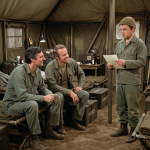
An hour later, the Swamp was illuminated by the soft glow of a kerosene lamp. Surprisingly, the entire inner circle of the 4077th had gathered. Margaret sat on the edge of a cot, her posture relaxed, while Father Mulcahy stood quietly near the door. Klinger had even shown up, having shed his latest theatrical outfit for a simple utility uniform, recognizing that this wasn’t a moment for jokes.
On the small wooden table in the center of the tent sat Charles’s record player. Beside it were the two broken pieces of the Mozart record, carefully aligned on a piece of cardboard, held together by a meticulous layer of surgical tape on the non-grooved side.
“It won’t play through a needle, Charles,” B.J. said gently as Charles entered the tent, looking suspicious and tired. “We tried. The skip would ruin your phonograph.”
“Then why am I subjected to this gathering?” Charles asked, his voice defensive.
Father Mulcahy stepped forward, holding a small black notebook. “Because, Charles, while we may not have the luxury of the finest European pressings, we do have memory. And we do have each other.”
The priest opened the book. “During our last few quiet evenings, I happened to write down some of your descriptions of the pieces you love. You speak of them with such vivid detail, it’s almost like hearing them.”
Hawkeye leaned against a tent pole, a warm smile on his face. “So, tonight, you’re the orchestra, Charles. Tell us about the Clarinet Quintet. Start from the beginning. How does the first movement feel when the winter wind is blowing through Beacon Hill?”
Charles looked around the room, seeing no mockery in their eyes, only the deep, genuine empathy of people who shared the same hardships, the same isolation, and the same desperate longing for the world they had left behind.
The arrogance melted from his features. He looked down at the taped-up record, then slowly sat down on his cot. He removed his white gloves, placing them neatly in his lap.
“The first movement,” Charles began, his voice dropping into a rich, resonant tone that filled the quiet tent, “begins with a theme of absolute serenity. The strings enter first, like a gentle dawn over the Charles River…”
As Charles spoke, translating the broken music into words, the sounds of the war outside seemed to fade away, replaced by the collective imagination of a family bound together by a shared, fragile hope.
In a place where everything could break in an instant, they learned that the things that mattered most could always be held together by hand.