The Sound of a Stitch in Time
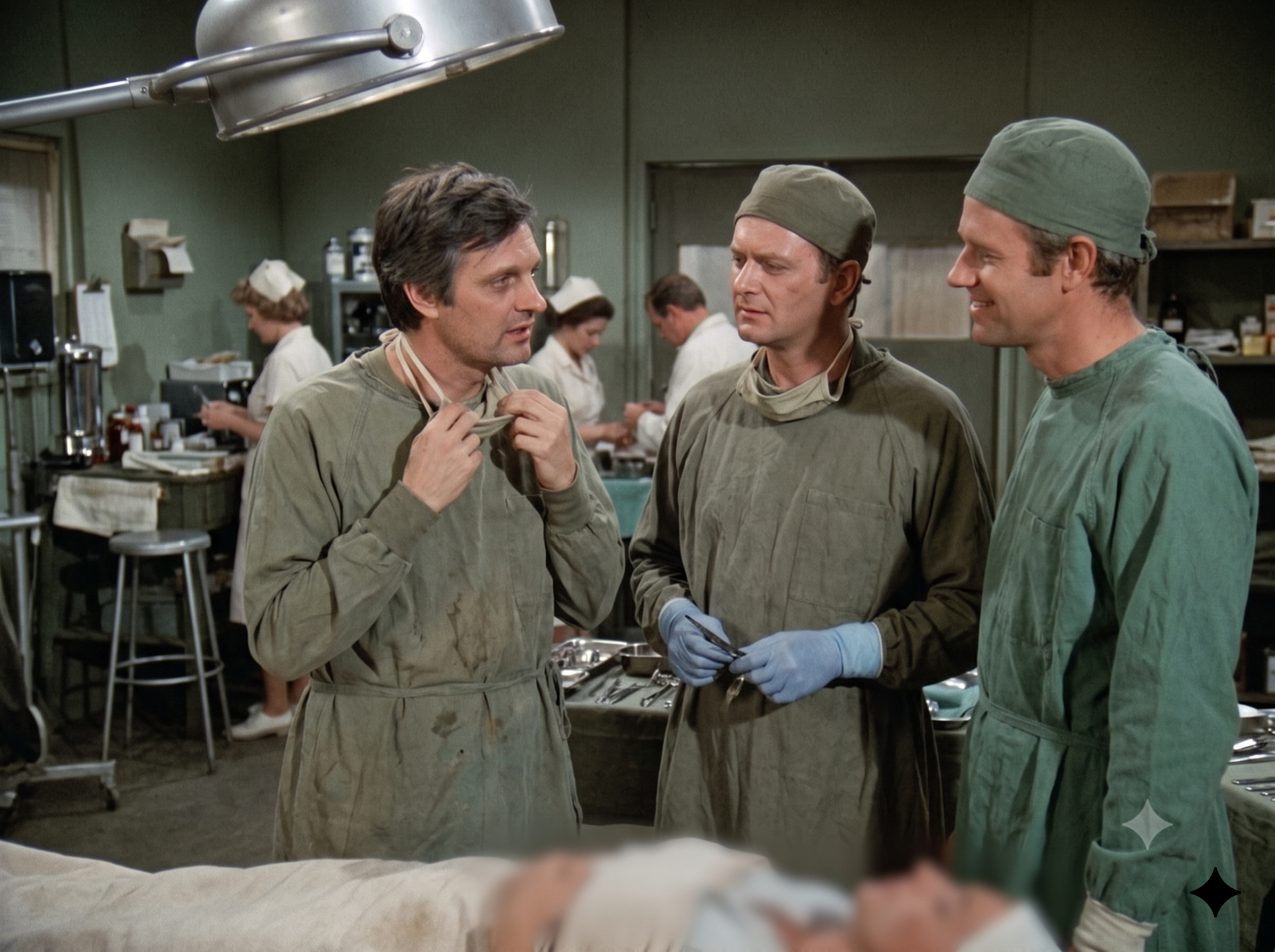
The hardest part of a twenty-hour shift wasn’t the standing, and it wasn’t the blood. It was the crushing, absolute silence that followed the final stitch.
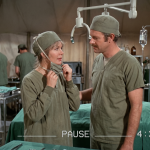
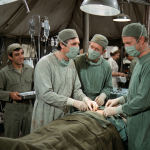
Inside the OR of the 4077th, the air was thick with the smell of ether, damp canvas, and profound human exhaustion. The harsh, bright glare of the overhead surgical lamps cast long, weary shadows across the linoleum floor. In the background, the rhythmic squeak of a nurse’s rubber-soled shoes offered the only proof that the world was still turning outside this sterile, green-tented bubble.
Hawkeye Pierce stood beside the operating table, his shoulders slumped beneath the weight of his faded, sweat-stained scrubs. He reached up with trembling fingers and pulled his surgical mask down around his neck. His face was deeply lined, heavily shadowed with fatigue, but his eyes remained sharp. They possessed that desperate, emotionally alert franticness that always appeared when he had successfully cheated death out of another eighteen-year-old kid.
To his left stood Major Charles Emerson Winchester III. Charles looked as though his pristine, aristocratic soul had been dragged backward through the Korean mud. He held a pair of forceps loosely in his gloved hand, staring down at the patient. His posture was usually rigid with Bostonian superiority, but today, his refined dignity was visibly cracking. There was a look of reluctant, agonizing compassion etched onto his features—the look of a man who desperately wanted to remain aloof, but who cared far too deeply for the broken boys placed in front of him.
On Hawkeye’s right, Captain B.J. Hunnicutt stood as the quiet anchor of the room. B.J. leaned slightly forward, offering a gentle, dryly amused smile. His posture was relaxed, a stark contrast to the coiled springs of the other two men. He was the steady middle ground, the quiet observer who understood the fragile emotional tightrope they were all walking.
They had been fighting for this particular young corporal for three agonizing hours. An artery had blown. Vitals had plummeted. It had been a chaotic, terrifying dance of clamps, sponges, and sheer, stubborn willpower.
Charles had performed a vascular miracle that they had no business attempting in a tent. Hawkeye had patched the surrounding shrapnel damage with a speed born of pure panic. Now, the corporal’s chest was rising and falling in a steady, beautiful rhythm. The crisis had passed.
But the adrenaline was fading, leaving a dangerous, heavy vacuum in its wake. The room was too quiet. The reality of the war was threatening to crash back down on them.
Hawkeye knew the signs. He could see Charles staring into the middle distance, his jaw clenching as the trauma of the morning threatened to overwhelm his carefully constructed defenses. If someone didn’t break the tension, the silence was going to suffocate them all.
Hawkeye took a deep, shaky breath. He locked eyes with the pompous Bostonian, the unspoken trauma vibrating between them. He parted his lips, preparing to throw a comedic grenade into the middle of Winchester’s dignified suffering, praying it would be enough to bring them all back from the edge.
Hawkeye let the silence hang for one more agonizing second before he leaned in, his voice rough as sandpaper but laced with his trademark, desperate sarcasm.
“You know, Charles,” Hawkeye began, pointing a weary finger toward the surgical tray. “I was just thinking.”
Charles did not look up immediately. His grip on the forceps tightened, his knuckles turning white under the thin rubber. “A deeply dangerous pastime, Pierce,” Charles muttered, his voice a low, gravelly rumble of pure exhaustion. “And one I highly doubt you possess the necessary equipment to successfully execute.”
“No, really,” Hawkeye insisted, his eyes sparkling with the absolute necessity of keeping the banter alive. “I was watching you work that artery. It was poetry. Pure, unadulterated poetry. With delicate, dainty little needlework like that, you could make an absolute fortune hemming my father’s winter long johns back in Maine.”
Charles blinked. The sheer audacity of the insult momentarily short-circuited his fatigue. He finally lifted his head, his eyes meeting Hawkeye’s. The aristocratic indignation flared instantly, a deeply ingrained reflex from a lifetime of high society, but it struggled to take root under the harsh surgical lights.
He looked at Hawkeye, really looked at him, and saw the exact same bone-deep, soul-crushing weariness mirrored in the chief surgeon’s face. Hawkeye wasn’t mocking him; he was throwing him a lifeline.
B.J. shifted his weight, his mustache twitching as his warm, steady smile widened into a quiet chuckle. “I don’t know, Hawk. Charles doesn’t really strike me as a long john kind of guy. He’s more of a bespoke velvet smoking jacket tailor. Though I bet he’d look stunning holding a thimble.”
A tiny, almost imperceptible huff of air escaped Charles’s nose. It wasn’t a laugh—a Winchester does not laugh in the presence of such profound vulgarity—but the rigid, pained lines around his mouth noticeably softened. The defensive, isolating walls he had been building around his heart relaxed just a fraction of an inch.
“I assure you, Hunnicutt,” Charles replied, his voice regaining a tiny hint of its usual pompous tenor, “my tailoring talents are far too refined for the moth-eaten horrors of New England knitwear. Furthermore, my thimbles are strictly reserved for Egyptian cotton.”
The tension broke. It didn’t shatter violently; it just quietly dissolved, melting away into the damp, antiseptic-smelling air.
Hawkeye let out a long, slow exhale, the kind of breath that carried the terrible weight of a saved life out of his lungs. The frantic energy in his eyes settled into a warm, grounded relief. He offered Charles a small, respectful nod—a rare, silent ceasefire between the swamp rat and the aristocrat.
“Whatever you say, maestro,” Hawkeye said softly.
The background noises of the 4077th slowly returned to their awareness. The nurses, efficient and silent in their muted white gowns, were already stepping in to prep the young corporal for post-op. Margaret Houlihan’s sharp voice could be heard in the scrub room, directing the corpsmen with her usual fierce, protective authority.
The war was still waiting right outside the canvas doors. The artillery was still rumbling in the distant hills, promising more helicopters and more broken bodies. But inside this small, brightly lit room, surrounded by medical trays and bloody gauze, they had won a temporary, beautiful victory.
B.J. reached over and clapped a heavy, deeply affectionate hand on Hawkeye’s shoulder. “Come on, seamstresses. Let’s go see if Igor is serving anything that vaguely resembles breakfast. Or dinner. Or whatever meal we missed three days ago.”
Charles carefully set his forceps onto the metal tray, the sharp, metallic clink echoing softly in the room. He stripped off his surgical gloves with a practiced, weary grace, tossing them into the bin. “If they are serving those abominable powdered eggs again, Pierce, I hold you personally responsible.”
“Me? Why me?” Hawkeye protested, turning toward the scrub room doors, his step miraculously a little lighter than it had been five minutes ago.
“Because,” Charles replied, following them, pulling his own mask down to reveal a face completely drained of color but full of life, “you, Pierce, are the sole architect of all my misery in this godforsaken place.”
Hawkeye chuckled, a dry, rasping sound that felt like music. “I try, Charles. I really try.”
As Charles walked behind his tentmates, B.J. glanced back and caught a fleeting, unguarded look on the Bostonian’s face. It was a look of quiet, undeniable gratitude.
They were trapped in a living nightmare, knee-deep in mud, cold coffee, and endless tragedy, but they were not alone. They had each other. The drafted rebel, the devoted family man, and the prideful aristocrat were bound together by the strange, beautiful alchemy of keeping people alive. They used humor as a shield, sarcasm as a bandage, and deep, unspoken friendship as their ultimate cure.
They pushed through the swinging wooden doors of the OR together, leaving the bright lights and the smell of ether behind them. They stepped out into the chilly, damp Korean morning, exhausted, filthy, and profoundly human.
It was just another brutal shift at the 4077th. And just another day of surviving the madness, side by side.
In a place defined by what was lost, their greatest triumph was always what they managed to save—including each other.