The Small Victories and Quiet Mercies of Ward 4
Sometimes, you measure the time not in days, but in pulses, heartbeats, and whispered prayers.
In the middle of that perpetual cycle of mud and mortar, there was a brief, almost miraculous lull in Post-Op.
The chaotic noise of the chopper blades had finally stopped, replaced only by the steady rhythm of soft breathing and the quiet squeak of rubber soles on the floor.
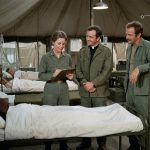
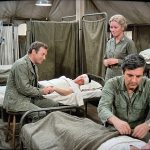
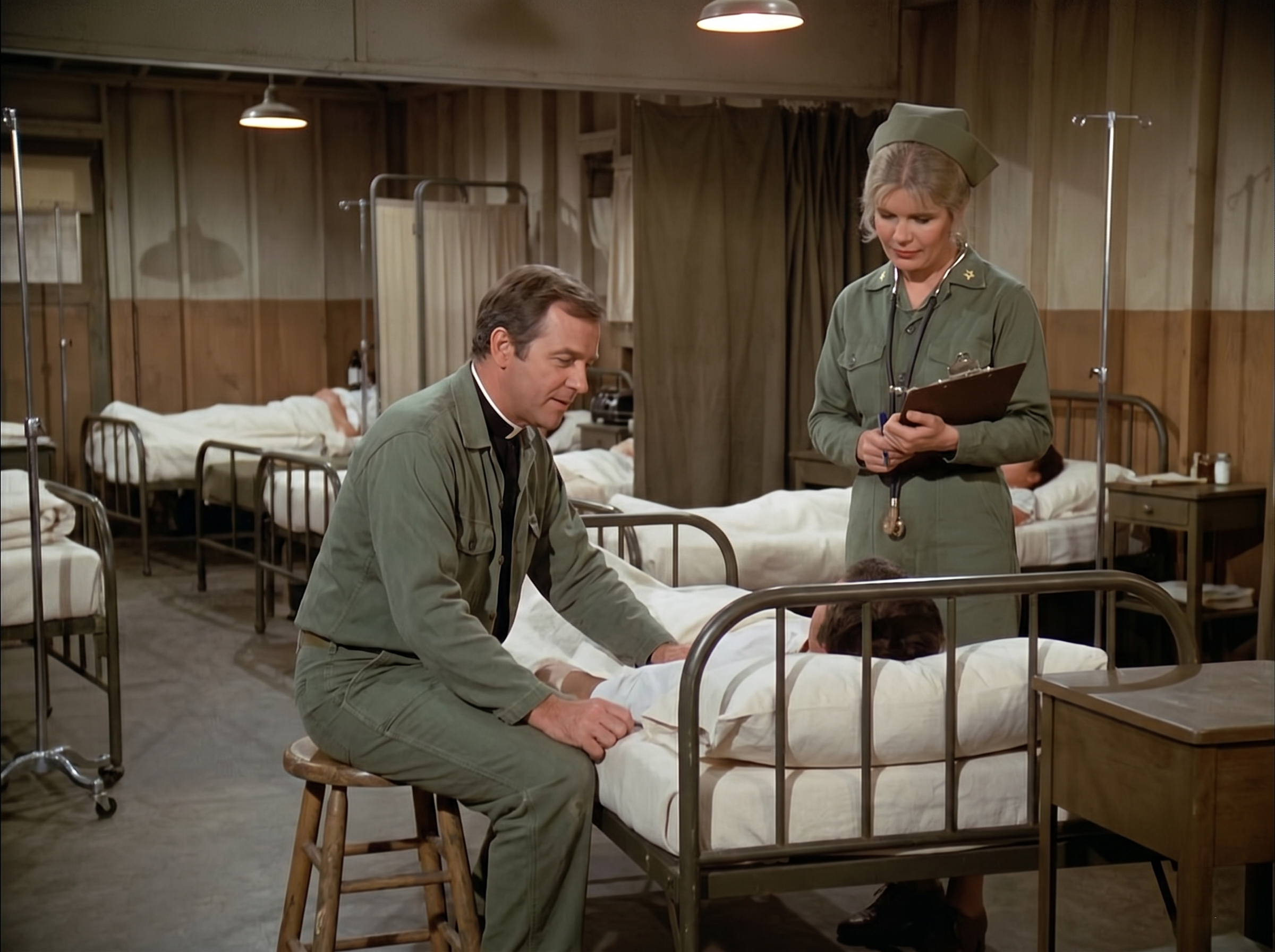
It was during this small moment of peace that two figures, bonded by the shared exhaustion and compassion that only 4077th veterans understand, found themselves by a single bed.
Father Mulcahy, perched on a wooden stool, had his hand gently resting on the forearm of a sleeping soldier.
His face held that quiet, thoughtful blend of weariness and deep, abiding kindness that made everyone from generals to privates find comfort in his presence.
Major Margaret Houlihan stood beside him, her crisp uniform a sharp contrast to the soft lines of exhaustion around her eyes.
She held her clipboard close, scanning the patient’s chart with the focused intensity of a surgeon, but her eyes kept drifting down to the sleeping boy, seeing him not as a statistic but as a human being needing care.
“He’s stabilizing, Father,” Margaret said quietly, her voice a soft murmur that didn’t disturb the silence.
“That’s a comfort, Major,” Mulcahy replied, looking down at his hand resting on the boy. “Sometimes I feel… almost useless. Hawkeye mends their bodies, and you nursed them back to health, and I…”
He trailed off, his gaze far away, seeing all the faces that had passed through that ward.
Margaret softened. She knew that feeling too well—the feeling that despite their best efforts, the war was still an endless, draining machine.
“You’re not useless, Father,” she said gently, touching the sleeve of her own jacket. “You heal things that scalpels can’t reach.”
Mulcahy smiled, a small, tired, but sincere expression. “Perhaps. But this one… he hasn’t spoken a word since he came in. He hasn’t opened his eyes. Just… held on.”
He looked at the boy’s silent form, the weight of a hundred unseen wounds suddenly very heavy in the air. “It’s as if he’s locked inside.”
Just then, a faint, barely audible sound came from the bed, and both the priest and the nurse leaned in closer, holding their breath.
The sound was a weak, dry moan, so soft it barely registered against the low hum of the remaining medical equipment.
It was followed by a slight shift, a subtle tension in the boy’s shoulders beneath the thin sheet.
Margaret held her breath, her hand hovering over the chart as she watched his face, looking for the tiny, critical signs that meant everything to her profession.
“Easy, son,” Mulcahy said softly, not shifting his hand, maintaining that steady, calm presence. “You’re in good hands. Just try to breathe.”
The soldier’s eyelids fluttered, a struggle as great as any battlefield charge, before finally opening, blurry and disoriented in the soft overhead light.
“Wher… where am I?” the voice was cracked and thin, the words struggling for purchase.
“Post-Op, 4077th MASH,” Margaret said instantly, her professional voice taking over with a reassurance that only she could provide. “You’re safe. The surgery was successful.”
The soldier’s gaze moved, eventually landing on the man in the fatigues with the clerical collar, the one whose hand had never left his arm.
“Father?” the boy whispered, the confusion in his eyes slowly clearing.
“Yes, son,” Mulcahy said, a warmth that transcended language or religion flowing through his voice. “I’m right here. And this is Major Houlihan, the finest nurse in the whole Korean theater.”
A small flicker of a smile touched the boy’s lips. “Tired…”
“Rest,” Margaret said, her hand reaching out to smooth the hair from his forehead. “You’ve done the hard part. The only job you have now is to heal.”
She made a note on his chart, her expression softening into that quiet, deep satisfaction that came from seeing a patient finally begin to turn the corner.
Mulcahy looked up at Margaret, and for that fleeting moment, they weren’t just a priest and a major; they were two people who had just witnessed a small victory against the overwhelming odds.
In the 4077th, those victories were rare, quiet, and usually unseen by the rest of the world.
But they were the true foundation of everything they did.
As the soldier’s breathing evened out and he drifted back into a restful sleep, Margaret and Mulcahy remained by his side, the silence in the room no longer heavy with anxiety, but peaceful and filled with hope.
It was in moments like this, during the rare lulls between the storm, that they could pause and remember that they weren’t just fighting to save lives; they were fighting to preserve humanity itself.
And sometimes, all that took was a gentle hand on an arm and a few words in the quiet of a Post-Op ward.
They say that every life you save is a small piece of home you get to keep in your heart forever.