The Stack on the Colonel’s Desk
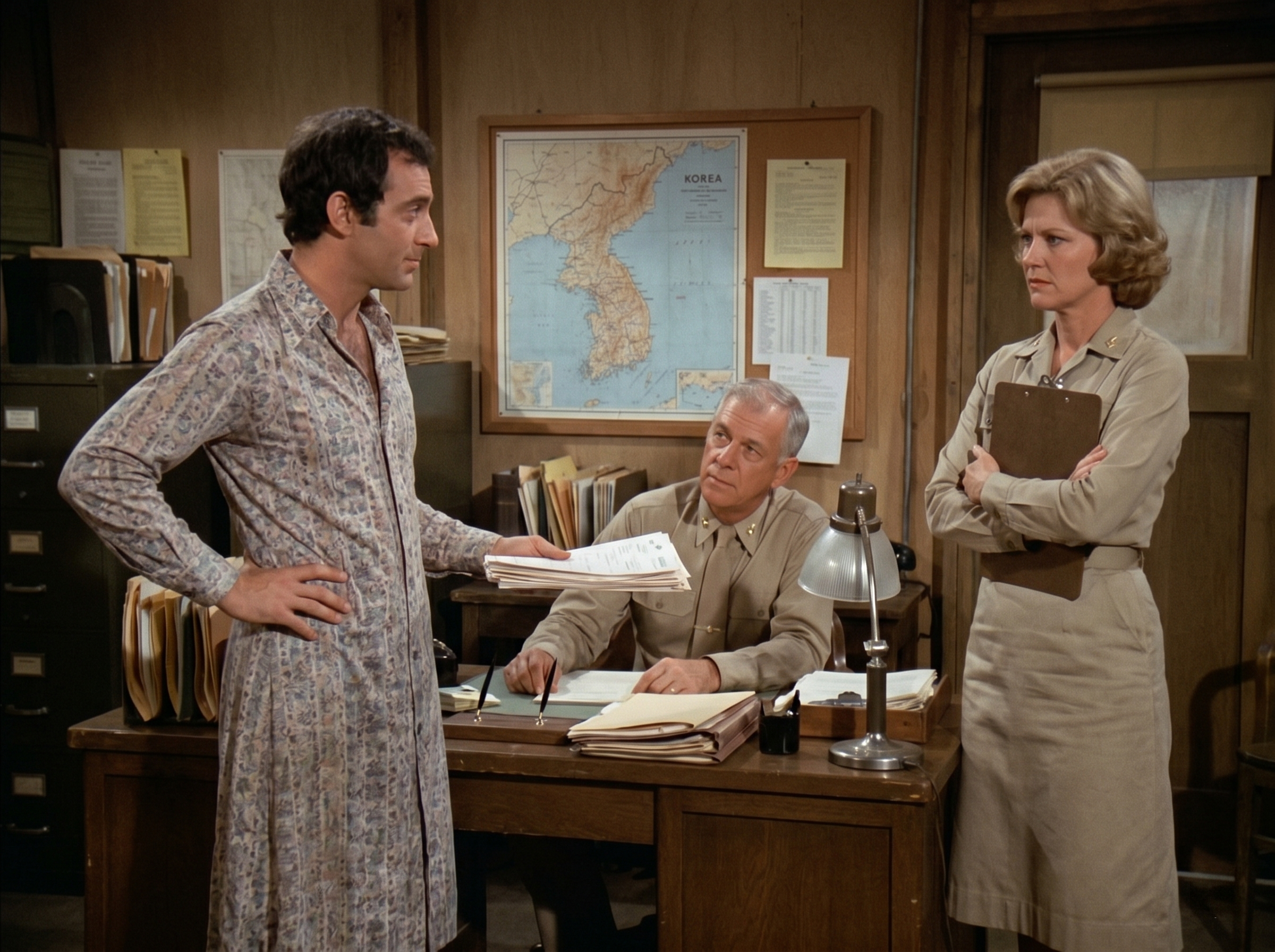
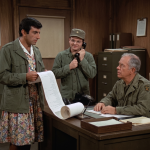
If there was one thing they were good at in the 4077th, it was adapting to the absurd. This evening, the absurdity was named Captain Benjamin Franklin Pierce, and he was standing in Colonel Potter’s office.
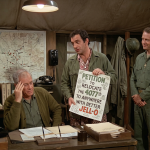
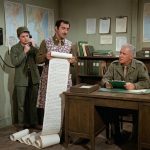
He wasn’t wearing a uniform; he was wearing his favorite patterned bathrobe, a wild blend of blues and greys. The casual fabric clashed spectacularly with the utilitarian military backdrop, the faded green filing cabinets, and the large, menacing map of Korea tacked to the wall. His posture was familiar: one hand planted firmly on his hip, the other presenting a substantial stack of paper to his commanding officer. He looked like he was pitching a slightly rebellious business plan rather than navigating the bureaucracy of a war.
Colonel Potter sat behind his desk, peering up over the top of a manila folder. His face was a map of weary frustration and patience, the product of countless late nights and impossible situations. Beside him, standing perfectly straight with arms crossed defensively, was Major Margaret Houlihan. She held her clipboard like a shield and directed a look at Hawkeye that was sharp enough to cut through steel.
“Forty-seven pages, Colonel,” Hawkeye began, his voice surprisingly devoid of his usual rapid-fire sarcasm. “And I don’t think you have enough rubber stamps in this entire camp to handle it.”
Margaret’s clipboard shifted slightly. “This better not be another petition for shrimp, Captain.” Her tone was frosty, indicating her tolerance for non-regulation activities was at its limit. “And for heaven’s sake, put on a shirt.”
Potter just sighed. He took a single pair of glasses off and placed them on the desk with a quiet *click*. He didn’t want to know. He truly didn’t.
“I’m sure whatever is in this stack represents a significant abuse of official military paper,” Margaret added, looking at the papers as if they were infected. “And I don’t see any carbon copies.”
Hawkeye didn’t take the bait. He held the papers steady, meeting Potter’s tired eyes. “I’m sure you’re right, Major. But this isn’t official. And it isn’t for you.”
He looked from Margaret back to Potter, his demeanor softening just enough. “It’s for the whole camp. Everyone has signed it. Everyone has written on it.”
Potter rubbed his temples. “Pierce, if you’ve gone around and gathered a camp-wide request for more gin, I’m going to personally pack you in a crate and ship you to Tokyo.”
“It’s not gin,” Hawkeye said, his usual witty deflection failing him. He seemed stuck, the theatrical bravado draining away, leaving something raw underneath.
The silence in the cramped office stretched uncomfortably. The image (image_0.png) captures this precise moment: Hawkeye with his hand on his hip, the robe making him look vulnerable, presenting the stack; Potter watching him, tired and wary; and Margaret watching Hawkeye, disapproving and stern. But in this quiet, the real tension was just beginning to brew.
Potter leaned forward, his patience finally snapping. “Well, what *is* it, Pierce? If it’s important enough for you to interrupt my paperwork in your nightclothes, then spit it out before the Major here orders a court-martial based purely on your fashion choices.”
Hawkeye took a shallow breath, the stack of papers in his hand feeling suddenly very heavy.
Hawkeye hesitated. He knew that what he was about to say would change the room. It would break the professional, military-first walls they were all so careful to maintain. He gripped the papers more tightly.
“It’s for Kim,” he said finally.
The name hung in the air. The silence that followed was different. It wasn’t full of annoyance; it was heavy with understanding.
Margaret’s arms loosened, her clipboard sinking an inch. Colonel Potter’s eyes narrowed, but the weary annoyance was gone, replaced by a deep, compassionate weariness.
Kim was a local Korean orphan, a bright-eyed boy with a toothy smile who had spent the last week in post-op. He’d stolen everyone’s heart, a small beacon of normalcy in the chaos. He’d survived shrapnel, but he was currently fighting a ferocious infection that was testing the limits of their meager supply of penicillin.
They had been working him around the clock, not as doctors but as people trying to protect a fragile life. Hawkeye had spent three nights without sleep, his wit a poor replacement for rest, his humor a shield for his terror.
“Kim,” Potter repeated, his voice low and fatherly. “The little fellow in Ward 3.”
Hawkeye nodded, the small motion a testament to his fatigue. “We can’t give him any more medicine right now. Not until we see if this latest dose works. He’s… he’s fighting it. But he’s also starting to look like he’s giving up.”
He swallowed. “This isn’t an official document. These are forty-seven pages of hope, written on official requisition forms, cocktail napkins, and graph paper. It’s a letter. A single, very long letter from everyone.”
Hawkeye began to read from the top page, his voice thickening slightly. “The first one is from Klinger. It just says, ‘Don’t you dare leave. We still haven’t found a dress that looks good on you.’ Then there’s a note from Radar. He just traced his hand and wrote, ‘Stay strong, kid.’ And a few paragraphs from Father Mulcahy, a quiet prayer and a joke about how Kim snores.”
Potter’s face softened completely. He pushed away the stack of official forms. This stack, this collection of human scrap, suddenly became the most important paperwork on his desk.
Hawkeye continued, his voice softer now. “Nurses wrote messages, the cooks wrote something about him needing to eat more mashed potatoes, the laundry crew. Some people just drew pictures. It’s everything we are. The bad jokes, the exhaustion, the weird things we cling to. It’s all here, all written for him.”
Margaret wasn’t just standing there now. She had taken a step towards Hawkeye, her hands clasped. “He doesn’t speak much English, Captain,” she said, her voice unusually gentle, the rigid armor of Major Houlihan replaced by the quiet compassion of Nurse Margaret.
“I know,” Hawkeye said, his eyes still on Potter. “I can’t translate a forty-seven-page camp joke. But I can sit there. I can read to him. I can let him know that forty-seven pages of people are fighting with him. I can let him *feel* it.”
Potter leaned back and just looked at Hawkeye. He didn’t see the ridiculous bathrobe. He saw the tired, heart-worn man he was incredibly proud of. He saw the core of what made their family at the 4077th work: the stubborn refusal to let the darkness win.
“Pierce,” Potter said, his voice husky. “That is the finest abuse of government paper I have ever seen. You’re lucky I don’t have a form for ‘gross displays of sentimentality,’ because I’d sign that one myself.”
Hawkeye managed a tired, crooked smile. He looked at Margaret. “Major? If you want, I can add a note about regulation-compliant bravery. But the cooks are already making a joke about how Kim fought over mashed potatoes, so I don’t know where it would fit.”
Margaret gave a soft, surprising chuckle. “I’ll let it slide, Captain. Just make sure the letter is finished. If you need any translation, I can find someone.” She actually offered her own help, a move that only someone as tired as Hawkeye would have realized was monumental.
Potter stood and reached out his hand. Not to take the paper, but to give Hawkeye a firm squeeze on the shoulder. “He’s a brave kid, Pierce. He’ll make it. Especially with you reading him that whole novel.”
Hawkeye nodded, the weight of the papers finally feeling manageable, a collection of messages that was also a collection of friends. He didn’t just have a stack of paper; he had a collective promise. He gave a quiet salute that was far from regulation but absolutely full of respect.
He turned and left the office, the loud bathrobe finally disappearing into the camp night. The image (image_0.png) was now the silent prequel. The real moment had passed, a shared secret between three tired people who knew that in a place like this, sometimes the best prescription isn’t medicine at all. Sometimes, it’s just forty-seven pages of hope, delivered by a man in a silly robe.
Forty-seven pages might seem like a small thing, but for a moment, in a small office on the edge of a big war, they were everything.