A Quiet Toast at Rosie’s Bar
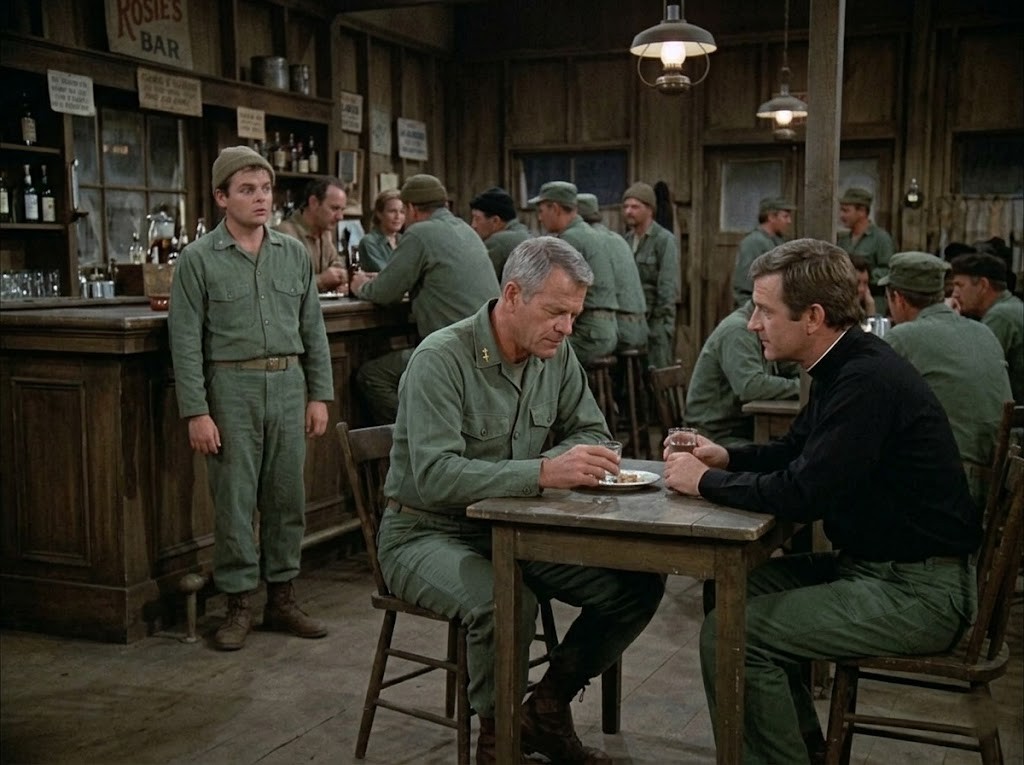
They say the mud of Korea can soak right through the thickest combat boots, but it’s the silence after a forty-eight-hour shift in the O.R. that really seeps into a man’s bones.
When the last stitch is put in and the choppers finally stop coming, the exhaustion doesn’t just hit you—it wraps around you like a wet wool blanket.
That was the kind of heavy, soul-weary evening that drove Colonel Potter and Father Mulcahy across the road to Rosie’s Bar, looking for nothing more than a few minutes of quiet and a drink that didn’t taste like battery acid.
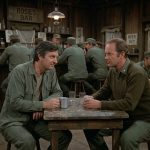
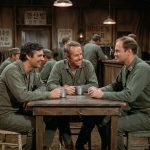
The bar was packed to the gills with enlisted men, a sea of olive drab caps and tired shoulders hunched over wooden tables under the dim, swinging lanterns.
The air was thick with the smell of cheap beer, stale tobacco, and the damp, earthy scent of a Korean autumn creeping through the wooden floorboards.
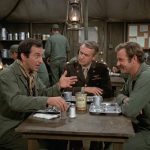
In the corner, Colonel Potter sat heavily at a small, battered table, his silver hair catching the low light, staring down at a tiny glass of local rice wine like it held the secrets to the universe.
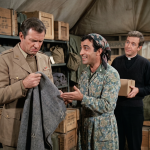
Across from him sat Father Mulcahy, his black cleric’s collar a stark contrast to his green military trousers, holding his own glass with gentle, reverent hands.
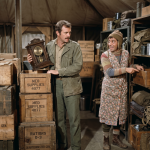
A few paces away, Radar O’Reilly stood by the edge of the bar, his knitted cap pulled low over his ears, his oversized green uniform making him look even younger than he was.
Radar wasn’t drinking; he was just standing guard in his own quiet way, his eyes darting anxiously between his commanding officer and the priest, sensing the invisible weight hanging over their table.
Potter didn’t say a word for a long time, just rotating the tiny glass between his weathered fingers while the boisterous chatter of the enlisted men drifted around them like background static.
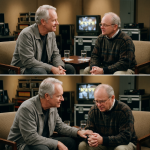
“You know, Father,” Potter said, his voice a low, gravelly rasp that barely carried above the room’s hum, “back in Missouri, when the harvest was done, the old men used to sit on the porch and just watch the sun go down. No words. Just knowing the work was finished.”
Mulcahy smiled softly, his eyes reflecting the warm glow of the overhead lamp. “A beautiful image, Colonel. A well-earned peace.”
Potter let out a short, dry sound that was half-sigh, half-laugh, his eyes fixed on a small plate of dry crackers between them. “Except out here, the harvest never ends. We just clear one field, and the wind blows in another crop of boys.”
The Colonel lifted his glass, his hand shaking just a fraction—a rare, unsettling sight for the rock-solid leader of the 4077th.
He didn’t drink; he just held it level with his chin, his face etched with a sudden, profound sadness that seemed to age him ten years in a single second.
“To the ones we couldn’t keep a hold of today,” Potter whispered, his voice cracking slightly on the last word.
Radar took a step forward, his breath catching in his throat as he saw the proud, fatherly Colonel look so completely vulnerable, leaving the young clerk frozen in place, terrified of what might happen if the strongest man in the camp finally broke.
Father Mulcahy didn’t offer a platitude, nor did he reach for a Bible verse to heal a wound that was still raw and bleeding.
Instead, he quietly raised his own glass until it gently clicked against the Colonel’s, the clear ring of the glass sounding like a small, solitary bell in the crowded tavern.
“May their souls find the green pastures, Sherman,” Mulcahy said softly, using the Colonel’s first name with a quiet tenderness that belonged to a friend rather than a subordinate.
They drank together, the harsh, burning liquor going down smooth because of the shared grief that accompanied it.
Radar watched them swallow, then slowly let out the breath he’d been holding, his shoulders dropping an inch as Colonel Potter set his glass down with a firm, familiar thud.
The tension in the air didn’t vanish, but it shifted, softening into the kind of comfortable, heavy melancholy that only old soldiers and tired healers truly understand.
From the bar, Rosie slid another bottle toward them, not asking for scrip, her sharp eyes softening just enough to show she knew exactly what kind of day the 4077th had endured.
“You see them in every bed, Father,” Potter murmured, tracing a circle in the condensation on the table. “Every boy from Iowa or Illinois looks like my boy. Every one of ’em.”
“That is because you have the heart of a father, Colonel,” Mulcahy replied, his voice steady and full of a quiet, unassuming bravery. “It is what keeps them alive on your table. And it is what keeps us human in a place that wants us to forget how.”
Just then, the door of Rosie’s swung open, and the unmistakable sound of Hawkeye Pierce’s laughter drifted in, followed by B.J. Hunnicutt’s booming voice complaining about a hole in his left boot.
They didn’t approach the table—perhaps seeing the Colonel and the Padre in deep conversation—but their presence alone seemed to bring a spark of life back into the room.
Potter looked up, watching the two younger surgeons jostle each other at the counter, their faces still pale from the O.R. but their spirits stubbornly refusing to be crushed.
A tiny, dry smile finally tugged at the corner of the Colonel’s mouth, the shadows in his eyes retreating just a bit.
“Look at ’em,” Potter muttered, shaking his head. “A couple of driving-reins lunatics. But I wouldn’t trade ’em for a whole division of regular army.”
“The Lord provides us with the comfort we need, Sherman, even if it comes in the form of Captain Pierce in a bathrobe,” Mulcahy chuckled, taking a small sip of his drink.
Radar quietly backed away, returning to his spot near the door, a sense of immense relief washing over his youthful face as he realized the camp’s foundation was still entirely intact.
The night rolled on, the laughter got a little louder, the smoke got a little thicker, and for an hour or two, the war outside stayed exactly where it belonged—in the dark, out in the cold, far away from Rosie’s front door.
Because beneath the canvas and the chaos of the 4077th, it was moments like these that kept the heart beating.