The Truce at Rosie’s Bar
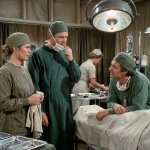
The mud in Korea has a way of seeping into your boots, your clothes, and eventually, your bones. But after a brutal seventy-two-hour stretch in the operating room, the heaviest thing to carry isn’t the mud—it’s the silence that follows when the generators finally stop humming.
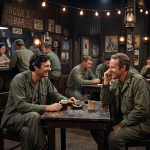
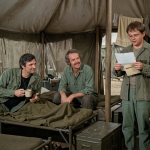
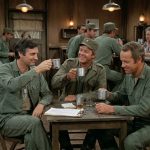
Hawkeye Pierce, B.J. Hunnicutt, and Charles Emerson Winchester III had just walked out of the Swamp and straight across the compound, completely bypassed the mess tent, and pushed through the swinging doors of Rosie’s Bar. They didn’t say a word to each other on the walk over; they didn’t have the energy to trade insults, let alone pleasantries.
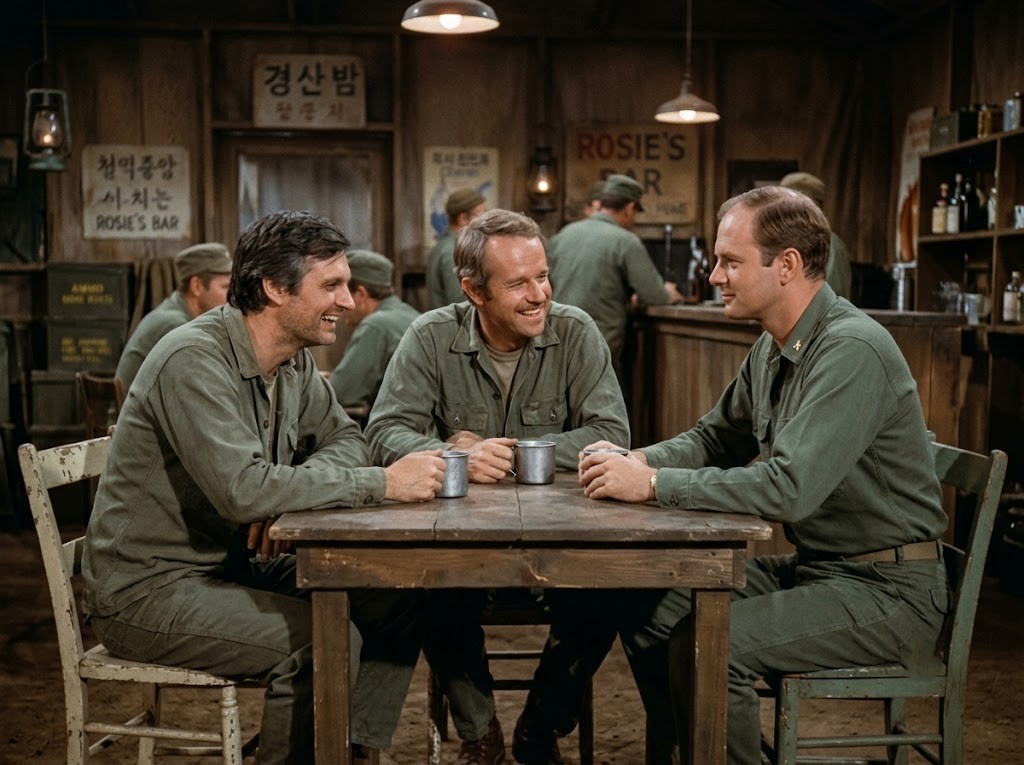
They took their usual wooden table under the dim, hanging incandescent bulb, the familiar “ROSIE’S BAR” signs written in English and Korean hanging loosely on the worn wooden walls behind them. Other tired soldiers in olive drab fatigues leaned against the bar or slumped over back tables, everyone trying to drown the phantom smell of ether in cheap local beer.
Rosie slid three dented tin mugs across the scratched wooden table. Hawkeye wrapped his fingers around his cup, his hands still trembling slightly from the sheer exhaustion of holding surgical clamps for three days straight.
“To the finest surgeons in the 4077th,” Hawkeye muttered, his voice raspy and stripped of its usual theatrical bite. “And to Charles, who somehow managed to keep his posture perfect through fifteen amputations.”
B.J. let out a soft chuckle, his mustache twitching as he looked at Charles, who was sitting up remarkably straight in his crisp olive shirt, the gold major’s insignia on his collar catching the dull light. “I think Charles has a steel rod sewn into his fatigues, Hawk. It’s the only logical explanation.”
Charles didn’t snap back with his usual aristocratic disdain. Instead, he stared down at his tin mug, tracing the rim with a thumb that was scrubbed raw. The silence stretched between them, but it wasn’t the cold, adversarial silence they usually shared in the Swamp; it was the quiet bond of three men who had just looked into the same abyss and pulled twenty young boys back from the edge.
“You know,” Hawkeye said, leaning back into his creaking white wooden chair, a sudden, bright grin breaking through the exhaustion on his face. “If my father could see me now, drinking whatever fermented battery acid Rosie serves out of a cup that looks like it survived the Civil War, sitting next to a man who thinks Mozart is a personal friend, he’d ask for his tuition money back.”
B.J. burst into a warm, genuine laugh, the kind that reached all the way to his tired eyes. He looked between Hawkeye and Charles, the sheer absurdity of their shared existence hitting him all at once. “At least your dad knows where you are, Hawk. Peg probably thinks I’m attending high-society galas with Boston’s finest export.”
Charles looked up, his face softening. For a fleeting second, the haughty persona vanished, replaced by a man who was deeply, profoundly exhausted, yet strangely comforted by the company. He looked at Hawkeye’s laughing face, then at B.J.’s broad smile, and a rare, genuine grin broke across his own face. It was a beautiful, fragile moment of pure camaraderie—three brothers in arms, sharing a private joke in a dingy bar half a world away from home.
Then, the bell above the door jangled violently, breaking the spell.
Radar O’Reilly burst through the entrance, his oversized cap nearly covering his eyes, his breathing heavy, and his face pale with a look of absolute dread that immediately froze the laughter right in Hawkeye’s throat.
“Sirs,” Radar gasped, clutching his clipboard against his chest like a shield. “Colonel Potter needs you. Right now. In the office.”
The warmth evaporated from the table instantly. Hawkeye’s grin vanished, his shoulders slumping as the familiar, cold weight of reality slammed back down. B.J. closed his eyes for a brief second, offering a silent prayer that the choppers weren’t already on their way back. Charles merely tightened his grip on his tin mug, his jaw setting back into its rigid, aristocratic line.
“Radar,” Hawkeye said slowly, his voice dropping an octave, desperately trying to keep the panic out of it. “Tell me those aren’t more chopper blades you hear. Tell me it’s just a very large, very aggressive bird.”
“No, sir,” Radar whispered, looking down at his boots. “It’s not choppers. It’s… well, Colonel Potter said it’s a matter of absolute urgency regarding the supply lines. Something went wrong with the latest shipment from Seoul.”
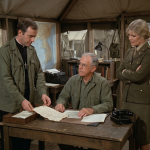
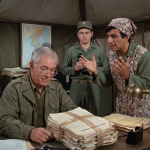
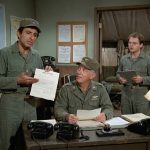
The three surgeons rose from the table, leaving their half-empty mugs behind. The short walk across the muddy compound felt twice as long as it had five minutes ago. When they entered the administrative office, Colonel Potter was pacing behind his desk, a half-chewed cigar clamped between his teeth, looking like a man who had just been handed a declaration of war.
“Pull up a piece of floor, boys,” Potter barked, though his eyes held more weariness than anger. “We’ve got a major crisis on our hands, and I need my top brass to handle it before the whole camp goes AWOL.”
“Did the penicillin get rerouted to Tokyo, Colonel?” B.J. asked, his voice steady but laced with deep concern.
“Worse,” Potter growled, slamming a crumpled piece of paper onto his desk. “The supply truck from Seoul arrived twenty minutes ago. They brought the whole blood supply, the surgical tape, and the fresh sheets. But due to a clerical screw-up in Tokyo, the entire shipment of coffee for the next three weeks was replaced by seventy cases of powdered, dehydrated goat’s milk.”
Silence hung in the room. Hawkeye blinked twice, staring at the Colonel. Charles let out a sharp, aristocratic breath that sounded suspiciously like a deflating balloon.
“Goat’s milk?” Hawkeye finally repeated, a hysterical edge creeping into his voice. “Colonel, you are looking at three men who have survived on pure caffeine and sheer spite for the last seventy-two hours. If you take away the coffee and replace it with the powdered byproduct of a farm animal, there won’t be a 4077th left to command. We will eat each other alive.”
“I am well aware, Pierce,” Potter said, a faint, fatherly smirk tugging at the corner of his mouth. “Which is why I didn’t call you here to operate. I called you here because I know for a fact that you three have a certain… alternative supply network.”
Charles stepped forward, his chest puffed out. “Colonel, if you are implying that I, a Winchester, have any hand in the illicit black-market trade of this peninsula—”
“Save it, Charles,” Potter interrupted, waving a hand dismissively. “I know about the stash of French roast you have hidden in the bottom of your trunk. And I know Hunnicutt here has a crate of premium blend his wife sent that he’s been hoarding for a rainy day. And Pierce… well, Pierce would find coffee in the middle of the Sahara.”
Potter leaned forward, his expression turning soft, the dry humor melting away into pure, fatherly affection. “Look, boys. The nurses are dead on their feet. Klinger is currently crying in the laundry tent. Father Mulcahy looks like he’s ready to confess his own sins just to get a cup of joe. We need a miracle, and we need it before the morning shift.”
Hawkeye looked at B.J. B.J. looked at Charles. The aristocratic major looked down his nose at both of them, let out a massive, dramatic sigh, and adjusted his collar.
“It appears,” Charles said with immense dignity, “that the Boston aristocracy must once again bail out the proletariat. I shall contribute half of my private reserve. But I expect a full apology from the United States Army.”
“I’ll match it,” B.J. said with a warm grin, clapping Charles on the shoulder. “Peg sent enough to jump-start a locomotive anyway.”
“And I,” Hawkeye said, placing a hand over his heart, “will personally charm Margaret into letting us use the autoclave in Post-Op to brew the biggest, darkest, most illegal batch of coffee this side of the 38th parallel.”
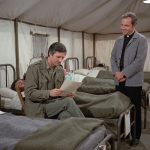
An hour later, the deep, rich aroma of real coffee began to drift across the compound, cutting through the damp morning air and the lingering smell of exhaust. In the mess tent, tired nurses smiled for the first time in days. Father Mulcahy took a sip from a tin cup and muttered a very sincere blessing.
Back in Rosie’s Bar, later that evening, the three surgeons found themselves back at the exact same wooden table under the dim hanging light. The crisis had been averted, the camp was quiet, and the mud outside was still thick.
Rosie brought over three fresh mugs. This time, it wasn’t her usual local brew. It was a dark, steaming blend of Charles’s French roast and B.J.’s home-sent coffee, brewed to perfection.
Hawkeye raised his tin cup, his eyes crinkling at the corners with that familiar, beautiful warmth. “To the great goat’s milk rebellion of 1953.”
B.J. clinked his cup against Hawkeye’s. “And to the finest roommates a guy could ask for.”
Charles looked at his tin mug, then at the two men sitting across from him. He didn’t say a word, but as he raised his cup to join theirs, the genuine, soft smile returned to his face, illuminating the dingy corner of the bar. They were miles from home, surrounded by a war that made no sense, but sitting together at that battered wooden table, they had everything they needed to survive another day.
In the middle of nowhere, surrounded by the chaos of war, the best medicine was always the family you found in the mud.