The Weight of the World in Triplicate
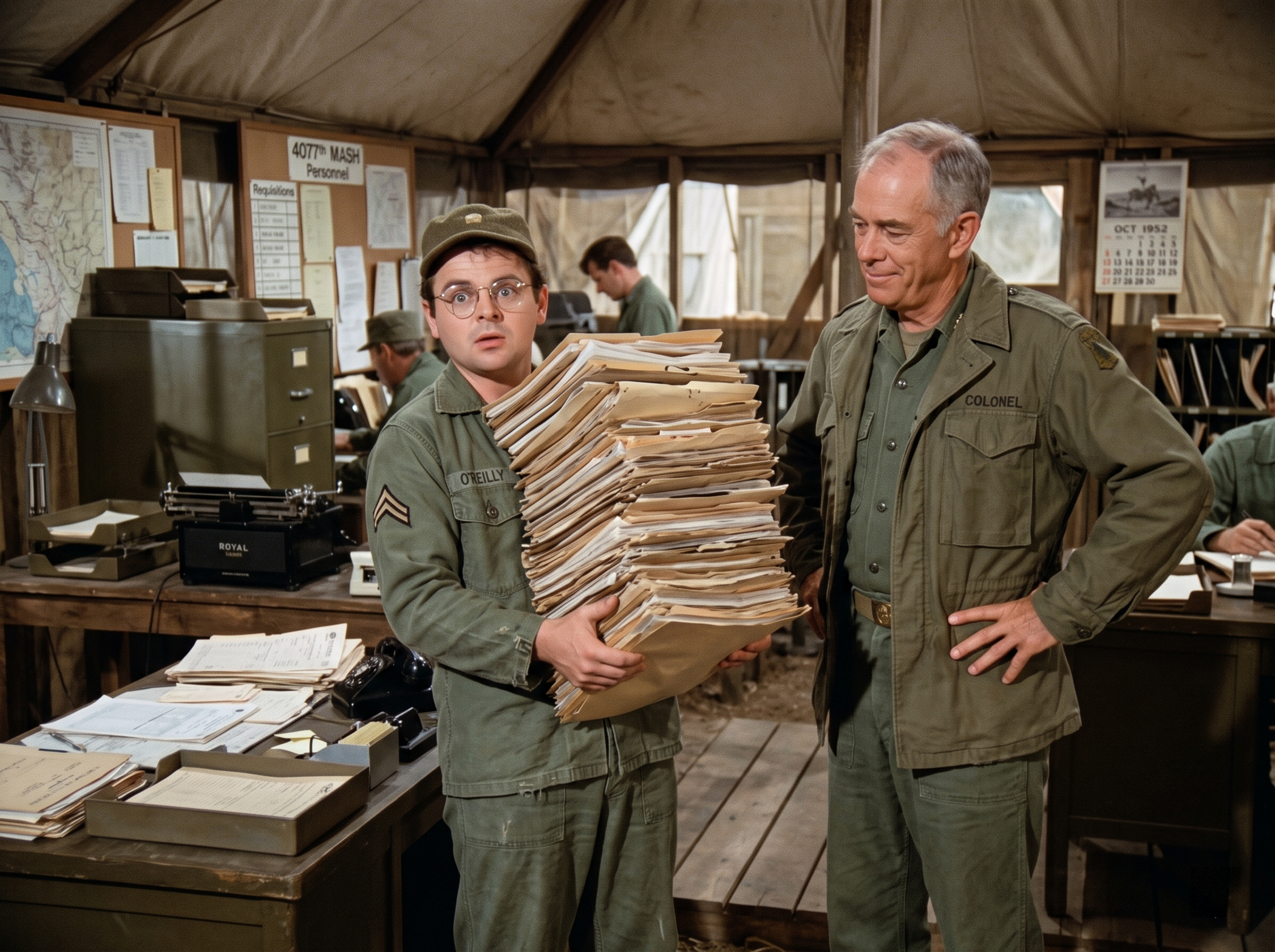
The war stopped for no man, but at the 4077th, it occasionally ground to a halt for paperwork.
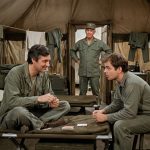
It was late afternoon in the company clerk’s office, and the air was thick with the permanent dust of Korea and the smell of stale, burnt coffee. For the first time in three days, the distant chop-chop-chop of Huey rotors was absent from the sky. The surgical teams were finally asleep, collapsing into their cots after a brutal, unending stream of wounded.
The camp was quiet. But the United States Army’s bureaucracy never slept.
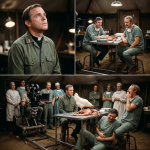
Colonel Sherman T. Potter stood near the clerk’s desk, enjoying a rare moment of stillness. His olive-drab jacket felt heavy on his shoulders, the fabric holding the exhaustion of a man who had spent the last eighteen hours on his feet in the OR. He had his hands planted firmly on his hips, stretching a back that was reminding him, loudly, of his age.
He was just about to head to his tent to pour a generous measure of something medicinal when the squeak of standard-issue boots interrupted the silence.
Potter turned his head. He didn’t see a soldier at first. He just saw a walking mountain of manila.
Slowly shuffling into the office was Corporal Walter “Radar” O’Reilly. Or, at least, it appeared to be Radar. Only the boy’s oversized cap, his round spectacles, and a pair of wide, frightened eyes were visible behind an impossibly tall, teetering stack of beige requisition forms and personnel files.
The stack was absurd. It was a monument to red tape, rising from Radar’s belt buckle to just below his nose. The edges of the paper were frayed, stuffed with carbon copies, memos, and cross-referenced annexes.
“Ah… C-Colonel, sir?” Radar stammered. His voice was muffled behind the wall of forestry products.
Potter turned fully toward his clerk. A dry, weary amusement settled into the lines of his face. He kept his hands on his hips, his eyes crinkling at the corners. He had served in two World Wars before this police action, and he had seen a lot of things. But he had never seen a corporal look quite so much like a terrified turtle hiding behind its own shell.
“Son,” Potter said gently, his voice carrying the warm, gravelly tone of a seasoned commander. “Unless you’ve suddenly decided to build a paper-mâché replica of the Hoover Dam, I suggest you explain what you’re holding before it collapses and buries us both.”
Radar gulped. The sound was audible across the room. The massive stack of paper wobbled dangerously to the left. Radar scrambled to correct it, his knees knocking together under his baggy fatigues.
“It’s the… well, sir, it’s the End of Month Divisional Supply Manifest. Combined with the I Corps Quarterly Inventory. And, um, the Motor Pool Depreciation Log,” Radar babbled, his eyes darting back and forth in innocent panic.
“All of that?” Potter asked, an eyebrow ticking upward. “Radar, that stack is taller than my grandson. And he’s eating solid foods.”
“Yes, sir. Well, they sent down a new directive. Everything has to be itemized in triplicate. And cross-referenced. And notarized by a commanding officer. That’s you, sir.”
Potter sighed, staring at the sheer volume of bureaucratic nonsense. It was a sharp, ridiculous contrast to the life-and-death reality they had just faced in the operating room. Here they were, patching boys together with spit and baling wire, and the brass in Tokyo was worried about how many spark plugs they had used in November.
“Put it on the desk, Radar, before you give yourself a hernia,” Potter instructed, stepping out of the way.
But Radar didn’t move. He just stood there, clutching the mountain of forms to his chest, looking like a boy caught with his hand in the world’s largest cookie jar. His round face was pale. The wide-eyed concern behind his glasses wasn’t just physical strain. It was sheer, unadulterated guilt.
“Radar,” Potter said, his tone shifting slightly. The amusement faded into a sharp, observant focus. “Why aren’t you putting the paper down?”
Radar’s voice squeaked. “Because, sir… if I put it down, you’re going to have to sign it.”
“That is generally how paperwork functions in this man’s army, yes.”
“But, sir… if you sign it, you’re technically verifying everything in it. And, well, I wouldn’t want you to verify something that might, hypothetically speaking, get you court-martialed.”
The quiet of the office suddenly felt very heavy. The Royal typewriter sat silently on the desk. The 1952 calendar on the wall seemed to hold its breath.
Potter took a slow, deliberate step toward the trembling clerk. He looked at the massive stack of papers, then looked right into Radar’s terrified eyes.
“Corporal,” Potter said, his voice dropping into a low, fatherly register that demanded nothing but the absolute truth. “What exactly did you bury in the middle of that stack?”
The mountain of paper swayed ominously as Radar shifted his weight. His knuckles were white from gripping the folders.
“Well, sir,” Radar started, his words tumbling out in a panicked rush. “You know how Major Winchester was complaining that the post-op ward was freezing? And how Hawkeye and B.J. said the kids at the orphanage were sleeping on bare floors?”
Potter nodded slowly. “I do. I also know I Corps denied our request for supplemental blankets three times this month. Said we were already at our winter quota.”
“Right. Yes, sir. They did,” Radar swallowed hard. “So… I didn’t ask for blankets.”
Potter’s eyes narrowed. “What did you ask for, Radar?”
“Well, sir. If you look at page… uh, page four hundred and twelve. Section C. Subsection paragraph nine.” Radar squeezed his eyes shut for a moment. “I requested three hundred yards of heavy-duty, unbleached canvas engine-insulation wrapping. For the motor pool. To keep the jeeps warm.”
Potter stared at him. The old cavalry officer processed the information. “Engine-insulation wrapping. Which, I imagine, feels remarkably like wool.”
“It is wool, sir. Very soft wool. The Navy uses it. I sort of… traded a favor with a supply sergeant down in Inchon. But he needed official paperwork to justify the transfer.” Radar opened his eyes, looking up at the Colonel with desperate, earnest hope. “It’s enough to make sixty blankets, sir. Half for post-op, half for the orphanage. But I had to hide the requisition inside all this other junk so the quartermaster in Seoul wouldn’t notice the cost discrepancy.”
The silence returned to the clerk’s station. Radar stood frozen, waiting for the explosion. He waited for the booming voice, the lecture on military regulations, the threat of the stockade.
Instead, a soft, breathless sound escaped Colonel Sherman T. Potter. It was a chuckle.
The chuckle grew into a warm, genuine laugh that rumbled deep in Potter’s chest. He brought a hand up to rub his tired face, shaking his head at the sheer, magnificent audacity of the nineteen-year-old farm boy standing in front of him.
“Engine-insulation wrapping,” Potter muttered, a smile breaking through his weary expression. “Radar, you are a menace to the United States military establishment.”
“I’m sorry, sir! I know it’s against regulations—”
“Hush, son,” Potter interrupted gently.
The Colonel reached out. He didn’t take the paperwork. Instead, he placed his strong, steady hands over Radar’s trembling arms. With a careful, guided motion, Potter helped the boy lower the impossible stack of files onto the wooden desk. It landed with a heavy, satisfying thud that sent a small cloud of dust into the air.
Radar let out a massive sigh of relief, his shoulders slumping as the physical weight was lifted. But his eyes remained fixed on his commander, waiting for the final verdict.
Potter looked down at the towering stack of bureaucratic nonsense. Then, he looked at Radar. He saw the innocence that the war hadn’t yet managed to burn away. He saw the pure, unselfish heart that beat at the center of the 4077th. This boy, who still drank grape Nehi and slept with a teddy bear, was single-handedly keeping them all human.
Potter reached into his breast pocket and pulled out his gold fountain pen. He uncapped it with a smooth, practiced motion.
“Sir?” Radar asked softly. “You don’t have to sign it. If we get caught…”
“If we get caught, Corporal,” Potter said, leaning over the desk, “I will simply tell the brass that I have a very deep, abiding concern for the thermal integrity of our jeeps.”
Potter didn’t flip to page four hundred and twelve. He didn’t check the itemized lists or the cross-referenced annexes. He simply pressed his pen to the bottom of the very first page and signed Sherman T. Potter, Col., Commanding in bold, sweeping strokes.
He capped the pen and slipped it back into his pocket.
“There,” Potter said, giving the stack of papers a firm pat. “The United States Army is now the proud owner of three hundred yards of very soft, blanket-shaped engine insulation. Have Klinger pick it up tomorrow. Quietly.”
Radar’s face lit up. The panic melted away, replaced by a smile so bright and genuine it seemed to light up the dingy, olive-drab office.
“Oh, thank you, sir! Thank you! The kids are gonna be so warm. And Major Winchester might actually stop complaining for five minutes.”
“Let’s not ask for miracles, son,” Potter said dryly. “Now, I believe you have some filing to do. And after that, I want you to go get some sleep. That’s an order.”
“Yes, sir. Right away, sir.”
Radar snapped a crisp, eager salute. Potter returned it with a casual, affectionate flick of his hand.
As Potter turned to finally leave the office, he paused at the doorway of the tent. He looked back at the clerk’s station. Radar was already humming happily to himself, wrestling the massive stack of papers into smaller, manageable piles.
Potter smiled. His back still ached, and the war was still waiting for them just outside the camp perimeter. The madness of the world had not stopped. But here, in this dusty tent, a small, quiet victory had been won.
He stepped out into the cool Korean evening, feeling just a little bit lighter.
In a place defined by what was broken, their greatest rebellion was simply taking care of each other.