The Dust, The Mail, and the Ties That Bind
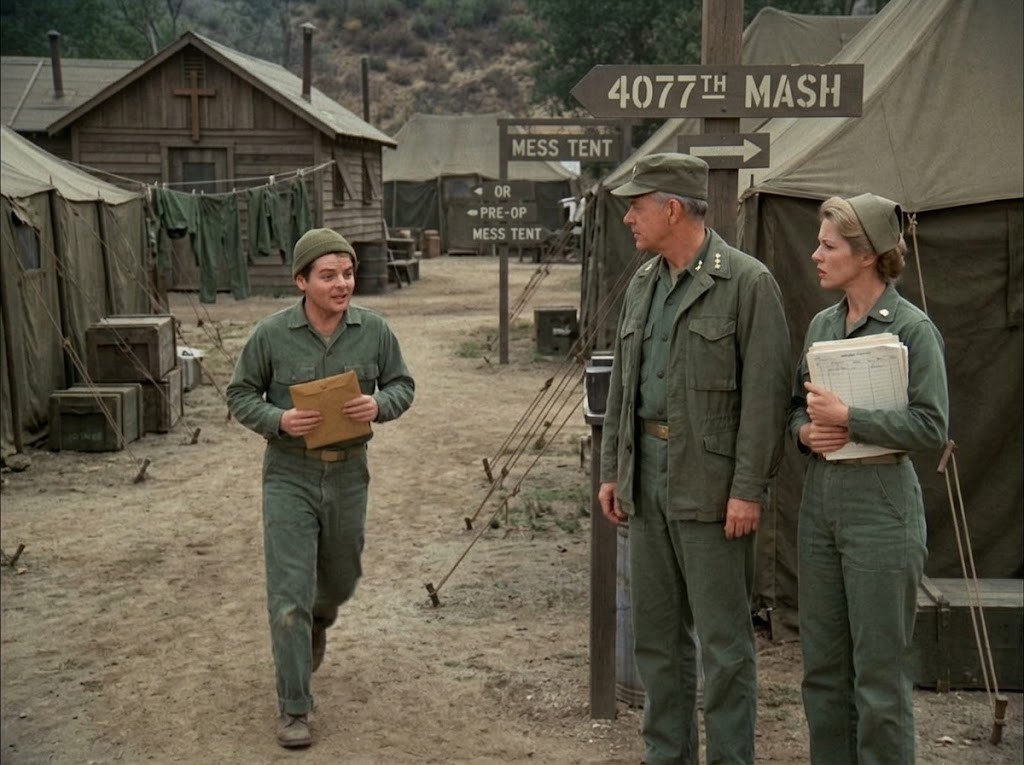
Some days, the Korean dust settles over the 4077th like a heavy woolen blanket, burying the noise of the choppers under a temporary, fragile silence. It’s in these rare, quiet gaps between surgeries that the weight of being ten thousand miles from home really pushes down on a person’s shoulders. You can see it in the way the canvas tents sag, and in the slow, tired stride of anyone walking down the dirt company street.
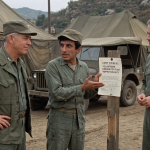
Colonel Potter stood near the main signpost, his eyes scanning the camp with the steady, fatherly vigilance of a man who carried the burdens of every soul under his command. Next to him, Major Margaret Houlihan clutched a thick stack of medical rosters tightly against her chest, her posture rigid, though her face betrayed a deep, exhaustion-born softness. They had been discussing the supply shortages—the lack of fresh linens, the dwindling penicillin—but their voices were low, matching the somber mood of a hot, windless afternoon.
Suddenly, the silence was broken by the rapid, rhythmic thud of combat boots slapping against the hard-packed earth.
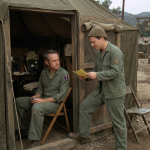
Around the corner of the pre-op tent came Corporal Radar Reilly, his olive-drab beanie sitting snugly on his head, clutching a thick manila envelope to his chest like it was made of solid gold. He wasn’t just walking; he was practically marching with a desperate, breathless urgency, his face wide with an expression that was one part pure panic and two parts profound hope. He caught the Colonel’s eye from thirty yards away, his mouth already open to speak before his feet could even catch up.
“Colonel! Colonel Potter, sir!” Radar gasped, skidding to a halt just a few feet from the signpost, his breath coming in short, ragged puffs.
Potter shifted his gaze, his brow furrowing with a mixture of curiosity and mild irritation. “Take it easy, son. The North Koreans haven’t declared a monopoly on deep breaths. What’s burning a hole in your pocket?”
Margaret looked down at the envelope in Radar’s hands, her professional armor instantly slipping. A letter in Korea was never just a piece of paper; it was a lifeline, a fragile thread connecting a person to a world where people didn’t bleed out on operating tables. “Is it the dispatch from Seoul, Corporal? The O-negative blood supply?”
“No, ma’am—I mean, yes, the blood is on the truck, but this… this came in a separate pouch from the state department,” Radar stuttered, his fingers trembling slightly against the heavy paper. He looked up at Potter, his large eyes filled with an overwhelming, vulnerable anxiety. “It’s… it’s about Captain Pierce, sir. His father.”
The air between the three of them suddenly turned ice-cold despite the summer heat. Down in the Swamp, Hawkeye’s laughter could usually be heard echoing through the camp, a sharp, cynical shield used to ward off the darkness. But the thought of a telegram regarding his father—the one anchor the brilliant, fractured surgeon had left in the world—threatened to shatter that shield entirely.
Potter’s face hardened, the grandfatherly warmth instantly replacing itself with the stark gravity of a commanding officer preparing for a casualty report. “Give it here, Radar.”
Radar hesitated for a fraction of a second, his grip tightening on the envelope as if he could shield Hawkeye from whatever news lay inside just by holding onto it a little longer.
—
Colonel Potter took the envelope from Radar’s hands with a quiet reverence. He didn’t tear it open with his usual brisk efficiency; instead, he carefully worked his thumb under the seal, his eyes never leaving the crisp, typed letters on the front. Margaret stepped closer, her breath caught in her throat, the rigid military bearing completely forgotten as the universal fear of a “family emergency” notification hung over them.
“Is it… is it bad, sir?” Radar whispered, his voice sounding incredibly small against the backdrop of the quiet camp.
Potter pulled out the single sheet of official paper. He adjusted his glasses, his eyes scanning the lines quickly. For a long, agonizing moment, the Colonel’s face remained completely unreadable, a weathered mask of military stoicism that made Radar’s stomach do a slow, painful flip. Margaret closed her eyes for a brief second, preparing herself for the inevitable task of comforting a man who spent twenty hours a day fixing others but could never fix a broken heart.
Then, slowly, the corners of Colonel Potter’s mustache began to twitch.
He let out a sharp, dry bark of a laugh, shaking his head as he handed the letter over to Margaret. “Well, I’ll be a sucked donut. Look at that, Major.”
Margaret blinked, her eyes darting across the page, before a look of utter disbelief washed over her face. “A… a registered complaint? From the Crabapple Cove Town Council?”
“Turns out,” Potter said, a warm, rich chuckle rising from his chest, “old Daniel Pierce decided to protest the town’s new zoning laws by moving his entire medical practice into a tent in his front yard. Says if his boy can practice medicine in a canvas bag in the middle of a war zone, he doesn’t see why a civilized state like Maine needs indoor plumbing to check a prostate.”
Radar let out a massive sigh of relief, his shoulders dropping a full three inches as he leaned against the signpost. “Gee… so Dr. Pierce is okay? He’s just… being a Pierce?”
“Exactly,” Potter smiled, the heavy tension that had gripped the company street evaporating into the dusty air. “The state department was asked to notify the Captain that his father is technically facing a fine of fifty dollars for unauthorized occupancy of a front lawn.”
Just then, the screen door of the Swamp banged open. Hawkeye Pierce stepped out into the dirt, a pair of surgical scrubs draped over his shoulder, his eyes squinting against the bright glare of the sun. He looked tired—bone-tired, with dark circles under his eyes that no amount of homemade gin could wash away. He noticed the trio standing by the signpost, staring at him.
“What’s this? A committee meeting to discuss the lack of flavor in the creamed chipped beef?” Hawkeye called out, sauntering over with his signature loose, cynical stride. “Or are you finally presenting me with my medal for bravery in the face of absolute boredom?”
Margaret couldn’t help the small, genuine smile that broke through her usual stern expression. She handed him the letter. “It’s a citation, Captain. From home.”
Hawkeye took the paper, his eyes scanning the official letterhead with a momentary flash of apprehension. But as he read his father’s antics, the tension in his jaw melted away. A slow, brilliant grin spread across his face, lighting up his tired features with a boyish warmth that rarely made an appearance these days.
“He did it,” Hawkeye whispered, a quiet laugh bubbling up from his throat. “The beautiful, crazy old man actually set up the tent. He even used my old Boy Scout cot.”
He looked up at Potter, his eyes bright with a mixture of amusement and a deep, aching homesickness that no longer felt quite so heavy. “Colonel, I believe my father is currently fighting the Battle of New England from a surplus army tent. I’ve never been prouder.”
“Just make sure he doesn’t start trying to build a still out of old copper pipes, Pierce,” Potter said, clapping a heavy, comforting hand on Hawkeye’s shoulder. “One of you in the world is more than enough for the United States Army to handle.”
As Hawkeye walked back toward the Swamp, clutching the letter like a prize, Radar watched him go with a soft smile, his innocent face filled with the quiet satisfaction of a job well done. The dust was still there, the war was still just beyond the hills, but for a few minutes, the 4077th felt less like an army camp and more like a home.
Because in a place where tomorrow is never promised, sometimes a little piece of home is the only medicine that really works.