Grace, Gravity, and the Mystery Meat
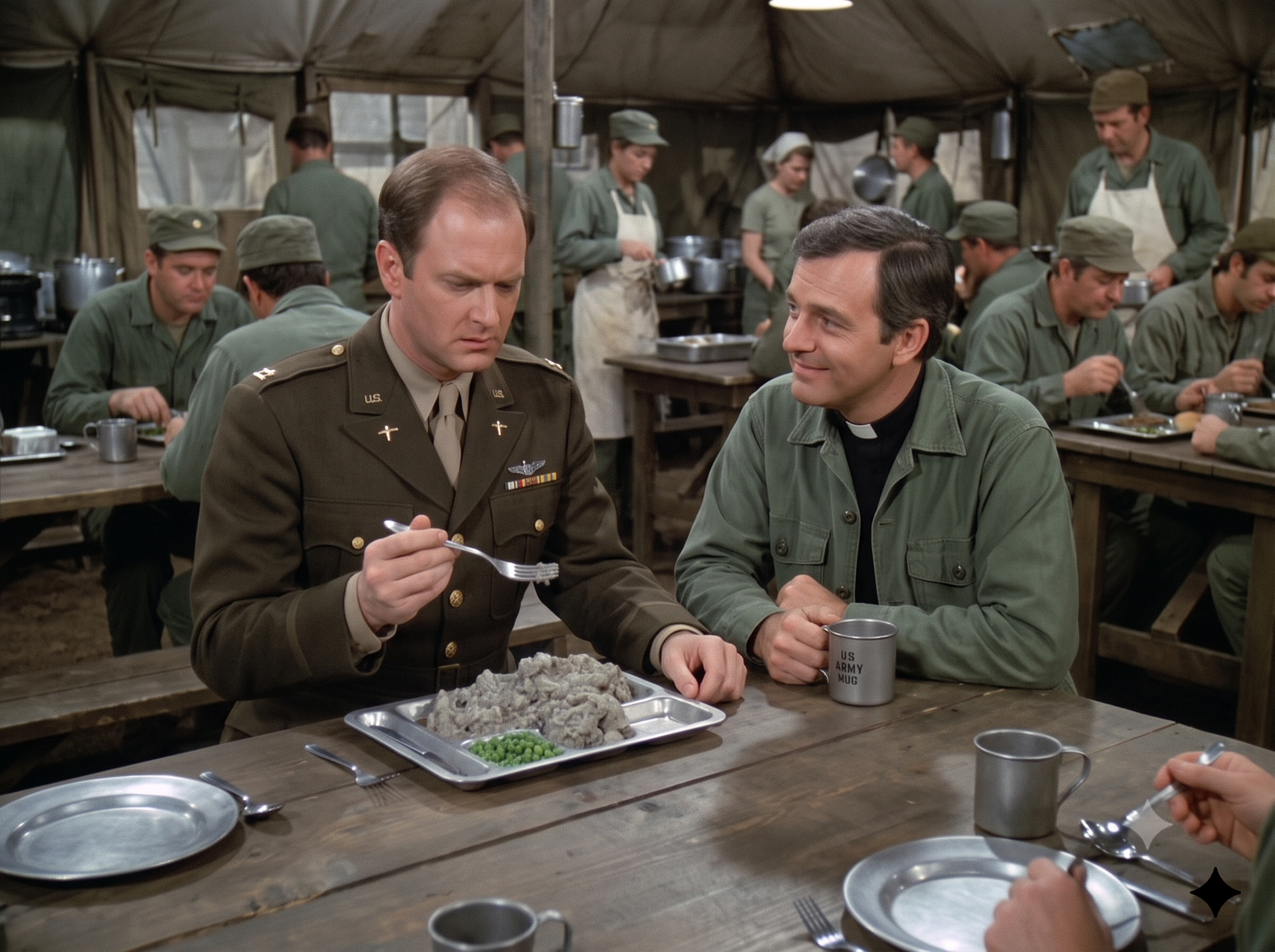
The Mess Tent of the 4077th was a place where culinary hope didn’t just die; it was slowly, methodically boiled into submission.
It was a damp Tuesday afternoon, and the air inside the canvas walls was heavy with the smell of wet wool, stale coffee, and something that vaguely resembled burnt cabbage.
The background hummed with the usual camp noise. Trays clattered against metal tables. Exhausted medics shuffled through the serving line, their faces pale from a brutal eighteen-hour session in the O.R.
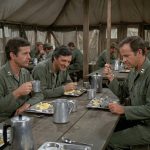
At a long, bare wooden table near the center pole, Major Charles Emerson Winchester III sat frozen in place.
His posture was impeccably rigid. Even in his rumpled, olive-drab wools, Charles carried himself as though he were seated in the dining room of the Boston Ritz-Carlton.
But his face told a different story. It was a mask of restrained, refined horror.
His right hand hovered in mid-air, a regulation military fork gripped tightly between his fingers.
Suspended beneath the tines of that fork was the day’s main course.
It sat on the dull metal tray like an insult to the very concept of agriculture. It was a grey, gelatinous lump, textured like damp dryer lint and utterly devoid of any recognizable geometric shape.
Beside it sat a small, tragic puddle of green peas that looked as though they had long ago surrendered to despair.
Charles stared at the grey mass. The mass, somewhat defying the laws of physics, seemed to stare back.
Beside him sat Father John Mulcahy.
The gentle priest leaned in close, resting his forearms on the rough wooden table. He held a scratched metal mug of coffee between his hands, letting the meager warmth seep into his cold fingers.
Mulcahy wore his clerical collar beneath a faded green field jacket, his expression impossibly calm amidst the sensory assault of the Mess Tent.
He looked at Charles, then at the tray, and offered a soft, optimistic smile. It was the kind of smile one might use to comfort a frightened child, or perhaps to bless a condemned man.
“I believe,” Mulcahy said gently over the din of the tent, “that Igor referred to it today as a ‘savory meatloaf surprise,’ Major.”
Charles did not blink. He did not lower his fork.
His jaw tightened, the muscles ticking beneath his skin. He had survived the blood of the operating room. He had survived the freezing Korean nights. He had even survived bunking with Pierce and Hunnicutt.
But as he stared down at the unholy grey lump on his tray, the final thread of his aristocratic composure began to fray.
The tent around him seemed to fade away. The noise dialed down to a dull roar.
Charles’s hand began to tremble, just slightly, as a profound, bone-deep exhaustion finally caught up with him. He took a sharp, shaky breath, and the fork wavered dangerously over the tray.
“Surprise,” Charles whispered, his voice dangerously thin. “Father, a surprise is finding a perfectly aged bottle of Bordeaux forgotten in the cellar. A surprise is a sudden, unseasonably warm breeze off the Charles River.”
He lowered the fork a fraction of an inch, his eyes wide and fixed on the food.
“This… this is not a surprise, Father. This is an act of unprovoked hostility.”
Mulcahy took a slow, deliberate sip from his tin mug. He didn’t laugh. He knew better than to laugh when a surgeon was standing on the edge of the abyss, even if the abyss was located on a lunch tray.
“It does lack a certain… visual appeal,” Mulcahy conceded, his tone mild and soothing. “But one must remember, Major, that beauty is often found within.”
“If there is beauty within this, Father,” Charles replied, his voice trembling with exhausted indignation, “it has been entombed by a war crime.”
Charles finally let his hand drop. The metal fork clattered against the tin tray with a sharp, defeated sound.
He slumped back on the wooden bench, his rigid posture deflating. The proud Boston Brahmin suddenly looked very small, and very tired. He closed his eyes, rubbing the bridge of his nose with his thumb and forefinger.
“I am so incredibly tired, John,” Charles murmured.
It was rare for Winchester to use first names. It was a subtle surrender, a dropping of the heavy armor he wore to protect himself from the realities of the 4077th.
Mulcahy’s smile softened into something deeply empathetic. He understood perfectly. It was never really about the food.
It was about the mud, the cold, the endless parade of broken bodies, and the overwhelming, suffocating homesickness that crept in when the surgical masks came off.
The terrible food was just the final, daily indignity that pushed them all to the breaking point.
“I know, Charles,” Mulcahy said quietly. “I know you are.”
Mulcahy reached into the deep pocket of his field jacket. He rustled around for a moment before producing a small, slightly crushed packet of actual, honest-to-goodness saltine crackers.
He had saved them from a care package received three weeks ago, hoarding them for a moment precisely like this one.
With quiet reverence, Mulcahy placed the packet on the wooden table and slid it across the rough surface until it rested right beside Charles’s tray.
Charles opened his eyes. He looked at the crackers, and then turned his head to look at the priest.
“It isn’t pheasant under glass,” Mulcahy said, his eyes twinkling with a touch of dry, quiet humor. “But I can personally vouch for their structural integrity. And they haven’t been boiled.”
Charles stared at the humble offering. The sharp contrast between his usual arrogance and the quiet vulnerability of this moment hung in the air between them.
Slowly, carefully, Charles reached out and picked up the packet.
“Father,” Charles said, his voice returning to its normal, measured cadence, though softer now. “You are, without question, a shepherd among sheep. And occasionally, among swine.”
“We do what we can with the flock we are given, Major,” Mulcahy replied, raising his coffee mug in a silent toast.
Charles managed a tight, polite nod—the closest he would ever come to a full smile in the Mess Tent. He carefully opened the cellophane wrapper, completely ignoring the grey lump of meatloaf that still sat on his tray.
He took a bite of the dry cracker. It was stale. It was tasteless.
And in that moment, it was the finest meal Charles Emerson Winchester III had ever eaten.
The noise of the tent washed back over them—the laughter of Hawkeye from across the room, the clatter of pots from the kitchen, the steady hum of a mobile hospital trying to survive another day.
They sat together in the noisy, crowded room, an aristocrat and a priest, finding a quiet moment of grace in the middle of a war.
Charles chewed his cracker with dignified precision, while Mulcahy sipped his terrible coffee, both of them anchored by the simple, quiet comfort of not being entirely alone.
In the 4077th, survival wasn’t just about what you could stomach; it was about who was sitting next to you when you couldn’t swallow another bite.