The View from The Swamp
The Swamp at two in the morning was the closest thing to a sanctuary the 4077th Mobile Army Surgical Hospital had to offer. It smelled of damp canvas, dusty footlockers, and the unmistakable, eye-watering fumes of Captain B.J. Hunnicutt’s latest batch of bathtub gin.
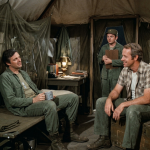
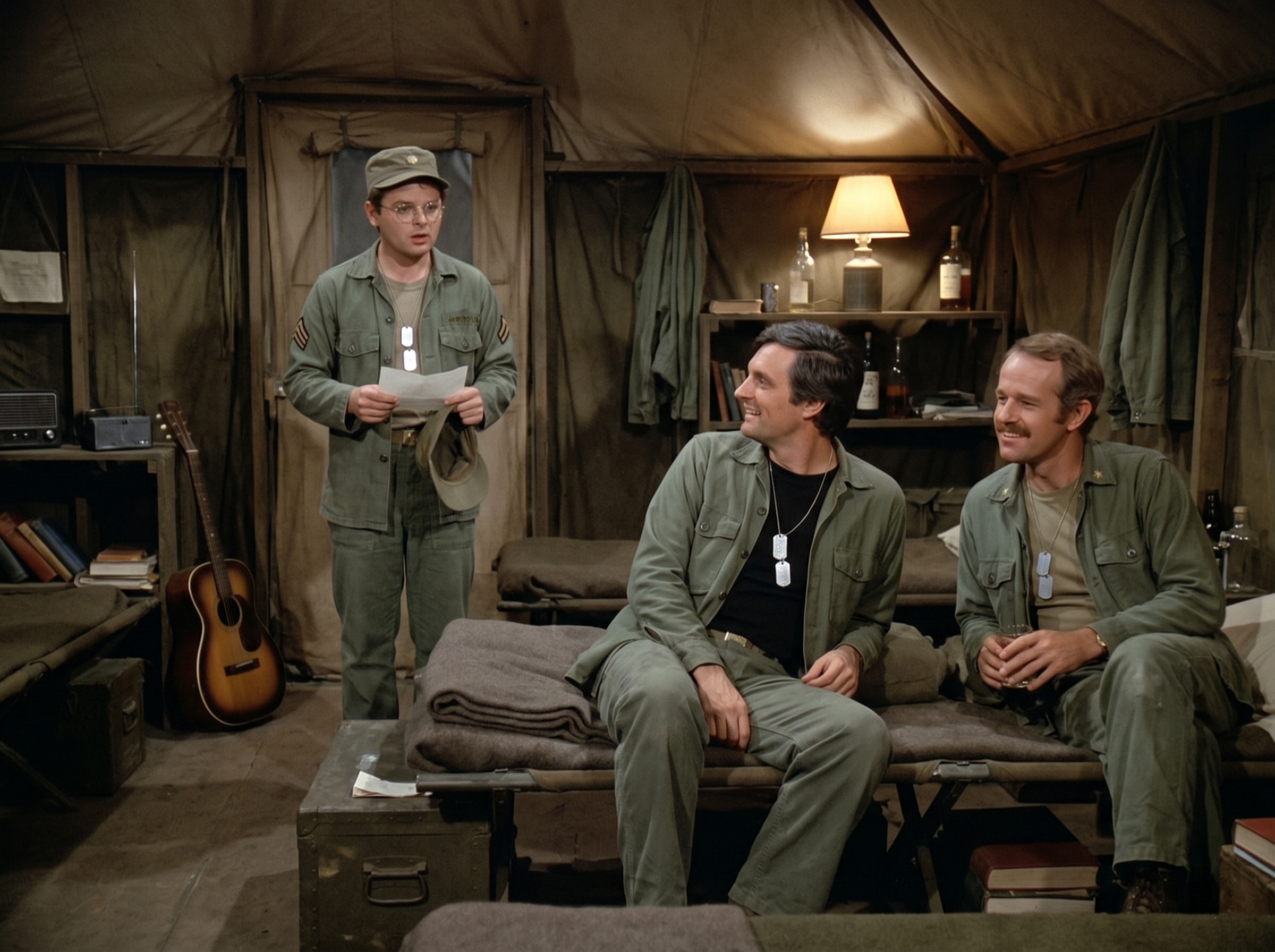
Outside, the Korean night was finally quiet. The choppers had stopped flying twenty-four hours ago, leaving behind a heavy, exhausted silence. Inside the tent, a single practical lamp cast a soft, warm yellow glow across the modest casual clutter of their shared life.
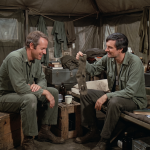
Hawkeye Pierce sat on the edge of his cot, a study in practiced exhaustion. He wore a plain black t-shirt beneath an unbuttoned fatigue jacket, the silver chain of his dog tags resting cold against his chest. His posture was a deeply relaxed slouch, the kind of comfortable collapse that takes years of surviving back-to-back surgical shifts to perfect.
Across the small, lived-in space, B.J. leaned back comfortably against his own pillow. He wore a faded olive drab t-shirt, his friendly mustache twitching with a quiet, dry amusement. In one hand, he loosely held a glass of the clear, lethal liquid they pretended was a dry martini. They were in the middle of a comfortable silence, enjoying a rare moment of simply existing without blood on their hands.
Then, the canvas door flap rustled.
Corporal Walter “Radar” O’Reilly half-entered the tent. He wore his standard-issue fatigue cap and an oversized jacket, looking, as always, like a boy playing dress-up in his father’s army. He stopped just inside the doorway, clutching a single sheet of crisp white paper in his hands.
Radar looked earnestly confused. His brow was furrowed tight behind his round spectacles, and he stared at the paper as if it might suddenly bite him.
Hawkeye turned with quick attention, immediately sensing the shift in the room’s energy. But seeing Radar’s intact composure, his brief flash of alarm quickly melted into a wide, amused grin. “Come on in, Radar. The concierge is just turning down the cots.”
B.J. gently swirled his glass. “What’s the word from the outside world? Did I Corps finally realize they drafted the wrong Hunnicutt?”
Radar stepped further into the soft yellow light, ignoring the banter. He looked down at the paper, then back up at the doctors. “Sirs… I think there’s been a terrible mistake.”
Hawkeye chuckled, leaning forward slightly. “It’s a common side effect of military intelligence. What did they do? Order us to wear neckties in the OR?”
Radar shook his head, his face a picture of absolute, troubled innocence. “No, sir. It’s not from the army. It’s a letter from my mother. But… there was another envelope inside it. It was addressed specifically to you two.”
Hawkeye’s smile widened, sensing a mystery. “To us? From the matriarch of Ottumwa?”
“Yes, sir,” Radar said, his voice dropping slightly. “And I know it’s a federal offense to read someone else’s mail. But the flap was kind of open, and Sparky said that the humidity in Seoul melts the glue, so technically it opened itself…”
“We won’t tell the Postmaster General,” B.J. said softly, his eyes crinkling with warmth. “What did Mrs. O’Reilly say, Radar?”
Radar stared at the paper, his confusion deepening into genuine worry. “That’s the thing, Captain. I don’t understand it at all. She’s thanking you for something you never did.”
Radar cleared his throat. The sound seemed unusually loud in the quiet, canvas-walled room. He began to read in a slow, halting voice, as if the handwritten words were in a foreign language.
“‘Dear Captain Pierce and Captain Hunnicutt. Please forgive the intrusion. I know you are very busy men, saving so many lives over there. But a mother worries about her boy, so far from home in such a terrible place.'”
Hawkeye’s grin softened into something more grounded and genuine. He rested his hands casually on his knees. B.J. stopped swirling his drink, giving Radar his complete, quiet attention. The wisecracks evaporated, leaving only the profound, unspoken respect they held for this kid and the family that had loaned him to the war.
Radar continued, his brow wrinkling further. “‘Walter writes to me every week. He tells me about the frightening things he hears, but he always tells me about you two. He tells me how you joke, and how you care for the wounded, and how you look out for him.'”
Radar paused, looking up at Hawkeye and B.J. with a sheepish, almost apologetic expression. “I didn’t say you were heroes or anything, sirs. Just that you weren’t as crazy as everybody at I Corps says you are.”
Hawkeye laughed, a warm, rich sound in the dimly lit tent. “High praise, Corporal. Go on.”
Radar looked back at the paper. “‘I am writing to thank you. Not for your medical skills, though I am sure they are wonderful. I am writing to thank you for taking care of my son’s eyes.'”
Radar lowered the letter, his face the very definition of earnest bewilderment. He reached up and pushed his round glasses further up the bridge of his nose.
“Sirs… I don’t get it,” Radar said. “I clean my own glasses. I use the special shammy cloth Uncle Ed gave me. And my eyes are fine! I mean, I can still see a chopper coming before the sentries even hear it. Why would she thank you for taking care of my eyes? Did you write to her and tell her I was going blind?”
The silence that followed was thick and sudden, filled only by the distant, rhythmic hum of the camp generator.
Hawkeye looked over at B.J. B.J. looked back. A silent, instantaneous communication passed between them. They were doctors who spent twelve hours a day elbow-deep in the tragic, shattered reality of war. They stitched farm boys back together, but they knew they couldn’t erase what those boys had seen.
Except for Radar.
Radar was the beating heart of the 4077th. He was the pure innocence they were all desperately fighting to preserve. Hawkeye and B.J. spent half their free time actively shielding Radar from the darkest truths of the camp. They softened the blows of the daily casualty reports, distracted him from the worst of the suffering, and wrapped the horrors of the war in terrible jokes, elaborate pranks, and dry sarcasm. They did it instinctively, every single day, just to keep the light alive in the clerk’s eyes.
Mrs. O’Reilly, sitting at her kitchen table thousands of miles away in Iowa, had read between the lines of her son’s weekly letters. She understood exactly what the two tired captains were doing. They were protecting her boy’s soul. They were keeping his vision of the world clean.
Hawkeye shifted on his cot, the dog tags clinking softly. He didn’t offer a sarcastic remark to break the tension. He didn’t deflect the emotion with a joke about Iowa corn. Instead, he maintained that bright, amused expression, looking at the young corporal with a deep, fierce affection that he rarely let show.
“Well, Radar,” Hawkeye said smoothly, his voice dropping to a gentle, conversational tone. “Your mother is a very observant woman. You see, medical science has recently discovered that the glare from all these brass hats around here can cause severe optical strain. We’ve been secretly prescribing you a daily dose of our sparkling personalities to prevent permanent damage.”
B.J. smiled into his glass, taking a slow, appreciative sip. “It’s true, Radar. We’re considering writing a paper on it for the New England Journal of Medicine. We’re going to call it ‘The Therapeutic Effects of Terrible Puns on the Optic Nerve.'”
Radar looked back and forth between them, still entirely unconvinced by the medical jargon. He looked down at the letter again, shaking his head. “I just… I think she’s confused. Maybe she thinks you’re eye doctors? I should probably write back tomorrow and tell her you’re just regular meatball surgeons.”
“You do that, Radar,” Hawkeye said gently. “You tell her we’re just doing our jobs.”
“Yes, sir.” Radar carefully folded the white paper and slid it into the breast pocket of his oversized jacket, still looking slightly troubled by the mysteries of the adult world. “Should I put this in your official files, Hawkeye? As a commendation?”
“No, Radar,” B.J. said quietly, his voice full of steady warmth. “Just keep it safe for us. Right there in your pocket.”
Radar nodded, accepting the order even if he didn’t fully understand the logic behind it. “Okay. Well. Goodnight, sirs. Try not to drink too much of that stuff. Sparky says it eats through jeep tires.”
“Goodnight, Radar,” they said in unison.
The clerk turned and stepped back out into the cool Korean night, the heavy canvas flap falling shut behind him and sealing the Swamp off from the rest of the war.
The tent returned to its quiet state. The soft yellow light of the lamp cast long, familiar shadows over the cots and footlockers. The old guitar rested silently against the shelf in the corner.
Hawkeye looked over at his friend. The bright, protective grin had faded into a soft, genuinely tired smile. Tomorrow, the war would resume. The choppers would return, and the operating room would fill again with the broken pieces of a world gone mad. But for tonight, in this modest, lived-in space, they had achieved a small, quiet victory.
B.J. raised his glass toward Hawkeye in a silent, meaningful toast. Hawkeye nodded in return, leaning back on his cot, the heavy weight of the world feeling just a little bit lighter. They couldn’t save the whole world from the war, but at least they were keeping one pair of glasses clean.
In a place built for mending the broken, sometimes the greatest medicine was just a terrible joke and a quiet vow to protect the innocent.