The Miracle in the Cardboard Box
There were always two wars being fought at the 4077th Mobile Army Surgical Hospital.
There was the loud, bloody war that arrived by helicopter, tearing through the doors of triage with the terrifying roar of a wounded beast.
And then there was the quiet, maddening war fought in the dimly lit corners of the camp. It was a daily, grinding battle against bureaucracy, broken promises, and empty shelves.
The supply tent was the primary battlefield for this second war.
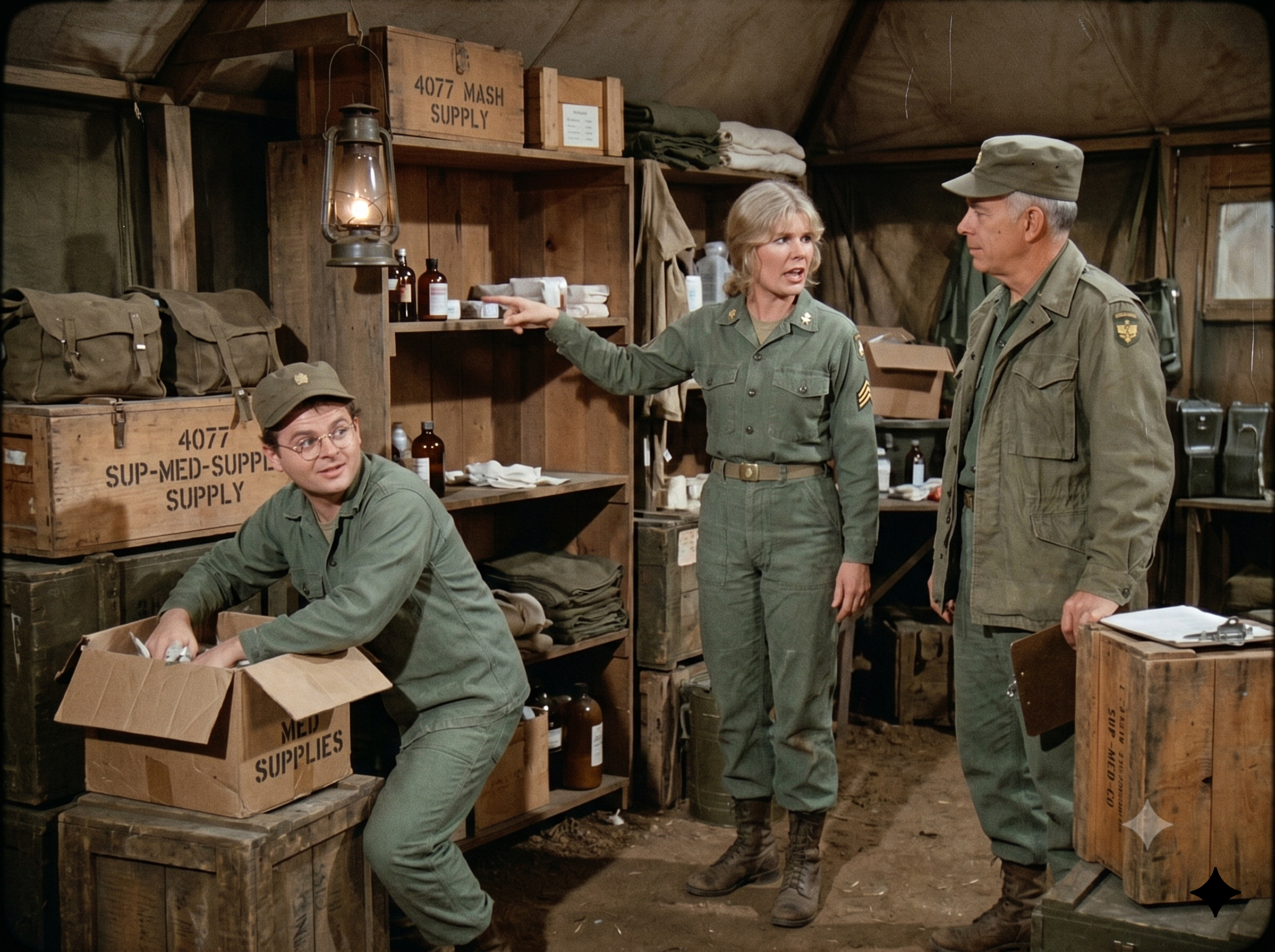
Tonight, the tent smelled of damp canvas, stale dust, and the sharp scent of old pine crates. A single practical lantern hung from a wooden post, casting a soft, yellow glow over stacks of faded cardboard and heavy canvas bags.
Major Margaret Houlihan stood in the center of the cluttered room, her posture rigid with professional outrage.
She was still wearing her green fatigues from the afternoon shift, her blonde hair pinned back, but her eyes were wide with a fierce, exhausted fire. She thrust her arm out, pointing a sharp, perfectly manicured finger at a completely bare wooden shelf.
“Empty, Colonel,” Margaret stated, her voice tight, echoing slightly in the drafty space. “Completely, utterly, and unacceptably empty.”
Colonel Sherman Potter stood a few feet away, holding a clipboard against his hip.
He didn’t flinch at her volume. He just watched her with the calm, seasoned control of an old cavalry man who had seen far worse things than a bare piece of pine wood. His worn green jacket hung loosely on his shoulders, a silent testament to the long hours they had all been keeping.
“I can see the wood grain, Major,” Potter said mildly, his voice a steady rumble beneath the hum of the camp generator outside. “My eyes might be old, but they still know the difference between a box of bandages and thin air.”
“This isn’t a joke, Colonel,” Margaret snapped, though her anger was laced with a desperate kind of pleading. “We have eighteen post-op patients in the ward. We are completely out of sterile dressing, and the surgical silk we received yesterday keeps snapping in my surgeons’ hands!”
She took a step closer to the shelf, her pride as the head nurse radiating from every tense muscle.
“I cannot—I will not—run a recovery ward with torn bedsheets and prayers,” Margaret declared, her voice cracking just a fraction. “My nurses deserve better. Our boys deserve better. I want I Corps on the phone right now.”
Down on the dirt floor, crouching beside a heavy wooden crate stenciled with ‘4077 MASH SUPPLY’, Corporal Radar O’Reilly was frantically digging through a cardboard box.
His glasses were slipping down his nose. He was tossing aside mislabeled pouches, faded paper forms, and useless rolls of twine, his hands moving with desperate speed.
“I’m looking, Major, I swear,” Radar mumbled defensively, his voice muffled by the cardboard flaps. “Sparky swore up and down on his mother’s prize-winning tomatoes that he slipped the surgical silk in with the powdered eggs.”
“Well, where is it, Corporal?” Margaret demanded, her patience entirely spent. “Did the powdered eggs eat the supplies?”
“No, ma’am, the powdered eggs don’t usually eat anything until they’ve been cooked,” Radar replied earnestly, not missing a beat as he kept digging.
Potter sighed, rubbing the back of his neck. “Take it easy, Margaret. The boy is looking. Yelling at the quartermaster corps over the phone won’t make a jeep materialize on the compound.”
“Then what are we supposed to do, sir?” Margaret asked, the anger finally giving way to the sheer, terrifying fatigue that haunted them all. “Tell the wounded to stop bleeding until Tuesday?”
Suddenly, the rustling from the cardboard box stopped.
Radar froze. He was crouched low, his shoulders tense under his green shirt. He didn’t stand up.
Slowly, carefully, Radar looked back over his left shoulder.
He peered up at Margaret and Colonel Potter, adjusting his round glasses with one dusty finger. His expression was a complicated mixture of nervous terror and a bright, shy, almost secret pride.
His hand was buried deep at the very bottom of the box, resting on something heavy.
Margaret held her breath, her pointing finger slowly dropping to her side. “Radar,” she whispered, the silence of the tent suddenly feeling very heavy. “What did you find?”
Radar swallowed hard, his Adam’s apple bobbing nervously.
“Well, ma’am,” Radar started, his voice squeaking slightly before he cleared his throat. “It’s… it’s not the standard Army issue 4-0 surgical silk.”
Margaret’s shoulders instantly slumped. The brief flash of hope vanished from her face, replaced by a devastating disappointment. She closed her eyes, bringing a hand up to pinch the bridge of her nose.
“Of course it isn’t,” she breathed, the fight finally draining out of her. “It’s probably a box of shoelaces. Or more toothbrushes. Lord knows we can perform a bowel resection with army-issue toothbrushes.”
“Now hold on, Margaret,” Potter said softly, stepping closer to the crouching clerk. He looked down at Radar with a fatherly curiosity. “Let’s see what you’ve got in the grab bag, son. Pull it out.”
Radar hesitated for a second, then slowly pulled his arm out of the depths of the cardboard box.
In his hands, he held a heavy, olive-drab metal tin. It didn’t have the standard Army Medical Corps markings. Instead, it bore a faded, stenciled anchor and a string of Navy serial numbers.
Radar stood up, dusting off his knees, and carefully offered the tin toward Margaret like a peace offering.
“It’s not Army issue,” Radar repeated quietly. “It’s Navy. High-tensile, waterproof surgical silk. The kind they use on the big hospital ships down in Inchon.”
Margaret just stared at the tin. She didn’t move.
“Navy?” Potter asked, his eyebrows shooting up toward the brim of his cap. He took a closer look at the tin, letting out a low, impressed whistle. “That’s top-tier brass material, Radar. The admirals hoard this stuff like it’s made of solid gold. How in the name of jumping Jupiter did a clerk in a dirt-floor MASH unit get his hands on Navy hospital supplies?”
Radar hugged the box of medical supplies slightly closer to his chest, looking down at his boots.
“Well, sir,” Radar mumbled, a faint blush creeping up his cheeks. “It turns out the supply sergeant down at the Inchon docks has a real weakness for grape Nehi. And… well, I might have traded him those extra jeep tires we didn’t need, which I got from the Marines in exchange for a dozen tins of the good creamed corn, which I got from…”
“Never mind the itinerary, son,” Potter interrupted with a gentle, dry chuckle, shaking his head in sheer amazement. “I shudder to think what you’d manage to acquire if this hospital ever needed a submarine.”
Margaret finally reached out. Her hands, usually so firm and commanding, trembled slightly as she took the heavy metal tin from Radar’s hands.
She popped the latch. Inside, neatly packed and beautifully sterile, were dozens of spools of the finest surgical silk money couldn’t buy. It was enough to get them through the week. It was enough to save lives.
The harsh lines around Margaret’s mouth softened. The fierce, demanding major melted away, leaving only the deeply caring, profoundly exhausted head nurse.
She looked up from the tin, her eyes glistening with unshed tears in the soft lantern light. She looked at Radar, really looked at him.
He was just a kid from Iowa. A farm boy who slept with a teddy bear and drank grape soda. Yet, time and time again, when the massive, indifferent machinery of the United States Army failed them, this boy held their broken little world together with paperclips, phone cords, and bartered goods.
“Corporal,” Margaret said, her voice dropping to a thick, tender whisper.
Radar braced himself, still expecting a reprimand for going outside of official channels. “I know it’s against regulations, Major, and I’m sorry, I just thought—”
“Walter,” Margaret interrupted softly, using his first name.
Radar blinked, looking up at her in surprise.
Margaret offered him a small, genuine smile that reached all the way to her tired eyes. “You did good. You did really, really good. Thank you.”
Radar’s face lit up with a brilliant, unmistakable pride. He stood a little taller, his chest puffing out beneath his wrinkled green shirt. “You’re welcome, Major Houlihan.”
Potter watched the exchange, a warm, quiet affection settling over his features. He tapped his clipboard against his leg, the tension of the evening completely broken.
“Alright,” Potter said, turning toward the door of the supply tent. “Let’s get this Navy silk over to the sterilization room before the admirals realize they’re missing it. Radar, you put the rest of that box away. And son?”
“Yes, sir?” Radar asked.
“Remind me to put a commendation in your file,” Potter smiled faintly. “Under ‘Creative Acquisitions’.”
“Yes, sir,” Radar beamed, turning back to the cardboard box with renewed energy.
Margaret clutched the tin of silk to her chest like a newborn child. She followed Colonel Potter out of the drafty tent, stepping back out into the cold Korean night.
As the canvas flap fell shut behind them, the supply tent was quiet again. The lantern flickered, casting soft light over the worn crates, the folded blankets, and the dusty floor.
It was a miserable place to fight a war. But standing there in the cold, holding a traded tin of thread that would mend the broken boys in the morning, Margaret knew there was no other place on earth she would rather be, and no other people she would rather be standing with.
In a place where everything was meant to be temporary and disposable, the only things that truly held the 4077th together were the people.