The Toledo Loaf and the Grace of the 4077th
The mess tent of the 4077th Mobile Army Surgical Hospital always smelled of damp canvas, stale coffee, and the lingering regret of a thousand terrible meals.
It was a bleak Tuesday morning, the air still biting with the damp chill of a Korean autumn. The camp had just staggered out of a grueling forty-eight-hour session in the operating room. Everyone was moving with the slow, underwater grace of the utterly exhausted.
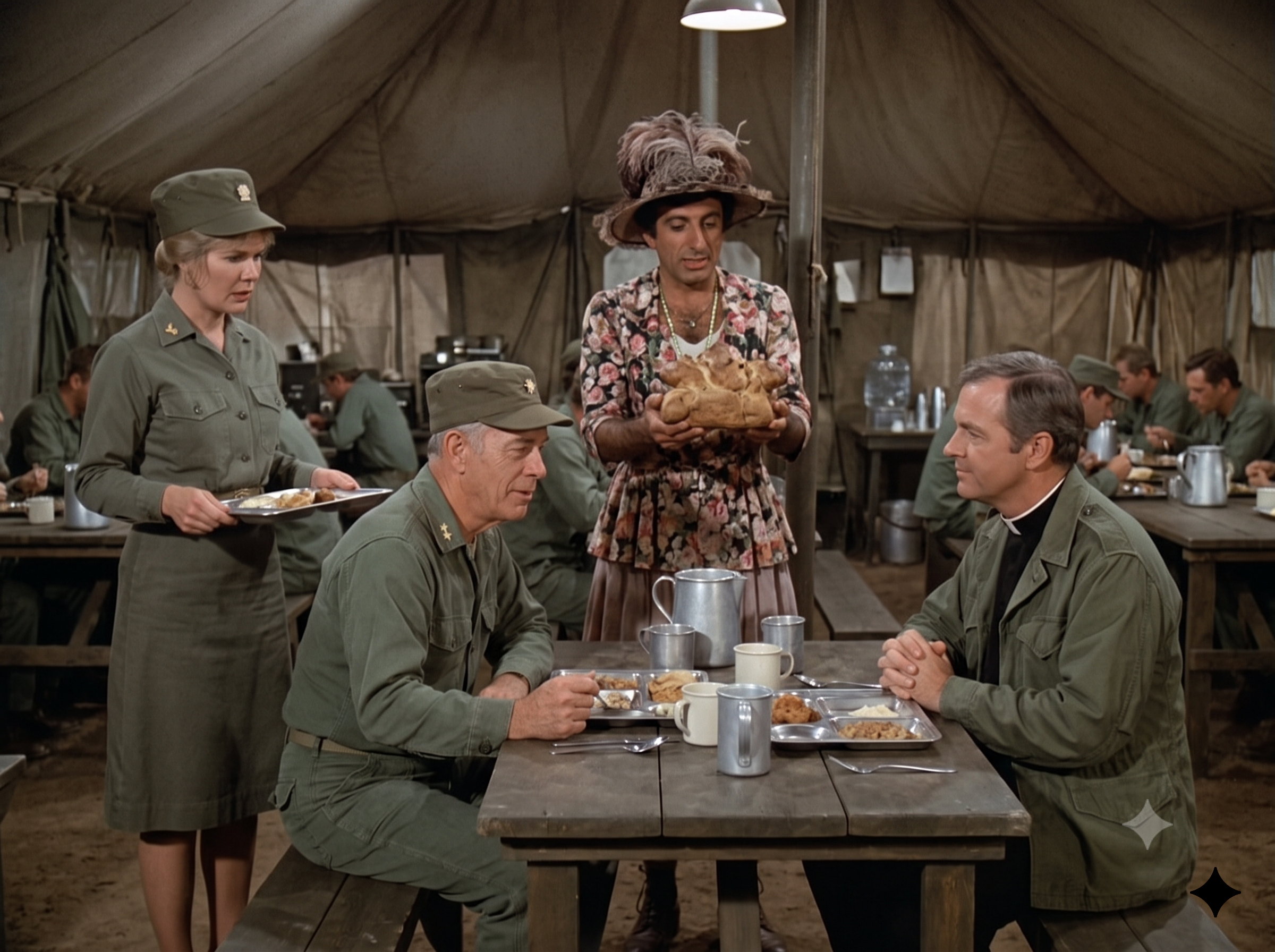
Major Margaret Houlihan stood near the center tables, her posture as straight and unyielding as a flagpole. She was clutching a dull metal tray. On that tray sat a scoop of something gray, lumpy, and entirely unidentifiable.
Margaret stared down at the food, her jaw tight. She was a woman who prided herself on military discipline, on maintaining standards in a place that constantly tried to strip them away. But looking at her breakfast, her composed exterior masked a deeply tired, controlled frustration. It was just one indignity too many.
Sitting at the wooden table in front of her was Colonel Sherman T. Potter. He was leaning slightly forward, his elbows resting on the rough timber. He wore his standard olive drab fatigues, the fabric soft from countless washes in muddy water.
Beside him sat Father John Mulcahy, the spiritual anchor of the unit. The priest sat quietly, his hands folded neatly on the table before him. He was a portrait of serenity amidst the clatter of tin cups and weary complaints, always trying to find a glimmer of grace in the grinding machinery of war.
The low hum of the mess tent was suddenly interrupted by a rustle of fabric that decidedly did not belong to the United States Army.
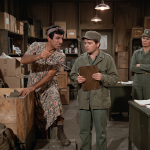
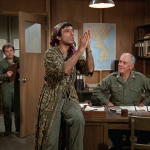
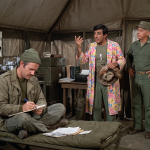
Corporal Maxwell Q. Klinger made his entrance. He wasn’t wearing his standard fatigues. Instead, he was dressed in a dark, busy, floral-patterned dress. Around his neck hung a thick gold-colored chain, and perched proudly atop his head was an extravagant, wide-brimmed hat adorned with large, dusty ostrich feathers.
But it wasn’t the outfit that commanded the room’s attention. It was what Klinger was holding in his hands.
He carried it like a crown jewel. He presented it with a theatrical flourish, stepping right up to Colonel Potter’s table.
It was, ostensibly, a loaf of bread.
However, it looked more like a twisted, knotted geological anomaly. It was strangely shaped, bulging awkwardly in random places, boasting a thick, hardened, golden-brown crust that seemed entirely impenetrable.
“Gentlemen,” Klinger announced, his voice carrying the grand, dramatic timber of a Broadway star on opening night. “And Major. I present to you a miracle. A genuine, authentic, homemade loaf of Toledo sourdough.”
Margaret closed her eyes for a brief second, tightening her grip on her metal tray. “Klinger,” she sighed, her voice tight. “We have just spent two days putting young men back together. I do not have the patience for a floor show.”
Colonel Potter didn’t yell. He didn’t order Klinger to change. He simply looked up at the corporal, leaning in closer to examine the strange object. A look of dry, fatherly exasperation washed over his weathered face, mingled with a reluctant, quiet amusement.
“Son,” Potter said slowly, his Missouri drawl thick in the morning air. “I have seen a lot of things in my time. I’ve seen artillery shells shaped like milk jugs. I’ve seen mules try to eat jeeps. But what in the name of Marco Polo’s trousers is that?”
“It’s bread, Colonel!” Klinger said, his theatrical pride slipping just an inch to reveal a desperate, earnest plea. “Real bread. Baked with my own two hands, in the ovens of the 4077th.”
Father Mulcahy leaned forward slightly, his eyes wide with gentle, sincere misunderstanding. He looked at the loaf, then up at Klinger’s feathered hat, trying to connect the visual dots. “It has a very… robust architecture, Corporal. It almost resembles the stone they rolled away from the tomb.”
“It’s a rustic crust, Father,” Klinger defended, holding it higher.
He set the heavy loaf down on the wooden table. It landed with a dull, heavy thud that sounded entirely un-bread-like.
The theatricality suddenly drained out of Klinger’s face. The funny, scheming corporal from Toledo faded away, leaving behind just a tired, homesick young man thousands of miles from the world he knew.
“I just wanted us to have something real,” Klinger said quietly, the desperation clear in his voice. “Something that didn’t come out of a tin can. Something that didn’t taste like the war. Please, Colonel. Do the honors. Break the bread.”
The mess tent grew unnervingly quiet. Margaret stopped glaring at her tray. Mulcahy unclasped his hands.
Potter looked at the boy in the dress. He saw the profound ache of homesickness hiding beneath the ostrich feathers. Slowly, respectfully, Potter picked up a dull metal mess knife. He gripped it firmly, placed the blade against the top of the bizarre, misshapen loaf, and pressed down.
The blade didn’t even scratch the surface.
Potter narrowed his eyes. He pressed harder, putting his shoulder into it. The metal knife began to bow outward, curving under the immense pressure, bending dangerously against the impenetrable crust of the Toledo loaf.
Everyone in the tent held their breath, waiting for the metal to snap.
With a loud, metallic twang, the mess knife slipped off the hardened crust and clattered loudly against the wooden table.
Colonel Potter slowly sat back in his chair. He looked at the bent knife, then down at the undisturbed, triumphant loaf of bread, and finally up at Klinger.
Klinger’s face had fallen completely. The proud, theatrical baker was gone, replaced by a devastating look of defeat. His shoulders slumped beneath the floral fabric of his dress.
“I tried,” Klinger whispered, his voice cracking slightly. “I traded three pairs of nylons to a supply sergeant in Seoul for real flour. I tried to remember how my mother did it on Sunday mornings. I thought… I thought I could bring a little piece of home to this godforsaken dirt patch.”
Margaret, still standing with her tray, felt a sudden lump form in her throat. Her rigid, military posture softened instantly. The frustration that had been radiating from her just moments before melted into a quiet, profound tenderness.
She knew that feeling. The desperate, clawing need to hold onto something civilized, something normal, before the war washed it all away.
She set her metal tray down on the table, ignoring the gray slop entirely. She stepped closer to Klinger.
“It’s the altitude, Klinger,” Margaret said softly, her voice remarkably gentle. “And the dampness in the air. Baking is an exact science. It’s nearly impossible to get yeast to proof properly in a drafty canvas tent. You didn’t do anything wrong.”
Klinger looked at her, his dark eyes wide with surprise at her unexpected kindness. “You think so, Major?”
“I know so,” she lied smoothly, offering him a small, reassuring nod.
Colonel Potter cleared his throat. He wasn’t about to let this boy’s spirit break over a piece of overcooked dough.
“Major Houlihan is absolutely right,” Potter said, his voice taking on that steady, fatherly tone that made the entire camp feel safe. “But I’ll be damned if I’m going to let a little tough crust stand between me and a piece of authentic Toledo sourdough.”
Potter tossed the bent knife aside. He stood up from his chair.
“Padre,” Potter said, looking across the table. “I believe this situation requires a bit of divine intervention. Lend me a hand.”
Father Mulcahy smiled warmly. “I would be honored, Colonel. It is, after all, an ancient and sacred tradition to break bread together.”
Mulcahy stood up. He and Potter both grabbed a side of the strangely shaped loaf.
“On three,” Potter instructed. “One. Two. Three.”
Both men pulled with all their might. For a second, the loaf resisted, proving its structural superiority. But then, with a sound like a dry tree branch snapping in a winter storm, the loaf fractured perfectly down the middle.
A puff of steam rose from the center. And suddenly, miraculously, the unmistakable, warm, yeasty smell of fresh baked bread wafted into the damp air of the mess tent.
It wasn’t perfect. It was dense, uneven, and slightly gray in the middle. But it smelled like a kitchen. It smelled like home.
Klinger gasped, his hands flying up to his feathered hat in pure joy. “It worked! It actually worked!”
Potter tore off a small, jagged chunk of the bread. He looked at it for a moment, then placed it in his mouth and began to chew.
It was a culinary disaster. It took immense jaw strength to break down the dough, and it tasted faintly of canvas and burnt matches. But Colonel Sherman T. Potter didn’t even flinch. He chewed steadily, swallowed hard, and looked Klinger right in the eye.
“Son,” Potter said, his eyes crinkling at the corners with deep, genuine affection. “That is without a doubt the finest piece of bread I have had in all of Korea.”
Mulcahy took a piece next. He chewed politely, his gentle eyes watering slightly from the sheer physical effort required to process the food.
“A truly robust vintage, Corporal,” Mulcahy managed to say, offering a sincere, bright smile. “Full of character. Full of heart. Thank you.”
Margaret reached out. She bypassed her tray entirely, her manicured fingers snapping off a tiny crumb of the Toledo sourdough. She placed it on her tongue. She tasted the disaster of the recipe, but more importantly, she tasted the love and the desperation that had gone into making it.
A tiny, beautiful smile broke across Margaret’s face. It was a smile she rarely showed, reserved only for the moments when the armor slipped and she allowed herself to love these impossible people.
“It’s wonderful, Maxwell,” she said softly.
Klinger beamed. He stood taller, his dignity fully restored, his floral dress suddenly looking less like a gag and more like the proud uniform of a hometown baker. He picked up one half of the heavy loaf and began to walk down the line of tables, offering a piece of home to anyone who wanted to break their teeth on it.
Potter sat back down, watching the corporal work the room. He picked up his tin mug of terrible coffee and took a sip to wash down the brick resting in his stomach.
He glanced over at Mulcahy, who was discreetly rubbing his jaw. They shared a quiet, knowing look.
They were thousands of miles from anything that made sense. They were surrounded by mud, blood, and the endless fatigue of a forgotten war. But in that small, canvas-covered room, sharing a terrible loaf of bread baked by a boy in a feathered hat, they had found something deeply, profoundly sacred.
They had found each other. And for a few quiet moments before the choppers returned, that was enough to keep the cold away.
It was never about the food they were served, but the love they managed to share in the shadows of the 4077th.