The Best Medicine at Rosie’s
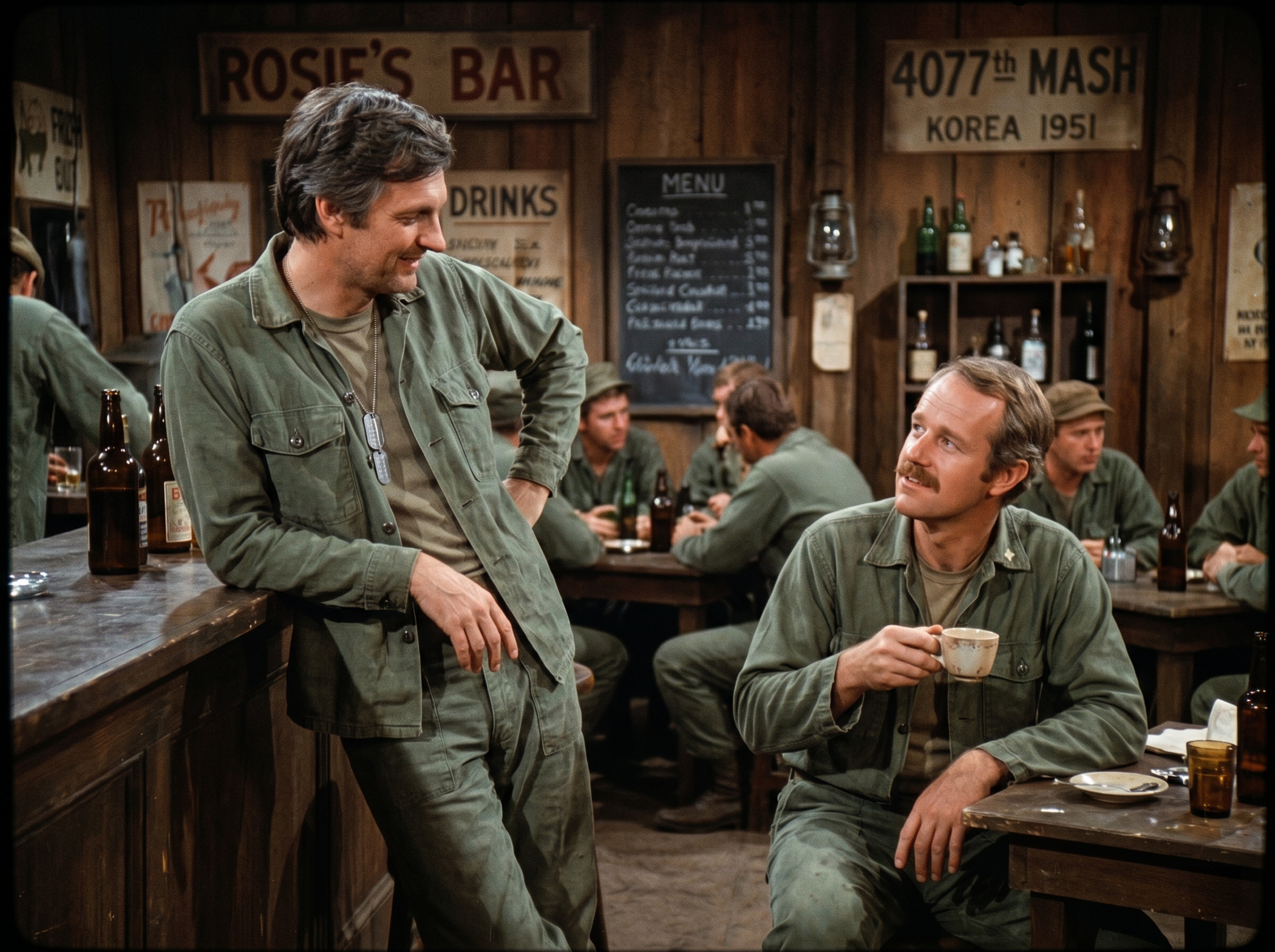
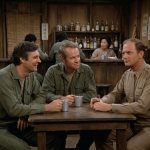
Rosie’s Bar always smelled like a potent blend of cheap local gin, stale cigar smoke, floor wax, and desperate optimism.
It was a sanctuary built out of rough wood, corrugated tin, and sheer human willpower.
Tonight, the air inside the small, rustic room was thick with the weary murmur of the 4077th trying to forget the last three days.
In the background, a faded wooden sign proudly declared “4077th MASH KOREA 1951,” a constant, mocking reminder of exactly where they were and when they were stuck there.
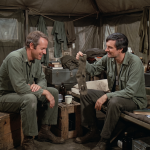
Hawkeye Pierce was leaning heavily against the scarred wooden bar, his long frame draped casually as if he had nowhere else in the world to be.
His olive-drab fatigues were deeply wrinkled, carrying the invisible dust of the motor pool and the lingering, sharp scent of surgical soap.
His metal dog tags dangled loosely outside his undershirt, catching the dim, warm amber light radiating from the lanterns overhead.
He was turning slightly toward B.J., a quick, teasing smile playing on his lips, his eyes expressive and bright.
Almost too bright.
“I’m telling you, Beej,” Hawkeye said, his voice a smooth, rapid cadence of practiced charm. “If we just pool our monthly scrip and promise him my firstborn, we can bribe that supply sergeant down in Seoul.”
B.J. Hunnicutt sat comfortably at a small wooden table just a few feet away from the bar.
He was holding a small ceramic cup in both hands, letting the meager heat of the liquid seep into his tired, scrubbed-raw fingers.
He didn’t say anything at first. He just looked up at his friend.
B.J.’s eyes held a mixture of dry amusement and deep, thoughtful concern.
He knew that rapid-fire banter. He knew the specific, charismatic slouch of Hawkeye’s shoulders.
It was the posture of a man who was running purely on nervous energy, caffeine, and absolute denial.
They had just walked out of a marathon session in the OR. Thirty-two straight hours of meatball surgery, patching up farm boys under hot, unforgiving lights.
The blood was finally washed from their hands, but the memories were still stained right behind their eyelids.
“An ice cream machine,” B.J. repeated slowly, his voice calm, grounded, and steady through his thick mustache.
“Vanilla, chocolate, maybe strawberry if we can find a local cow that eats exclusively red berries,” Hawkeye rattled on, flashing that famous grin.
He gestured wildly with one hand, almost knocking over a stray bottle on the counter. “Think of it, Beej. We could open a parlor right in the middle of the Swamp. Charge admission. We’d be rich.”
But the smile didn’t quite reach Hawkeye’s tired eyes. His hand, gripping the edge of the bar, was white-knuckled.
The background noise of Rosie’s seemed to fade into a dull, echoing hum around them.
Hawkeye took a shallow breath, preparing to launch into another wild tangent about convincing Klinger to churn the ice cream in a velvet evening gown.
Before he could speak the words, B.J. gently set his ceramic cup down on the wooden table with a soft, definitive clink.
The quiet sound cut through Hawkeye’s manic, desperate energy like a surgical blade.
B.J. leaned forward in his simple wooden chair, the quiet amusement fading into something much sharper and much heavier.
“Hawk,” B.J. said quietly, his voice cutting cleanly through the smoky, faded beige atmosphere. “Who exactly are you trying to convince?”
Hawkeye froze mid-sentence, the teasing smile suddenly dying on his lips, leaving only the hollow, aching exhaustion underneath.
The silence between them felt infinitely louder than the low chatter of the enlisted men drinking in the shadowy corners of the bar.
Hawkeye stared down at B.J., his jaw tightening slightly.
For a fleeting second, it looked like he was going to deflect again. He opened his mouth, a sharp, sarcastic remark undoubtedly locked and loaded on his tongue.
But looking down at his friend—seeing the steady, unflinching warmth and quiet understanding in B.J.’s eyes—the fight just drained right out of him.
The performance was over. The curtain came down.
Hawkeye’s shoulders slumped. The charismatic, effortless lean against the bar turned into the heavy, broken slouch of a man carrying far too much weight on his back.
He looked away, his gaze wandering aimlessly over the faded menus and worn wooden textures of Rosie’s walls.
“That kid from Toledo,” Hawkeye said softly, his voice barely above a raspy whisper.
He didn’t need to explain further. He didn’t need to describe the wounds.
B.J. knew exactly who he meant. The young, freckled corporal with the bright red hair and the pocket full of creased baseball cards.
They had worked on him side-by-side for three grueling hours. They had pulled off a miracle. And then the miracle had failed.
“He asked me if I thought the Mud Hens would win the pennant this year,” Hawkeye continued, staring hard at the grain of the wood on the bar, refusing to blink. “While I was clamping his artery, he was worried about minor league baseball standings, Beej.”
B.J. didn’t interrupt. He picked up his cup again, letting the rough ceramic warm his palms.
“You gave him a fighting chance, Hawk,” B.J. said softly, his tone completely free of judgment. “You did everything you could. We all did.”
“Everything isn’t always enough in this place,” Hawkeye replied bitterly, the anger flaring up just for a second before fading into total weariness.
He finally turned his head back to look at B.J.
The soft, practical lighting caught the deep, bruised lines of fatigue under Hawkeye’s expressive eyes.
He looked ten years older than he had that morning. They all did. The war was stealing their youth one bloody triage session at a time.
B.J. didn’t offer any empty platitudes. He didn’t tell Hawkeye it was going to be fine, or that the kid was in a better place.
He just sat there, a grounded, steady presence in a world that felt like it was constantly spinning out of control and covered in mud.
“No,” B.J. agreed quietly, honoring his friend’s pain with the simple truth. “Sometimes it isn’t enough.”
He nudged the empty, rickety wooden chair across from him with the toe of his boot. It scraped softly against the dusty floorboards.
“Sit down, Hawk,” B.J. said gently. “Before you fall down.”
Hawkeye hesitated for a fraction of a second, clinging to his stubborn pride.
Then, slowly, he pushed off the wooden bar. His knees actually popped as he sank heavily into the simple chair.
He let out a long, ragged, shuddering breath, resting his elbows on the table and burying his face in his hands for just a moment.
B.J. didn’t push him to talk. He just let his friend have the rare gift of silence.
In a crowded, chaotic camp where privacy was entirely nonexistent, these quiet moments of shared grief were the closest thing they had to a church.
They sat together as the loose, weary atmosphere of Rosie’s Bar swirled around them like a protective blanket.
The clinking of glass bottles. The low, tired laughter of the G.I.s in the corner. The distant, heavy rumble of a jeep shifting gears on the dirt road outside the compound.
It was a weary, bittersweet symphony of human survival.
After a few long minutes, Hawkeye slowly lifted his head, smoothing his messy hair back from his forehead.
He rubbed his eyes with the heels of his hands and let out a dry, humorless chuckle that sounded a little more like the old Hawkeye.
“What’s in that cup, anyway?” Hawkeye asked, nodding his chin toward B.J.’s hands.
B.J. looked down at the dark, sludgy, mysterious liquid inside the ceramic mug.
“I asked Rosie for a cup of coffee,” B.J. replied deadpan, not missing a beat. “But judging by the texture, I think she boiled a surplus combat boot and added a dash of profound despair.”
The faintest ghost of a real, genuine smile finally tugged at the corner of Hawkeye’s mouth.
“Well,” Hawkeye said softly, leaning his arms on the table. “At least it’s warm.”
“Yeah,” B.J. agreed, taking a brave, cautious sip of the terrible brew and wincing slightly. “It’s warm.”
Hawkeye leaned back in his chair, the manic, desperate energy finally replaced by a quiet, shared, manageable exhaustion.
The brutal war was still waiting for them right outside those flimsy wooden doors.
Tomorrow, there would undoubtedly be more choppers, more wounded boys from places like Toledo, and more impossible odds to beat.
But right now, in the dim, amber light of this rundown, beautiful little bar, they weren’t alone.
They had a few terrible drinks, a few worn-out chairs, and the quiet, steady loyalty of a friend who understood the silence just as well as the jokes.
They couldn’t save the whole world, but in the quiet corners of the 4077th, they could at least save each other.