The Compass Pointing Home
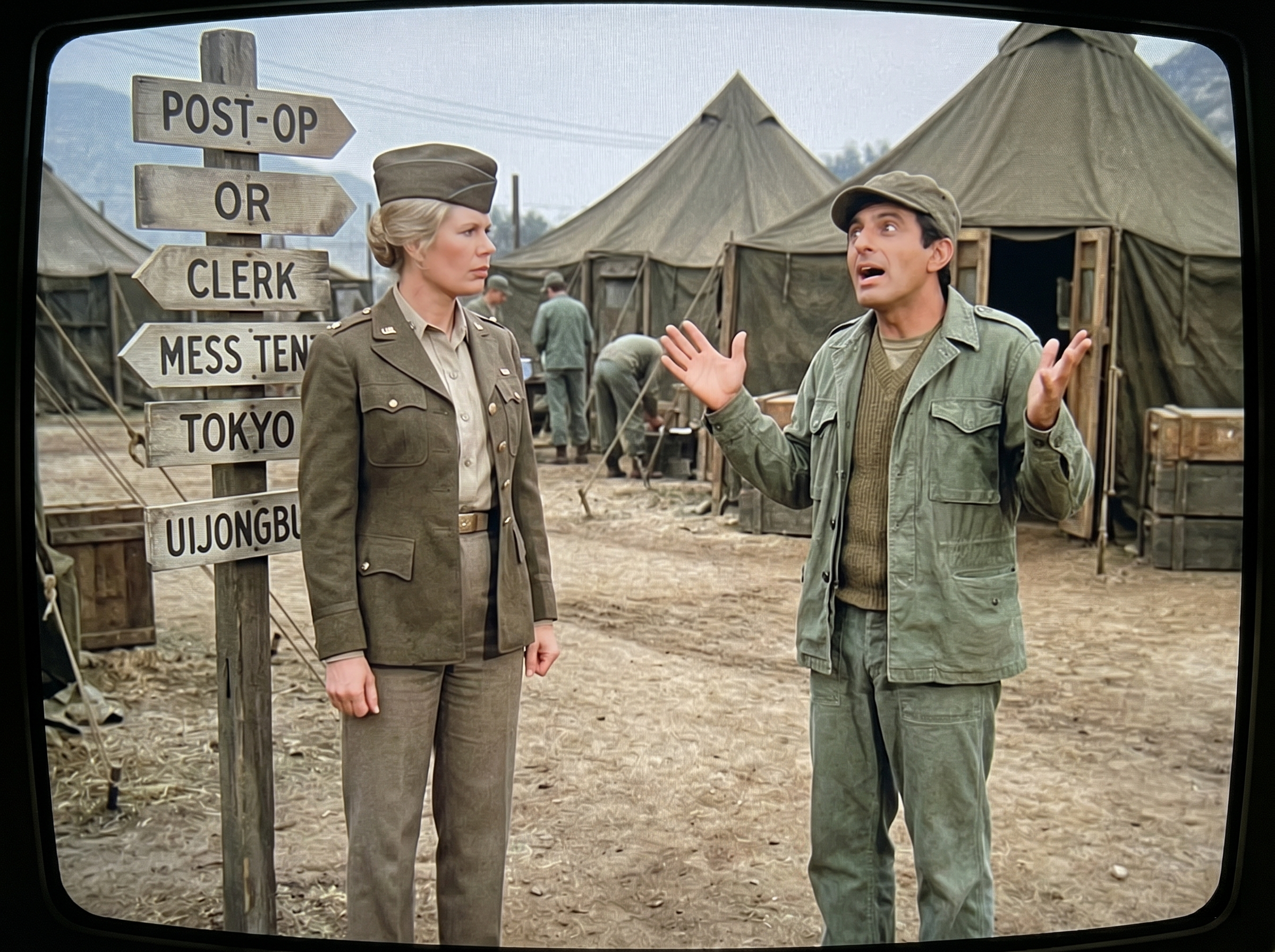
The mud of Uijeongbu had a way of clinging to your soul just as tightly as it clung to your boots.
It was one of those afternoons where the Korean sky hung heavy and gray, and the silence of the 4077th felt louder than the usual roar of the choppers.
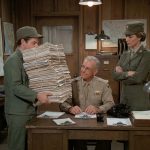
Major Margaret Houlihan stood by the signpost, her posture as sharp and pressed as the creases in her uniform. She looked like she was trying to hold the entire camp together through sheer force of will alone.
Across from her, Corporal Max Klinger was mid-gesture, his hands spread wide, his face contorted into an expression of theatrical exasperation. He looked like a man explaining the secrets of the universe to someone who had already decided not to believe him.
“Major, I’m telling you,” Klinger implored, his voice echoing slightly against the canvas tents. “It’s not just a sign. It’s a map of our collective sanity! If I follow that arrow, I’m in Tokyo. If I stay here, I’m in… well, I’m in this.”
Margaret didn’t blink. Her jaw was set, her eyes tracking him with that familiar, weary intensity that usually signaled a lecture was imminent.
“Klinger,” she said, her voice dropping into that low, dangerous register that could make a seasoned surgeon stop mid-suture. “I don’t care if that arrow points to the pearly gates or the bottom of the ocean. You are currently scheduled for supply duty, not philosophy.”
Klinger threw his head back toward the heavens, his hands still grasping at the air as if he were trying to catch the very patience he was losing.
“Duty! It’s always duty!” he cried, his voice cracking with just the right amount of dramatic flair. “I just want one day where the only thing I have to worry about is whether or not I’m wearing the right hat for the climate!”
Margaret stepped forward, closing the distance between them, her shadow stretching long across the packed earth. She looked tired—not just the kind of tired that sleep fixes, but the deep, bone-weary exhaustion of someone who had spent too many nights holding lives together with nothing but needle, thread, and grit.
“Do you really think any of us want to be here, Max?” she asked, her voice softening just a fraction, a crack in the armor.
Klinger froze, his hands dropping to his sides. He looked at her then, really looked at her, and the theatrical mask slipped away to reveal something far more raw and honest.
“I just…” Klinger started, then stopped, his throat tightening. “I just don’t know if I can hold it together much longer, Major.”
The silence that followed was heavy, filled only by the distant, rhythmic thud of a jeep engine turning over nearby.
Margaret saw it then—the glimmer of genuine fear beneath Klinger’s colorful fabric and eccentric schemes. It wasn’t about the dress, or the discharge, or the insanity of the war. It was the simple, terrifying realization that they were all just hanging on by a thread, and that thread was beginning to fray.
She let out a long, slow breath, and the rigidity in her shoulders finally gave way. She didn’t march him to the supply tent. She didn’t bark an order. Instead, she leaned against the wooden post, right beside the sign that pointed to places they all dreamed of but couldn’t quite touch.
“My father used to say that when the world turns upside down, you stop trying to fix the horizon and you start focusing on the person standing right in front of you,” Margaret said softly.
Klinger looked at the signpost, then back to Margaret. He didn’t have a comeback. He didn’t have a joke. For the first time all day, he just looked like a kid lost a long, long way from Toledo.
“I’m tired, Margaret,” he admitted, his voice barely a whisper.
“I know,” she replied. “We all are.”
She reached out, a rare, uncalculated movement, and briefly rested a hand on his shoulder. It wasn’t a military gesture. It was human. It was the touch of two people who had seen too much, done too much, and somehow managed to remain standing in the middle of a war that seemed determined to break them.
Klinger looked at her hand, then up at her face. The lines of fatigue around her eyes seemed to soften, and for a moment, the madness of the 4077th faded into the background. There was no Major and no Corporal, no nurses and no orderlies, no war and no politics.
There was just the wind whistling through the tent flaps and the shared, quiet understanding that they were family—the kind of family that only forms when you have no one else to lean on.
“I’ll tell you what,” Margaret said, pulling her hand back and regaining her composure, though her eyes remained kind. “You go finish that inventory. And when you’re done, I’ll find a way to make sure there’s a real cup of coffee waiting for you in the mess tent. Not that sludge they usually serve.”
Klinger cracked a small, genuine smile—the first one he’d worn all morning. It wasn’t his usual grin, but something quieter, something real.
“A real cup, Major? That might be worth the walk.”
“Don’t push your luck, Klinger,” she said, turning back toward her own tent.
As she walked away, Klinger stayed by the post for a heartbeat longer. He looked at the arrow pointing toward Tokyo, then down at the dust at his feet. He took a deep breath, adjusted his cap, and turned toward his work.
The war wasn’t over, and the signpost was still just a piece of painted wood pointing to places that felt like fairy tales. But as the sun began to dip behind the Korean hills, the camp felt a little less like a prison and a little more like home.
It was just another day at the 4077th, where the laughter was a shield, the tears were a secret, and the only thing that really mattered was that we were all still here, together.
Sometimes, the bravest thing you can do is just show up for one another.