The Longest Mile of Ink and Ribbon
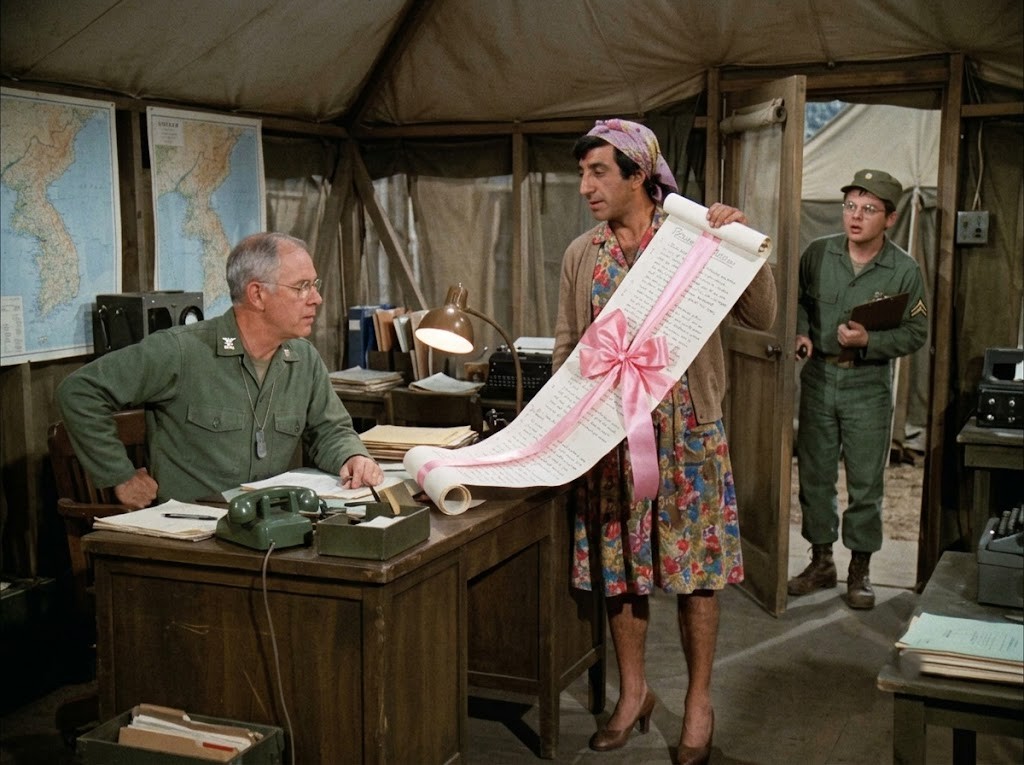
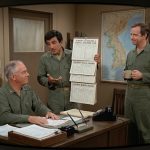
The air in Colonel Potter’s office was thick with the usual cocktail of damp canvas, stale tobacco, and the impending sense of another long night in Korea.
It was meant to be a quiet afternoon for the Colonel, a brief sanctuary of paperwork and reflection behind his trusty desk.
But quiet, as the 4077th had learned, was a commodity that simply didn’t exist in the middle of a war.
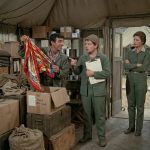
The door creaked open, and in strode Corporal Klinger, looking as if he’d raided a mid-century boutique and decided on a floral-print ensemble complete with a matching headscarf and heels that would have made a runway model nervous.
He wasn’t alone, though.
In his grip, he held a scroll of paper so absurdly long that it curled onto the floor, looped back up, and seemed to have its own gravitational pull.
Adorned with a massive, impossibly pink satin bow, it looked like a Valentine’s Day card that had been stretched across several zip codes.
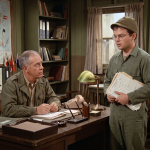
Radar stood in the doorway, clutching his clipboard like a shield, his mouth slightly agape as he witnessed the sheer scale of the display.
Colonel Potter looked up, his spectacles perched on the edge of his nose, his expression caught somewhere between deep military stoicism and the sudden realization that he might need a stiff drink.
Klinger held the scroll aloft with the pride of a medieval herald presenting a king’s decree.
“Sir,” Klinger announced, his voice carrying that familiar mix of desperation and theatrical flair. “This is a petition from my Aunt Bernice, her bridge club, three local bakeries in Toledo, and a confused stray dog I found behind the supply tent. It’s a formal request for my immediate discharge, based on grounds of ‘excessive cuteness’ and my urgent need to return to civilian hemlines.”
Potter stared at the scroll, then at Klinger, then back at the scroll, the silence in the room stretching until it felt like a rubber band pulled to its absolute limit.
The Colonel slowly stood up, his chair scraping against the wooden floor, and reached for the edge of the paper as if he were touching a live wire.
He didn’t scold, he didn’t yell; he just looked at the sheer, ridiculous effort of it all.
“Klinger,” Potter sighed, his voice raspy with the weariness of a man who had seen everything but was still being surprised by the details. “If I read this, I’m going to be here until the next millennium. Tell me, does it end anywhere, or is this a mobius strip of bureaucratic insanity?”
Klinger leaned in, eyes wide and brimming with a manic sort of hope, while Radar watched the Colonel’s hand tremor just slightly as he began to unroll the first three inches of the document.
The tension in the tent was palpable—it was a battle of wills, between the rigid demands of the Army and the sheer, unstoppable absurdity of one man just trying to go home.
Colonel Potter didn’t finish unrolling the scroll.
Instead, he let it fall, the paper cascading down like a waterfall of ink and grievance that pooled around Klinger’s heels.
“Corporal,” Potter said, leaning back and resting his hands on his belt buckle. “I don’t need to read the fine print to know that your Aunt Bernice has a very distinct, very loud, and very floral handwriting style.”
Klinger’s shoulders slumped, just a fraction.
The theatricality didn’t vanish, but it softened, revealing the tired, earnest young man underneath the layers of lace and ribbon.
“Sir, she really is quite insistent,” Klinger said, his voice dropping from a performance to a plea. “She says the neighbors are starting to talk about why I’m still wearing dresses in the middle of a conflict.”
Radar stepped into the room, finally finding his voice, his eyes darting between the Colonel and the ridiculous pink bow that seemed to glow against the drab, olive-drab surroundings.
“Sir, if it helps,” Radar chirped, “I checked the humidity levels. The ink on that scroll is actually starting to run. If we don’t file it, or at least acknowledge it, he’s probably going to try to rewrite it on something even larger. Like a tent flap.”
Potter looked at Radar, then at Klinger, who was now carefully smoothing out the pink ribbon with a touch of genuine tenderness.
It was the classic dance of the 4077th—a moment of utter absurdity masking the very real, very heavy desire to just be somewhere else, anywhere else, far away from the sounds of distant artillery.
“Klinger,” Potter said, his tone shifting into that rare, quiet cadence he reserved for when the fatherly side of him took the lead. “You’ve got a lot of spirit. You’ve got a lot of fight. And clearly, you’ve got a lot of people back home who are just as stubborn as you are.”
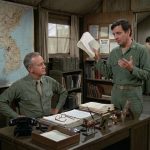
He gestured to the desk, covered in maps of the front lines—maps that meant life and death, and yet here they were, interrupted by a pink bow.
“Leave it,” the Colonel commanded, though there was no heat in it. “I’ll look at it when I’m done with the morning reports. But take that bow off. It’s making the maps nervous.”
Klinger beamed, a small, genuine smile breaking through his elaborate makeup.
He reached up, untied the oversized pink knot with a flourish, and tucked it into his pocket like a medal of honor.
Radar let out a breath he’d been holding, the tension in the room evaporating as quickly as the Korean morning mist.
As Klinger turned to leave, the scroll trailing behind him like a train, Potter watched them go, the sight of the floral dress disappearing into the bright, harsh light of the doorway.
He sat back down, picked up his pen, and looked at his maps again.
The war was still there, the fatigue was still etched into the lines of his face, and the future was as uncertain as ever.
But for one moment, in a canvas tent thousands of miles from home, they had managed to trade a bit of the darkness for something colorful, ridiculous, and undeniably human.
It wasn’t a discharge, and it wouldn’t end the war, but it was a reminder that even here, beneath the weight of everything else, you could still find room for a little bit of nonsense, and a whole lot of heart.
In a place where nothing made sense, sometimes the most important thing you could do was make sure you didn’t lose your sense of humor.