The Paperwork of Peace
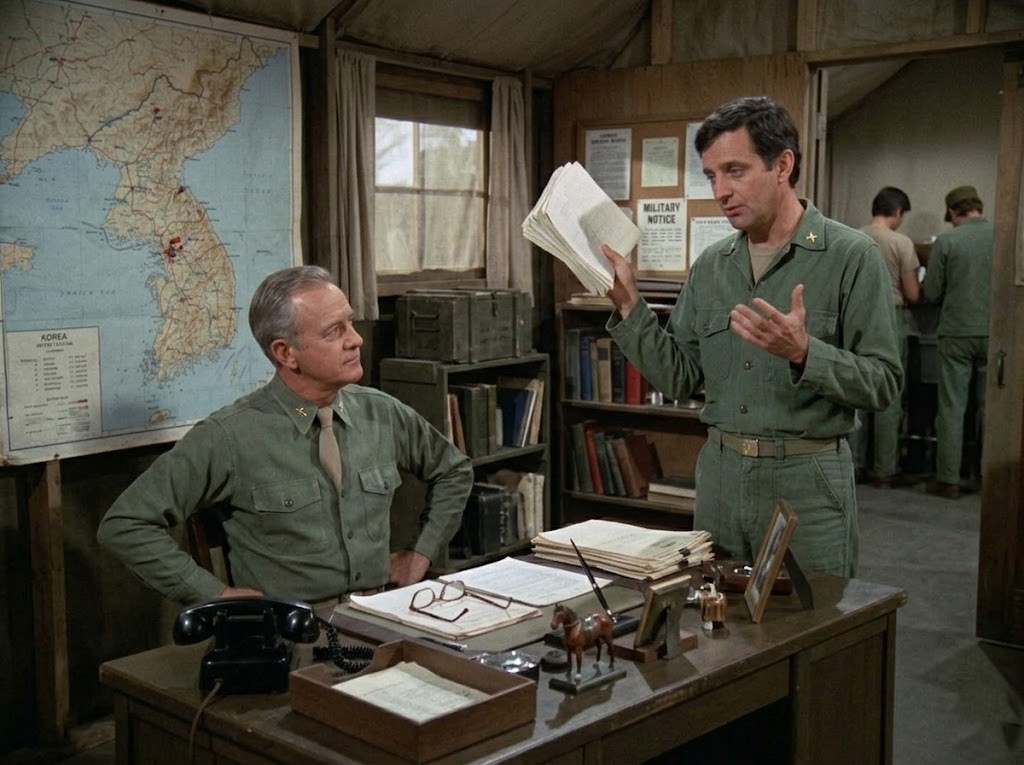
The afternoon sun was doing its best to turn Colonel Potter’s office into a kiln. Outside, the sounds of the 4077th hummed with that familiar, frantic vibration—jeeps idling, distant chopper blades, and the constant, rhythmic clatter of life trying to exist in the middle of a nightmare.
Inside, the air was thick with the scent of old paper, stale coffee, and the weary, unspoken exhaustion that defined their lives.
Colonel Potter sat behind his desk, his posture a stiff, familiar portrait of military stoicism, though his eyes held the soft, tired sag of a man who had seen too many sunsets over a place he never asked to be. Across from him, Hawkeye Pierce stood, his hands gesturing wildly, holding a stack of forms so thick they looked less like requisitions and more like a desperate, printed plea for sanity.
“Colonel, I’m not asking for a miracle,” Hawkeye said, his voice dancing on the thin line between sharp wit and raw, fraying nerves. “I’m asking for a stapler, some decent gauze, and perhaps, if the Army is feeling particularly generous, a moment where I don’t feel like I’m trying to hold the world together with a piece of chewing gum and a prayer.”
Potter didn’t even blink. He just stared at the papers, then slowly up at Hawkeye, his expression a masterpiece of weary patience. “Pierce, if I signed every piece of paper you shoved in my face, we’d be running a hospital by telepathy by Tuesday.”
Hawkeye took a breath, his shoulders dropping, his gaze momentarily losing its defensive sparkle. He looked at the stack of forms, then at the Colonel, and the room suddenly felt smaller, the silence louder than the war outside.
“It’s not just the supplies, sir,” Hawkeye whispered, his voice cracking just enough to let the truth slip out. “I just… I don’t think I have another shift in me if I have to fill out another one of these forms just to justify saving a life.”
Potter felt that familiar, heavy ache in his chest—the one that had nothing to do with age and everything to do with the kids in his care. He looked at the man standing before him, a man who masked his terror with jokes because, without them, the grief would be too vast to navigate.
The Colonel sighed, a sound that started in the soles of his boots and ended in a weary exhale. He reached out, his hand—rough, experienced, and steady—placing it firmly on the corner of the desk.
“Sit down, Hawkeye,” Potter said, his voice losing its military edge, replaced by a tone that felt like a warm blanket on a cold night. “Put the damn papers down.”
Hawkeye hesitated, then sank into the chair, the stack of forms sliding from his grip. The sudden absence of that paper barrier felt like a physical weight being lifted.
Potter opened his desk drawer, pulled out a small, battered tin of coffee, and pushed it across the scarred wood. He didn’t offer a lecture, nor did he offer a solution for the impossible demands of the Army. He simply offered a quiet minute of shared existence.
“You’re tired,” Potter said, not as a question, but as a statement of fact. “We’re all tired. But you’re not doing it alone. Even when you’re acting like you’re the only one trying to hold up the sky, you’ve got a team that’s right there beside you, holding the other corners.”
Hawkeye stared at the tin, then up at the map of Korea on the wall, the pins marking places where they had all left pieces of themselves behind. A ghost of a smile touched his lips—not the sharp, biting smirk of his usual routines, but something genuine and fragile.
He leaned back, the tension in his neck finally beginning to ease as the frantic pulse of the day slowed to the steady, rhythmic beat of a shared, quiet friendship. He realized then that the paperwork didn’t matter. The supplies were always a struggle. But the fact that he could come into this office, drop the act, and be seen—really seen—was the only thing that kept the madness at bay.
“You know, Colonel,” Hawkeye said, his voice soft, almost a murmur, “you’re a terrible administrator. But you’re a hell of a listener.”
Potter chuckled, a dry, rasping sound that echoed the history they had forged in this tent. “Don’t go spreading that around, son. It’ll ruin my reputation as a hard-nosed horse soldier.”
They sat there for a long time, the only sound the wind whipping against the canvas of the tent, a small, stubborn island of humanity in a sea of uncertainty. They didn’t fix the war, and the next surgery was undoubtedly waiting just around the corner, but for a few precious minutes, the world wasn’t quite so heavy.
They were just men, a long way from home, finding the strength to keep going simply because they didn’t have to do it by themselves.
Sometimes, the most heroic thing you can do is just sit still, share a cup, and let someone know you’re still there.