Static and Heartbeats on the Tokyo Line
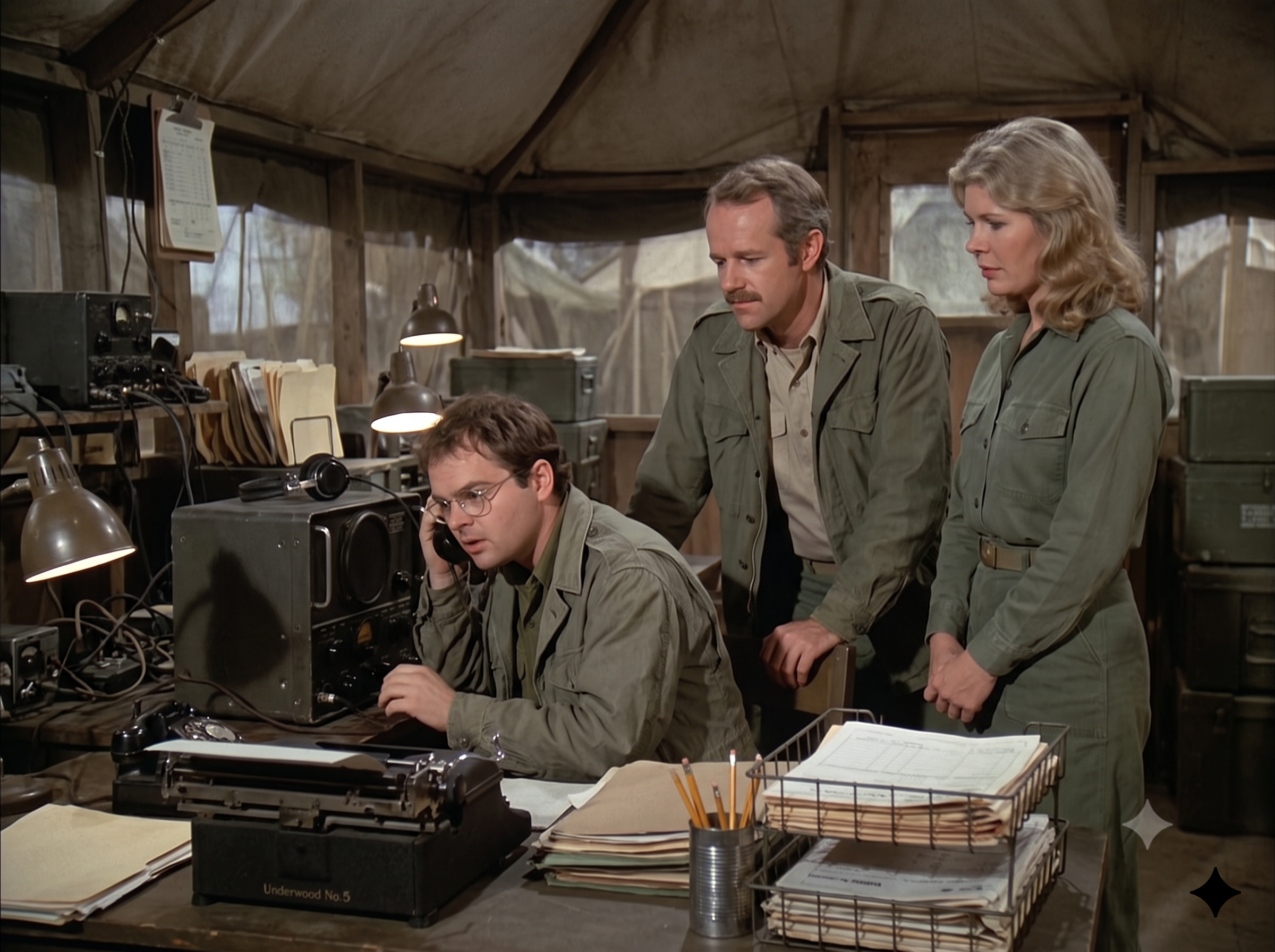
The war always seemed to shrink down to the size of a single, crackling radio speaker in the clerk’s office.
Outside the canvas walls of the 4077th, the Korean night was vast, cold, and indifferent. But inside Radar’s busy domain, the world was reduced to the soft, analog hum of the communications rig.
The soft practical lighting of the desk lamp cast a warm, golden glow across the cluttered desk. It illuminated the muted gray and beige paper colors of requisition forms, the heavy black keys of the Underwood typewriter, and the wire file trays stacked precariously high.
Radar O’Reilly sat hunched forward in his chair, leaning in toward the bulky metal radio with earnest focus.
His youthful face was tight with a nervous, sincere expression. He held the heavy black receiver pressed hard against his ear, his fingers white-knuckled around the plastic. His glasses slipped slightly down his nose, but he didn’t dare take a hand away to push them up.
To his left, Captain B.J. Hunnicutt leaned comfortably against the edge of the desk.
Despite his relaxed posture, B.J.’s face carried a heavy, thoughtful concern. He wore his worn, lived-in green fatigues, the fabric soft from countless washes in hard water. There was a quiet empathy in his eyes, tired but deeply human, as he watched the radio dials.
Standing rigidly beside them was Major Margaret Houlihan.
She was perfectly composed, her uniform crisp despite the late hour, her hands out of sight but undoubtedly clenched. Her face showed an intense emotional complexity. She wasn’t barking orders or demanding efficiency. Instead, her eyes were fixed on Radar with a fierce, silent pleading.
They were waiting for a ghost.
Three hours earlier, a chopper had lifted off the pad carrying a nineteen-year-old corporal named Tommy. The kid had arrived at the 4077th with massive internal injuries. B.J. had spent six exhausting hours in the OR putting him back together, working with a quiet, desperate rhythm.
Margaret had been right across the table, wiping B.J.’s brow, handing him clamps before he even asked, and whispering soft, steadying words into the unconscious boy’s ear.
They had done everything right. But sometimes, in this place, doing everything right just wasn’t enough. They had to ship Tommy to Tokyo General for a specialized thoracic procedure they simply couldn’t perform in a mud-floored tent.
He was hanging by a thread when they loaded him onto the litter.
Now, they were waiting for Sparky at I Corps to patch them through to the surgical ward in Tokyo. They needed to know if the kid had survived the flight and made it to the table.
“Come on, Sparky,” Radar whispered, his voice trembling slightly. “You said you had ’em on the hook.”
“Give it time, Radar,” B.J. said softly, his voice a low, steady rumble in the quiet room. “The lines are probably jammed.”
“He’s a priority patient,” Margaret said, her voice tight, trying to maintain her professional distance. “They should have a dedicated channel.”
Suddenly, the radio speaker popped with a loud hiss of static.
Radar jumped slightly, his hand flying to the tuning dial. The green eye of the radio indicator flickered wildly.
“Sparky? Sparky, is that you?” Radar practically yelled into the receiver.
A voice cut through the heavy analog interference. “I got ’em, 4077th. Patching you to Tokyo General, Ward 4. But listen, kid… I overheard the relay…”
The static swelled, drowning out the voice.
“Overheard what?” B.J. asked, leaning in closer, his comfortable stance suddenly gone.
“Sparky, repeat! Overheard what?” Radar twisted the dial, his face pale in the lamplight.
Through a sudden, eerie clearing in the static, Sparky’s distant voice returned, heavy and apologetic. “They lost him on the table, Radar. I’m sorry.”
Margaret let out a sharp, ragged breath, her rigid posture finally faltering.
The silence in the clerk’s office was suddenly louder than the artillery echoing over the distant hills.
Margaret closed her eyes. The complex mask of the tough, uncompromising head nurse cracked, revealing the profound, tender weariness beneath. She turned her head slightly away, swallowing hard, fighting the sudden shine of moisture in her eyes.
B.J. didn’t move. He just stared at the radio, his jaw tightening beneath his mustache. He looked suddenly older, the weight of the war settling heavily onto his shoulders. Another kid. Another letter to write. Another face he’d see when he tried to close his eyes tonight.
“Sparky,” Radar said, his voice dropping to a heartbroken whisper. “Are… are you sure?”
The radio hissed loudly, a chaotic wave of atmospheric noise that sounded like the ocean.
Radar frantically adjusted the black tuning knobs. “Sparky! Sparky, come back!”
“…damn it, Sparky, get off the line!” a new voice suddenly broke through. It wasn’t the laid-back drawl of the I Corps operator. It was a sharp, no-nonsense female voice.
Radar blinked, pressing the receiver harder against his ear. “Hello? Is this Tokyo General?”
“This is Major Collins, Head Surgical Nurse, Ward 4,” the voice crackled. “Am I speaking to the 4077th?”
Margaret’s eyes snapped open. She stepped forward, leaning over B.J.’s shoulder, her professional instincts overriding her grief.
“Yes, ma’am!” Radar said, sitting up perfectly straight in his chair. “This is Corporal O’Reilly.”
“I need to speak to the attending surgeon for Corporal Thomas Miller,” the nurse demanded through the static.
B.J. reached out and gently took the heavy black receiver from Radar’s hand. He pressed it to his ear, his face unreadable.
“This is Captain Hunnicutt,” B.J. said, his voice flat, bracing himself for the official bad news. “I operated on him here.”
The static cleared for just a brief, merciful moment.
“Captain, I don’t know who your radio operator was talking to,” Major Collins said, sounding utterly exhausted but crisp. “But they had the wrong OR. Miller wasn’t in Surgery A. We had to move him to Surgery C.”
B.J. froze. The air in the small office seemed to stand still. Margaret leaned in so close she was practically sharing the receiver, her hands gripping the edge of the wooden desk.
“Is he…” B.J. started, his voice cracking just a fraction.
“He crashed on the table ten minutes ago,” the nurse said.
Margaret closed her eyes again.
“But,” the nurse continued, a sudden, weary warmth entering her voice, “your field repairs held just long enough. We got his heart started again. We finished the thoracic closure five minutes ago.”
B.J. let out a breath he felt like he’d been holding for three hours.
“He’s heavily sedated, Captain,” the nurse said. “He’s going to be in for a long, rough haul. But he is alive. And his vitals are stabilizing. Whatever you did in that mud hut of yours, you gave us a fighting chance.”
A slow, brilliant smile spread across B.J.’s tired face. The deep lines of fatigue around his eyes seemed to soften instantly.
“Thank you, Major,” B.J. said softly. “Thank you very much.”
“One more thing, Captain,” the nurse added, the static beginning to return. “Before we put him under, he kept mumbling about an angel. Said she was loud, but she had nice eyes.”
B.J. glanced up at Margaret.
“I’ll be sure to pass that along, Major. 4077th out.”
B.J. handed the receiver back to Radar, who fumbled with it before dropping it safely back onto its cradle. The loud click severed the connection, leaving only the hum of the desk lamp and the distant sound of a jeep engine outside.
Radar slumped back in his chair, pulling his glasses off and rubbing his eyes with the palms of his hands. He looked like a little boy who had just woken up from a nightmare. “Holy cow,” he breathed. “Holy cow.”
B.J. pushed himself up from the desk. He stretched his back, a genuine, quiet laugh escaping his chest.
“You hear that, Margaret?” B.J. said, turning to her with a gentle, teasing smile. “An angel. Loud, but with nice eyes. Sounds like someone owes that kid a commendation for observation under fire.”
Margaret stood up straight, smoothing the front of her fatigue shirt. She cleared her throat loudly, trying desperately to reassemble her tough exterior.
“Impertinent private,” she said, her voice shaking just a little. “I should have him brought up on charges for disrespecting a superior officer.”
But her act wasn’t fooling anyone in the room.
A single tear slipped down her cheek, catching the golden light from the desk lamp. She didn’t wipe it away immediately. Instead, she looked at B.J., and then down at Radar, her expression softening into something incredibly vulnerable and deeply maternal.
“You did good work today, B.J.,” she whispered, her voice stripped of all rank and protocol.
B.J. reached out and gave her shoulder a gentle squeeze. “We all did, Margaret. We all did.”
Radar put his glasses back on, blinking at the two officers. He reached over to the tin can, grabbed a fresh pencil, and pulled a clean beige form toward him.
“I’m gonna write his mom,” Radar said earnestly. “Just to tell her he’s okay. Is that alright, sirs?”
“That’s a fine idea, Radar,” B.J. said softly.
Margaret nodded slowly, her composure returning, but the warmth remaining in her eyes. “Make sure your spelling is correct, Corporal. This is official correspondence.”
“Yes, ma’am,” Radar smiled, rolling the paper into the Underwood.
B.J. shoved his hands into his pockets and headed for the door, pausing just at the threshold of the tent. He looked back at the small, cluttered clerk’s area. The muted colors, the stacks of paper, the quiet hum of the radio. It wasn’t much of a home, but it was theirs.
They had pulled one back from the edge tonight. It wouldn’t stop the war. It wouldn’t empty the OR tomorrow. But for this one quiet moment, in the soft analog light of a muddy tent, it was enough.
In a place surrounded by darkness, they were always each other’s light.