A Jar of Home in a Land of Mud
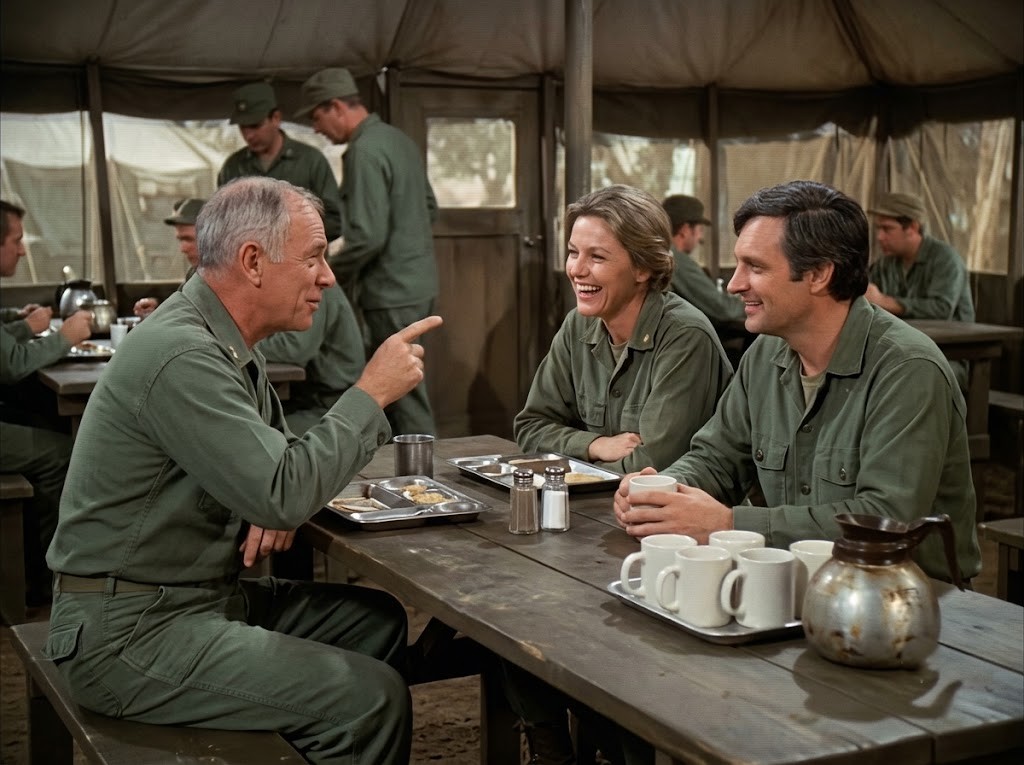
The mail hadn’t arrived in three days, the generator was wheezing like an asthmatic mule, and the last shipment of fresh vegetables was roughly the consistency of wet cardboard. It was just another Tuesday at the 4077th, where morale was hanging by a thread thinner than the coffee they were serving in the mess tent.
Then, Hawkeye walked in.
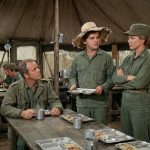
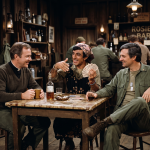
He didn’t just walk; he made an entrance, cradling a glass jar against his chest as if it were a fragile, holy relic salvaged from a crumbling civilization. Behind him, Margaret—her uniform crisp despite the oppressive humidity—stopped mid-sentence, her professional glare softening into genuine, unadulterated curiosity. Radar, who had been busy nursing a lukewarm mug, practically vibrated in his seat, his eyes locking onto the prize.
It was pickles. A massive, beautiful, briny jar of genuine, honest-to-God kosher dill pickles.
“Gentlemen, and Major,” Hawkeye announced, his voice carrying just enough theatrical gravitas to make them pause. “I submit to you that in a world defined by the absurd, the only rational response is fermented cucumbers.”
He set the jar onto the scarred wooden table. The sound it made—a heavy, resonant *thud*—felt like a gavel dropping in a courtroom of exhaustion. It was a mundane object, yet in the grey, dusty expanse of their existence, it looked like a beacon.
For a heartbeat, no one moved.
The air in the mess tent seemed to shift. The smell of disinfectant and damp canvas faded, replaced by the sharp, pungent, glorious scent of vinegar and garlic. Radar was the first to reach out, his hand hovering inches from the glass, afraid that if he actually touched it, the dream would shatter and he’d wake up back in his bunk.
Hawkeye’s grin was mischievous, but his eyes told a different story. He looked at Margaret, then at Radar, and for a fleeting second, the sharp wit faded. He looked tired. Not just “after-a-twelve-hour-shift” tired, but deep-in-the-bones, soul-weary tired.
“Open it, Hawk,” Radar whispered, his voice trembling slightly. “Before the colonel comes in and asks for an inspection of our ration intake.”
Hawkeye took hold of the lid, his knuckles whitening. He took a deep breath, preparing to twist, but as his fingers gripped the metal, his hand faltered. He looked around the table, realizing that opening this jar wasn’t just about food—it was about acknowledging how badly they all needed this one small, pathetic, beautiful slice of home. He hesitated, his face caught between a smile and a grimace, staring at the lid as if he were deciding whether or not to break the seal on their collective sanity.
The tension was palpable, a tiny, pickles-induced standoff in the heart of Korea.
“Go on,” Margaret said, her voice dropping the sharp military edge. “If you don’t open that lid, I’m going to pull rank, confiscate the jar, and finish it myself.”
Hawkeye let out a soft, ragged laugh. With a sharp, metallic *pop* that echoed like a distant firecracker, the seal broke. The scent wafted up, potent and sharp, hitting them all at once. It wasn’t just a smell; it was a memory. It was Sunday afternoons, backyard barbecues, the sound of a screen door slamming shut, and the quiet comfort of a pantry in a house that hadn’t been touched by war.
Radar let out a slow, long exhale, his shoulders finally dropping away from his ears. He reached out, his fingers brushing the glass, and Hawkeye didn’t pull away. Instead, he slid the jar toward the center of the table, a peace offering in a world that rarely offered anything but wounds.
They didn’t scramble for them. They didn’t act like starving men, even though they were. Instead, they moved with a strange, quiet reverence. They each held out their tin mugs, waiting for Hawkeye to use a makeshift fork to fish out a spear.
“It’s not prime rib,” Hawkeye murmured, dropping a pickle into Margaret’s mug with a splash of brine.
“It’s better,” she replied, and for the first time in weeks, she didn’t look like an officer. She looked like a woman who had just been handed a piece of a world she thought she’d lost forever.
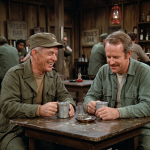
They sat there for a long time, just sipping the brine and munching on the crisp, tart spears. The banter eventually started up again—the dry, surgical humor that kept them upright—but it was different. It was softer.
B.J. wandered in, spotted them, and pulled up a chair without needing an invitation. He didn’t ask where it came from; he just accepted the offering with a nod of profound gratitude. They talked about nothing at all—the taste of the garlic, the crunch of the dill, the absurdity of finding such a luxury in the middle of a conflict that made so little sense.
As the sun began to dip behind the hills, casting long, bruised shadows across the compound, the jar sat in the center of the table, nearly empty. The silence that fell over them wasn’t the heavy, lonely silence of the late-night shifts in the O.R. It was a comfortable, shared silence. It was the sound of friends who were holding onto each other, one bite at a time.
They knew the next alarm would sound soon. They knew the choppers would arrive, bringing with them the reality they worked so hard to keep at bay. But for these few minutes, they weren’t just doctors and nurses in a war zone. They were just people, standing in a tent, sharing a jar of pickles and remembering what it felt like to be home.
Hawkeye looked at the last pickle, floating in the cloudy liquid. He didn’t take it. He nudged the jar toward Radar, who beamed with the kind of pure, unadulterated joy that could only be found in someone who still believed in miracles, no matter how small.
The war would still be there tomorrow, but tonight, they had been nourished.
Sometimes, it’s the smallest things that keep the heart from breaking.