THE MASTERPIECE AND THE MAJOR
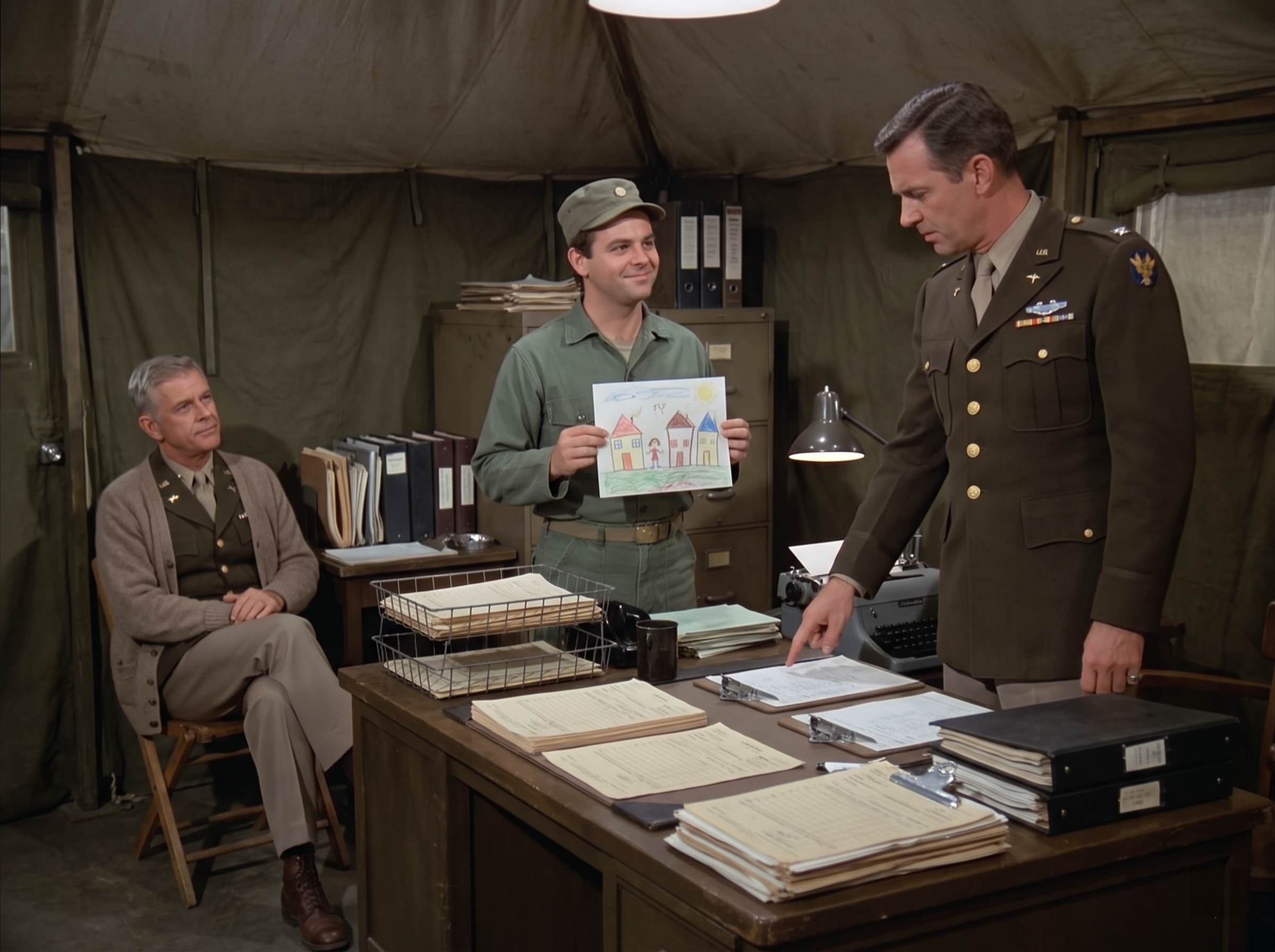
The war stopped for no man, but in the clerk’s office of the 4077th, time occasionally ground to a halt over the most ridiculous things.
It was a quiet Tuesday afternoon, the kind that smelled of dust, stale coffee, and mimeograph ink. Colonel Sherman T. Potter sat tucked away in the corner of the office, finding a rare moment of peace. He wore his comfortable tan cardigan over his uniform, his legs crossed, resting quietly on a small folding chair. Potter wasn’t there for official business. He was simply hiding out from a particularly chatty supply sergeant, enjoying the temporary silence.
That silence, of course, was never meant to last.
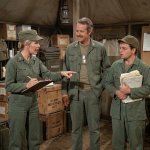
The tent flaps parted violently, and Major Charles Emerson Winchester III strode into the room. Charles was dressed impeccably, as always, in his Class A uniform, every ribbon perfectly aligned, his posture stiff with aristocratic irritation. He marched directly to the clerk’s desk, entirely ignoring the Colonel sitting in the shadows. Behind the desk stood Corporal Walter “Radar” O’Reilly, up to his neck in requisition forms and carbon paper.
“Corporal,” Charles announced, his voice dripping with Bostonian impatience. “I require your immediate, undivided, and preferably competent attention.”
Radar snapped to attention, though his face remained perfectly open and mildly confused. “Yes, sir, Major. What can I do for you?”
Charles leaned over the desk, slapping a heavy hand down on a metal clipboard resting near the typewriter. He pointed a long, imperious finger directly at the top sheet of paper. “This,” Charles demanded, “is the surgical rotation schedule you posted this morning. I suggest you look closely at it, Corporal.”
Radar didn’t look at the clipboard. Instead, a broad, innocent smile broke across his face. He reached under his desk, rustling through a stack of newly arrived mail, completely ignoring the Major’s growing fury.
“I’m glad you’re here, sir,” Radar said brightly. “I have something really important to show you.”
Charles blinked, his finger still rigidly pointing at the clipboard. “Important? Corporal, what could possibly be more important than the fact that I am scheduled for back-to-back shifts with Captain Pierce?”
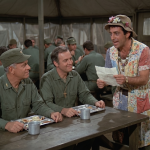
Radar stood up straight and proudly held up a piece of white paper. It wasn’t a form. It wasn’t a requisition. It was a child’s crayon drawing. It featured three brightly colored houses, a scribbled yellow sun, and a tiny stick figure standing in green grass. Radar held it up like it was a priceless artifact from the Louvre.
“Look, sir,” Radar beamed, his eyes shining with sincere pride. “It just came in the mail.”
Charles stared at the crude strokes of wax on paper. His jaw tightened. The veins in his neck began to throb. He leaned further over the desk, his rigid finger tapping the metal clipboard with a sharp, rhythmic clack.
“O’Reilly,” Charles said, his voice dropping to a dangerous, icy whisper. “Are you intentionally trying to test the limits of my sanity, or is this some new, exotic form of midwestern torture?”
Radar’s smile faltered only slightly, holding the drawing closer to Charles’s face. “But sir… it’s for you.”
In the corner, Colonel Potter leaned forward, a dry, patient smirk touching the edges of his mouth, waiting to see if Winchester was going to explode or simply disintegrate.
The silence in the clerk’s office grew incredibly heavy.
Charles remained frozen, his finger pressed hard against the clipboard, his eyes locked on the crayon scribbles floating just inches from his nose. He took a long, slow breath, clearly trying to summon the aristocratic restraint generations of Winchesters had bred into him.
“For me,” Charles repeated, the words tasting like ash in his mouth.
“Yes, sir,” Radar said earnestly, his face still holding that innocent glow. “It’s from the orphanage in Uijeongbu.”
Charles’s posture twitched. The rigid line of his spine faltered for just a fraction of a second. He suddenly looked very aware of his surroundings, his eyes darting briefly around the room before landing on Colonel Potter in the corner. Potter didn’t say a word. He just sat there, his hands clasped over his knee, his eyes twinkling with quiet amusement.
“I fail to see,” Charles stammered slightly, quickly lowering his voice, “what an orphanage has to do with my surgical schedule, Corporal.”
Radar lowered the drawing just a fraction, resting his hands on the edge of the desk. “Well, sir, Sister Theresa dropped it off with the mail truck this morning,” Radar explained, completely missing Charles’s discomfort. “She said the kids wanted to thank the nice, tall doctor who sent over that enormous box of French chocolates and the new wool blankets last week.”
Charles’s face flushed a deep, magnificent shade of pink. He pulled his hand back from the clipboard as if the metal had suddenly turned red-hot.
“I… I have absolutely no idea what you are talking about,” Charles lied, his voice climbing half an octave. “I am a busy surgeon, O’Reilly. I do not traffic in… in confectionery charity.”
“But the note says ‘To Major Winchester’,” Radar pointed out reasonably, flipping the drawing over. “Sister Theresa said you had it shipped all the way from a fancy store in Boston. She said the kids had never tasted anything like it.”
Radar turned the picture back around, holding it up again. “This one was drawn by little Kim-Joo. She’s six. She said these are the houses they’re going to build when the war is over. And she drew you right in the middle.”
Charles stared at the tiny, misshapen stick figure standing between the crayon houses. It was remarkably tall, colored entirely in green, with a large, slightly lopsided head. The imperious irritation melted from Charles’s face, replaced by a sudden, vulnerable softness he rarely let anyone see. He swallowed hard, his throat bobbing, though he kept his chin jutted out in a desperate attempt to maintain his dignity.
“It is… an adequate rendering,” Charles finally muttered, refusing to look at Potter. “Though her grasp of perspective is entirely pedestrian.”
“She wanted you to have it, sir,” Radar said softly. “To hang up.”
Charles reached out slowly. His manicured fingers, usually so steady holding a scalpel, trembled just the slightest bit as they pinched the edge of the cheap paper. He took the drawing from Radar’s hands, holding it delicately, as if it were spun glass.
From the corner, a chair creaked. Colonel Potter stood up slowly, smoothing the front of his cardigan. He walked over to the desk, stopping right beside the Major. Potter looked down at the drawing in Charles’s hand, then looked up at Charles’s face.
“That’s a mighty fine piece of art, Major,” Potter said quietly, his voice rich with fatherly warmth. “I’d say it belongs in a frame. Maybe right above your cot.”
Charles cleared his throat loudly, squaring his shoulders, desperately trying to rebuild the walls he kept around his heart. “I suppose it would be incredibly rude to discard a gift,” Charles said stiffly. “Even one as aesthetically challenged as this. I shall… file it appropriately.”
“You do that, Charles,” Potter said with a soft smile, patting the tall surgeon gently on the shoulder.
Charles turned on his heel, clutching the crayon drawing carefully against his chest, completely forgetting the clipboard on the desk. He marched toward the door, stopping just before he pushed through the canvas flaps.
“Oh, and O’Reilly?” Charles called out, not looking back.
“Yes, sir?” Radar answered.
“Regarding the surgical schedule…” Charles paused, his voice softer now, almost gentle. “Leave it as it is. I suppose I can endure Pierce’s company for a few consecutive hours without expiring.”
He slipped out into the dusty compound, leaving the office quiet once again.
Radar smiled, picking up his date stamp and pressing it into an ink pad. Potter chuckled softly, shaking his head as he walked back to his little chair in the corner. He sat down, crossing his legs again, the dry smirk returning to his face.
“You know, Radar,” Potter said softly. “For a bunch of tired, cranky surgeons trapped in a war zone… they sure do have a terrible time trying to hide their humanity.”
Radar stamped a form, looking up with that same innocent, understanding smile. “Yes, sir,” Radar said brightly. “They sure do.”
Amidst the endless paperwork and the noise of war, the most important records kept at the 4077th were always the ones drawn straight from the heart.