The Best Kind of Quiet at Rosie’s Bar
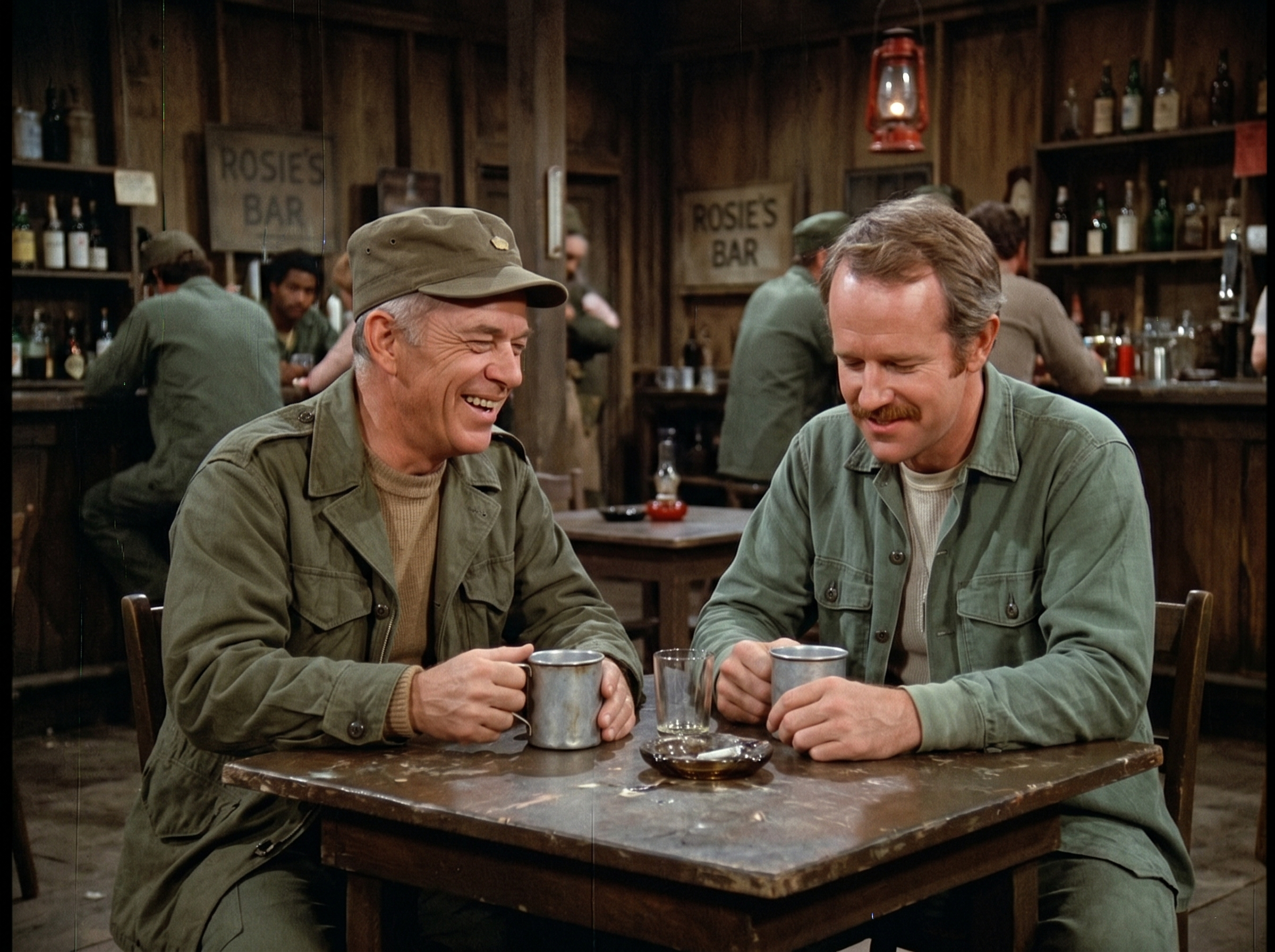
The best kind of quiet wasn’t the empty kind. It was the full kind. The kind where the only sounds were clinking glasses, distant laughter, and the soft hum of people who had just spent forty-eight hours straight trying to stitch the world back together.
It was eleven-forty-three PM on a Tuesday. This scene, this moment, was exactly that kind of quiet.
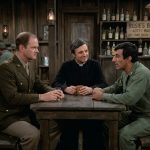
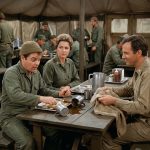
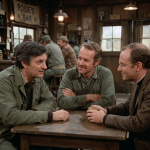
In the dimly lit sanctuary of Rosie’s Bar, Colonel Sherman Potter and Captain B.J. Hunnicutt sat across from each other. They were still in their fatigues, their bodies aching, their hands steady now only when gripping metal canteen cups.
A small glass of local, questionable liquid sat between them, a communal peace offering that neither of them seemed in a rush to drink.
Colonel Potter was laughing, a real, full-throated chuckle that crinkled the skin around his eyes. He was gesturing slightly, his hand cradling his tin cup. He looked fatherly, relaxed, as if the burden of command had finally slipped off his tired shoulders and onto the dirt floor.
Across from him, B.J. smiled—not a loud smile, but a deep, sincere one. His eyes were downcast, focused on his own cup. He looked weary, but his smile was the look of a man who had finally found the warmth he didn’t realize he was missing all day.
The background was a blur of similar green shapes, other ghosts of the 4077th seeking refuge, but these two sat in an bubble of shared history and mutual understanding. They had been in the OR together when the last bus arrived, and now they were here.
“You are a wonder, Hunnicutt,” Potter said, still chuckling. “Where do you come up with these stories?”
B.J. looked up, his smile widening. “Ah, well, you know, Colonel, when you spend as much time as I do staring at a mustache, you have to entertain yourself.”
Their shared amusement hung in the warm, lantern-lit air, creating a bubble of peace. The tension, the fatigue, everything but this friendship was outside those wooden walls. It felt like this one quiet laugh might be strong enough to push the war away forever.
And that was exactly when the telephone behind the bar began to ring.
The sound of the ring didn’t just break the quiet; it shattered the fragile bubble they had built. It was sharp, persistent, and entirely unwelcome.
Rosie, ever efficient, moved to answer it before the second ring. Both men instantly froze. Potter’s laugh died on his lips, though his smile remained in his eyes. B.J. looked up from his cup, his face instantly guarded, the lightness vanishing.
They both knew what a call at 11:45 PM meant. It wasn’t Klinger calling to say the dress arrived.
The entire bar seemed to hold its breath. Rosie listened, nodded once, and hung up. The silence that followed was heavy, a complete contrast to the comfortable quiet from moments before. She looked toward their table, her gaze sympathetic but professional.
“Colonel,” she said softly.
Sherman Potter exhaled, a sound that carried the weight of the last three wars. He looked at the communal shot glass. He looked at his cup. Then he looked at B.J.
“Duty calls, Hunnicutt,” Potter said. His voice was no longer that of the relaxed companion but the fatherly commander. The transition was seamless, practiced, and heartbreaking.
B.J. nodded. He drained the last of whatever was in his canteen cup and set it down with a definite clink. His expression was steady, grounded. The warmth was still there, but now it was fortified by resignation.
“Last bus must have been an early arrival,” B.J. said quietly.
“Or more coming,” Potter replied, standing up and pulling his cap straight. He reached down and gave B.J. a firm slap on the shoulder. It was a gesture of solidarity, a reminder that they were going back into the fight together.
B.J. rose too, mirroring the Colonel’s movement. They were no longer two friends relaxing; they were two pieces of a finely tuned medical machine, re-engaging.
“You know, Colonel,” B.J. said as they started walking toward the door, matching strides. “We still never finished that debate about which mule has the finer conversational skills.”
Potter grinned, his step regaining a little of its earlier lightness. “I told you, it’s not a debate. Sophie is a lady. Now, double-time it. They’re going to need all hands.”
They walked out of the warm, smoky refuge of Rosie’s and into the chilly Korean night, heading back toward the triage lights that were already flickering to life. The moment was gone, but the shared laugh stayed with them, a quiet strength waiting for the next quiet moment.
Because sometimes, the best medicine is just knowing someone is laughing with you.