The Secret Cargo of the 4077th
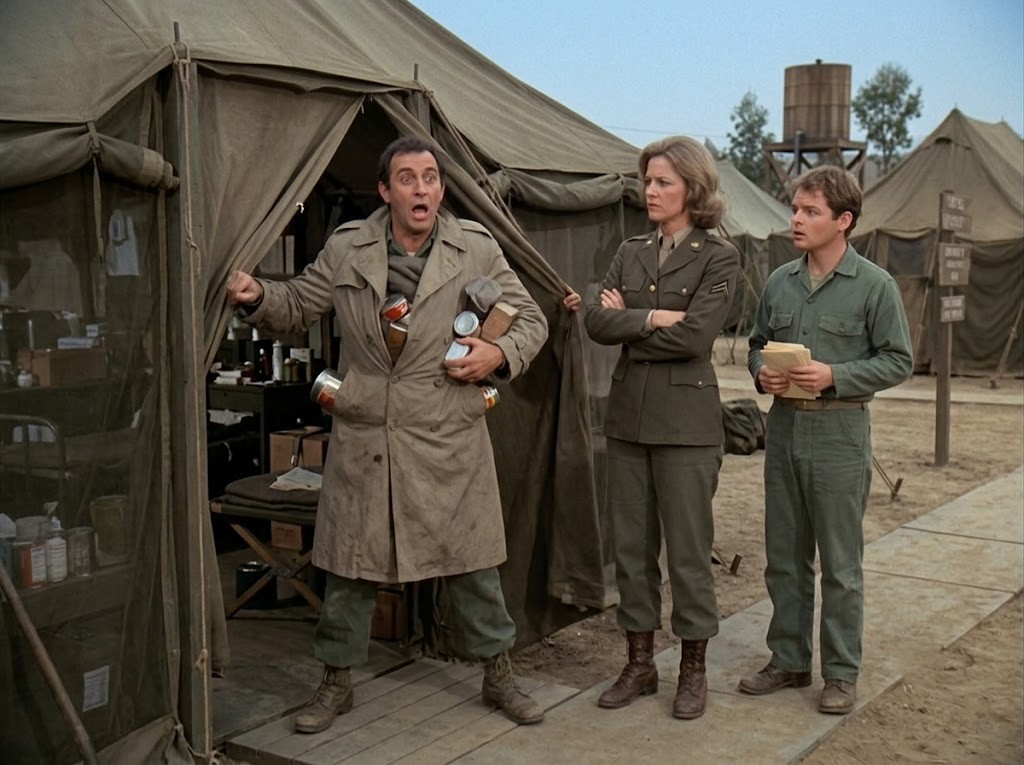
The mud of Uijeongbu had a way of sticking to everything, but it could never dampen Maxwell Klinger’s flair for the dramatic.
On a gray, biting afternoon, the kind that made your bones ache and your coffee freeze before you could finish it, the compound was unusually quiet. The operating room was empty for the first time in thirty-six hours, leaving behind nothing but the heavy scent of ether and the profound, exhausted silence of a temporary truce.
It was exactly the kind of quiet that made Corporal Radar O’Reilly’s ears twitch.
Standing on the wooden boardwalk just outside the supply tent, Radar clutched a stack of mail to his chest, his eyes wide behind his round spectacles. Next to him stood Major Margaret Houlihan, her arms crossed tightly over her olive-drab jacket, her expression carved from pure, unyielding military discipline. They were both staring at the tent flap, which was currently vibrating with a series of loud, metallic clunks and a muffled, frantic curse.
Suddenly, the canvas parted.
Klinger froze, one foot suspended in the air, his mouth dropping open in an O of absolute horror. He was wearing his heavy, mud-splattered trench coat, but it was deformed into a dozen bizarre shapes. Stuffed precariously into his pockets, shoved into the front of his shirt, and tucked under his arms were countless tin cans, a wooden crate, and loose rations.
“Going somewhere, Klinger?” Margaret asked, her voice dropping into that dangerously calm register that usually preceded a court-martial.
Klinger’s eyes darted from Margaret’s stern glare to Radar’s anxious face. He swallowed hard, trying to shift his weight, which resulted in a loud, betraying *clank* of metal against metal.
“Major! Radar! What a delightful coincidence,” Klinger squeaked, his voice pitching high as he instinctively tried to cover his bulging coat. “I was just… doing an inventory check. A very thorough, mobile inventory check.”
“An inventory check that involves stealing the camp’s remaining canned peaches, tinned meat, and condensed milk?” Margaret stepped closer, her eyes narrowing. “Colonel Potter has been looking for these rations since yesterday. We have wounded men who need nourishment, and here you are, looting the supply tent like a thief in the night.”
“I’m not looting, Major, I swear on my mother’s stuffed grape leaves!” Klinger pleaded, his chest heaving under the weight of his hidden contraband. “It’s not what it looks like.”
“It looks like section eight is about to turn into ten to fifteen in Leavenworth,” Radar whispered, his voice trembling as he looked around, terrified that Colonel Potter or Captain Pierce might walk by and witness the downfall of their company clerk’s closest accomplice.
Margaret extended her hand, palm up. “Hand them over, Klinger. Every single can. And then you are marching straight to the administrative tent to explain to the Colonel why you shouldn’t be scrubbing latrines until the end of the Korean conflict.”
Klinger stood frozen on the wooden planks, his knuckles white as he squeezed a tin of condensed milk against his ribs. A sudden, deep emotion flared in his dark eyes, replacing the comedic panic with something desperate, raw, and fiercely protective.
“No,” Klinger said softly, his voice cracking. He didn’t budge. “I can’t do that, Major.”
—
The silence that followed was heavier than the winter air. Margaret’s hand remained extended, her face a mask of shock at the sheer audacity of a direct refusal. Radar looked as though he might faint right into the dirt, his grip tightening on his letters until the paper crinkled.
“What did you say to me, Corporal?” Margaret asked, her voice dangerously quiet.
“I said no, ma’am,” Klinger repeated, his theatrical bravado completely vanishing. He looked down at the cans stuffed into his coat, his expression softening into a look of profound exhaustion. “You can court-martial me. You can put me in the stockade. But these cans aren’t going back on the shelves.”
Margaret opened her mouth to yell, to summon the MPs, to let loose the full fury of a regular army major. But before she could find her voice, Hawkeye Pierce and B.J. Hunnicutt ambled around the corner of the tent, their hands shoved deep into their pockets, their faces lined with the dark circles of a sleepless week in surgery.
“Is this a private mutiny, or can anyone join?” Hawkeye asked, his voice laced with his usual dry wit, though his eyes scanned the scene with immediate intelligence. “Klinger, you look like a walking grocery store. Planning a picnic in Pyongyang?”
“He’s stealing rations, Captain,” Margaret snapped, turning her anger toward the doctors. “And he is flat-out refusing a direct order to return them.”
B.J. walked over, looking at the cans of condensed milk and fruit protruding from Klinger’s coat. He didn’t look angry; he looked curious, his steady, fatherly gaze settling on the shivering corporal. “What’s the real story, Klinger? You don’t even like condensed milk. You’ve spent three years trying to trade it for silk stockings.”
Klinger sighed, the fight draining out of him. He looked at Radar, then at the doctors, and finally back to Margaret.
“It’s for the orphanage over the hill,” Klinger said quietly, his voice barely above a whisper. “The one Father Mulcahy visits on Thursdays. I went with him last week to fix a broken pipe.” He swallowed hard, his eyes shining. “They don’t have anything, Major. The kids are eating boiled roots. The youngest one, a little girl named Soo-Jin, she’s so weak she can barely hold her head up. Father Mulcahy gave them his own rations, but it’s not enough. I… I couldn’t just sit here and look at full shelves while they’re starving.”
The compound fell perfectly still. The dry humor that usually protected the doctors from the harsh reality of the war vanished, leaving behind only the raw humanity that bound them all together.
Radar looked down at his boots, a lump forming in his throat. “He told me about them, Major. I… I helped him find the keys to the lockbox. It’s my fault too.”
Margaret looked from Klinger’s desperate face to the cans of food, her rigid posture softening just a fraction. The fierce, professional head nurse who demanded absolute adherence to regulations was suddenly face-to-face with the devastating cost of the war around them. She looked at the stolen goods, not as military property anymore, but as a lifeline for children who had nothing left.
“Colonel Potter is going to notice they’re gone, Klinger,” Margaret said, her voice completely stripped of its sharp edge, replaced by a quiet, reluctant tenderness.
“Not if the inventory log shows a sudden infestation of very hungry, very localized camp rats,” a dry, commanding voice boomed from behind them.
Everyone turned to see Colonel Sherman Potter walking up, his hands clasped behind his back, his brow furrowed beneath his cap. He looked at Klinger’s stuffed coat, then at Margaret, and finally at the sky.
“I’ve seen some big rats in my time, but never any that could carry off a whole crate of peaches,” Potter muttered, a faint, wise smile tugging at the corner of his mustache. He walked up to Klinger, tapping a tin can with his index finger. “Next time you decide to wage a one-man war against hunger, Corporal, you might want to ask the old man for a pass. It saves on the wear and tear of a perfectly good trench coat.”
Klinger’s eyes widened. “Colonel?”
“Get those out of here before I change my mind and make you eat the crate,” Potter ordered gently. “And Klinger? Take the ambulance. Walking through the mud with that much weight is bad for your knees.”
A collective breath was released. Hawkeye patted Klinger on the shoulder, a proud smile breaking through his fatigue. “See? And you wanted a section eight. You’re far too sane for this place, Klinger.”
“Thanks, Doc,” Klinger whispered, his face flushing with genuine gratitude as he turned and hurried toward the motor pool, his coat clanking musically with every step, Radar rushing alongside him to help carry the load.
Margaret watched them go, her arms still crossed, but the stern expression was entirely gone, replaced by a quiet, wistful warmth. “They’re going to get caught one of these days, Colonel.”
“Maybe, Major,” Potter said, turning back toward his office with a soft, bittersweet sigh. “But until then, it’s comforting to know that in the middle of all this madness, a few kids are going to have sweet peaches for dinner.”
—
In a place built on heartbreak and mended bones, the true healing always happened in the quiet moments when the rules were forgotten, and the family we found took care of the world we left behind.