The Weight of a Few Sheets of Paper
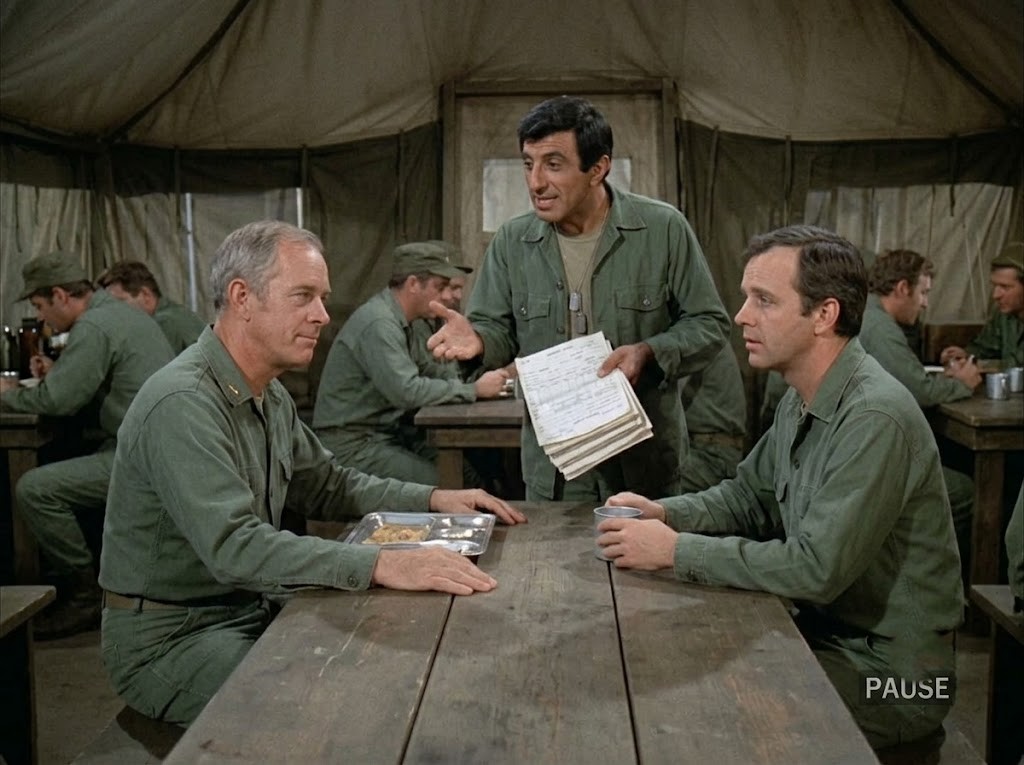
The smell of boiled cabbage and old canvas always seemed heavier after a thirty-six-hour session in the Operating Room. In the mess tent of the 4077th, the silence was its own kind of fatigue, broken only by the dull scrape of metal forks against tin trays.
Colonel Sherman Potter sat at the long wooden table, his shoulders curved under the weight of a war that never seemed to know when to quit. Opposite him, Captain B.J. Hunnicutt stared blankly into his metal cup, his thoughts likely thousands of miles away in San Francisco, tracing the contour of a daughter’s smile he hadn’t seen in over a year.
The routine of exhaustion was absolute, until Max Klinger burst through the tent flap.
He wasn’t wearing one of his signature chiffon dresses or a fruit-laden hat today; he was in standard olive drabs, his dog tags dangling over a sweat-stained undershirt. But the theatrical desperation in his eyes was entirely unchanged.
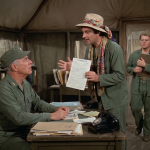
In his hands, Klinger clutched a thick, formidable stack of official army forms, waving them like a man holding the secret to alchemy.
“Colonel, I swear on my mother’s recipe for stuffed grape leaves, this is a crisis of administrative proportions,” Klinger pleaded, his voice cutting through the ambient hum of the tent.
Colonel Potter didn’t look up immediately. He slowly chewed a mouthful of something the cook called Salisbury steak, though no one in the room could verify its origins.
“Klinger,” Potter said, his voice a dry, gravelly rasp. “If those papers contain another request for a hardship discharge based on your sudden development of third-degree color blindness, you can march them right back to the latrine.”
“It’s not a discharge, Colonel! Well, it is, but it isn’t mine,” Klinger countered, shifting his weight and gesturing wildly with his free hand toward B.J. “It’s Supply Requisition Form 104-B. From the Tokyo depot. They’ve made a clerical error so massive it could shake the very foundations of the Pentagon!”
B.J. finally blinked, turning his gaze from his cup to Klinger’s animated face. “Did they finally send us the penicillin we asked for three weeks ago, Klinger? Or did they just send another crate of left-handed snowshoes?”
“Worse, Captain,” Klinger said, leaning over the table, his expression completely earnest. “They intercepted a shipment meant for a general’s officers’ club in Seoul. Because of a misplaced decimal point by some sleep-deprived corporal in logistics, three crates have just arrived at our supply tent.”
Potter raised an eyebrow, his interest piqued despite himself. “What kind of crates, Klinger?”
Klinger lowered his voice to a theatrical whisper, though half the mess tent was already listening. “Fresh Washington state apples. Two dozen bottles of real cream. And a master recording of the 1952 World Series radio broadcast, complete with a working phonograph.”
A sudden, sharp hush fell over the surrounding tables. Soldiers paused with their forks halfway to their mouths.
“But here’s the catch,” Klinger continued, his face falling into genuine panic. “The courier who dropped them off realized the mistake five minutes ago. He’s outside right now, calling his sergeant on the radio. If I don’t get your signature on these duplicate emergency consumption waivers within the next three minutes, he’s loading them back onto the truck, and we go back to eating powdered eggs and listening to the wind.”
Potter stared at the stack of papers, his fountain pen resting in his pocket. The tension in the tent became palpable as every eye turned to the Old Man.
—
B.J. leaned forward, a slow, tired grin breaking through his mustache. “Colonel, if I don’t taste something that didn’t come out of a tin can soon, I think my taste buds are going to file a formal grievance with the UN.”
“It’s government property, Beej,” Potter muttered, though his eyes were fixed on the paperwork. “Altering a delivery manifest for luxury goods during wartime is a court-martial offense. I could be reduced to private and sent to clean stables in Fort Leavenworth.”
“But Colonel,” Klinger interjected, his voice dropping its usual hustle and taking on a rare, quiet sincerity. “The boys just spent two days straight pulling shrapnel out of kids. Radar is so tired he fell asleep standing up against the filing cabinet. Father Mulcahy looks like a ghost. Just one apple, Colonel. One real piece of fruit from home.”
Potter looked at Klinger. He saw past the scheming, past the endless quest for a ticket out of Korea, and recognized the fierce loyalty that Klinger tried so hard to hide beneath his antics.
The Colonel looked around the mess tent. He saw the slumped shoulders of the enlisted men, the hollow eyes of the nurses sitting in the corner, and the absolute exhaustion etched into B.J.’s face.
Slowly, Potter reached into his breast pocket and pulled out his silver Schaeffer fountain pen. He unscrewed the cap with a deliberate, rhythmic click.
“Klinger,” Potter said softly.
“Yes, Colonel?”
“If I sign these, and the Inspector General comes sniffing around my tent, what happened to those crates?”
Klinger didn’t hesitate. “Sir, a tragic mortar shelling occurred precisely six minutes ago, completely incinerating the contents of the truck. The debris was swept away by a sudden, localized dust storm. It was an act of God, sir. Father Mulcahy will verify the spiritual anomaly.”
B.J. snorted into his metal cup, a genuine laugh bubbling up from his chest for the first time in days. “I’ll help bury the evidence, Colonel. One bite at a time.”
Potter pulled the thick stack of papers toward him. With a swift, practiced hand, he scrawled his signature across three different pages, the ink drying dark against the cheap military paper.
“Go,” Potter barked playfully. “Before I regain my senses and remember I’m a Presbyterian.”
Klinger snatched the papers back, a brilliant, gold-toothed smile spreading across his face. “You’re a prince, Colonel! A saint in army olive drab!” He turned on his heel and bolted out of the mess tent, his boots pounding against the dirt floor.
An hour later, the mood in the 4077th had completely transformed.
The mess tent was no longer silent. The crackle of an old phonograph filled the air, the distant, nostalgic voice of a baseball announcer bringing the sights and sounds of a sunny afternoon in New York straight into the muddy valley of Uijeongbu.
Soldiers sat on inverted crates, holding crisp, red apples as if they were made of solid gold.
Margaret Houlihan sat with her nurses, carefully sharing a small bowl of real cream, a rare, relaxed smile softening her usually rigid features. Near the back, Hawkeye Pierce was leaning against a tent pole, taking a deep bite of an apple, his eyes closed as he chewed, savoring the taste of a world without operating gowns and anesthesia.
At the center table, Potter and B.J. remained. Potter had a small pocket knife out, carefully slicing an apple into neat wedges, passing half of them across the table to his captain.
“Tastes like Ohio,” Potter murmured, looking out the open tent flap at the sunset painting the Korean hills in shades of bruised purple and gold.
“Tastes like home,” B.J. agreed quietly, holding a wedge up in a silent toast to the Old Man.
Outside, Klinger was leaning against the supply truck, completely devoid of his usual frantic energy. He wasn’t eating an apple. He was just watching the camp, listening to the laughter drifting out of the mess tent alongside the sound of a baseball game played a year ago and a world away.
For a few hours, the war didn’t exist. There was only the warmth of a shared meal, the comfort of good friends, and the quiet, enduring humanity of the 4077th.
Sometimes, the best medicine didn’t come from the pharmacy, but from the bottom of a misplaced supply crate.