The Toledo Loophole and the Olive Drab Blues
The 4077th had a specific rhythm to its madness, and it usually peaked just after the morning coffee had turned to battery acid.
Inside the commanding officer’s tent, the air was thick with the familiar scents of old canvas, mimeograph ink, and impending headaches. The war outside was temporarily quiet, leaving just enough room for the daily, localized skirmishes of camp life.
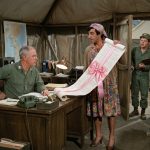
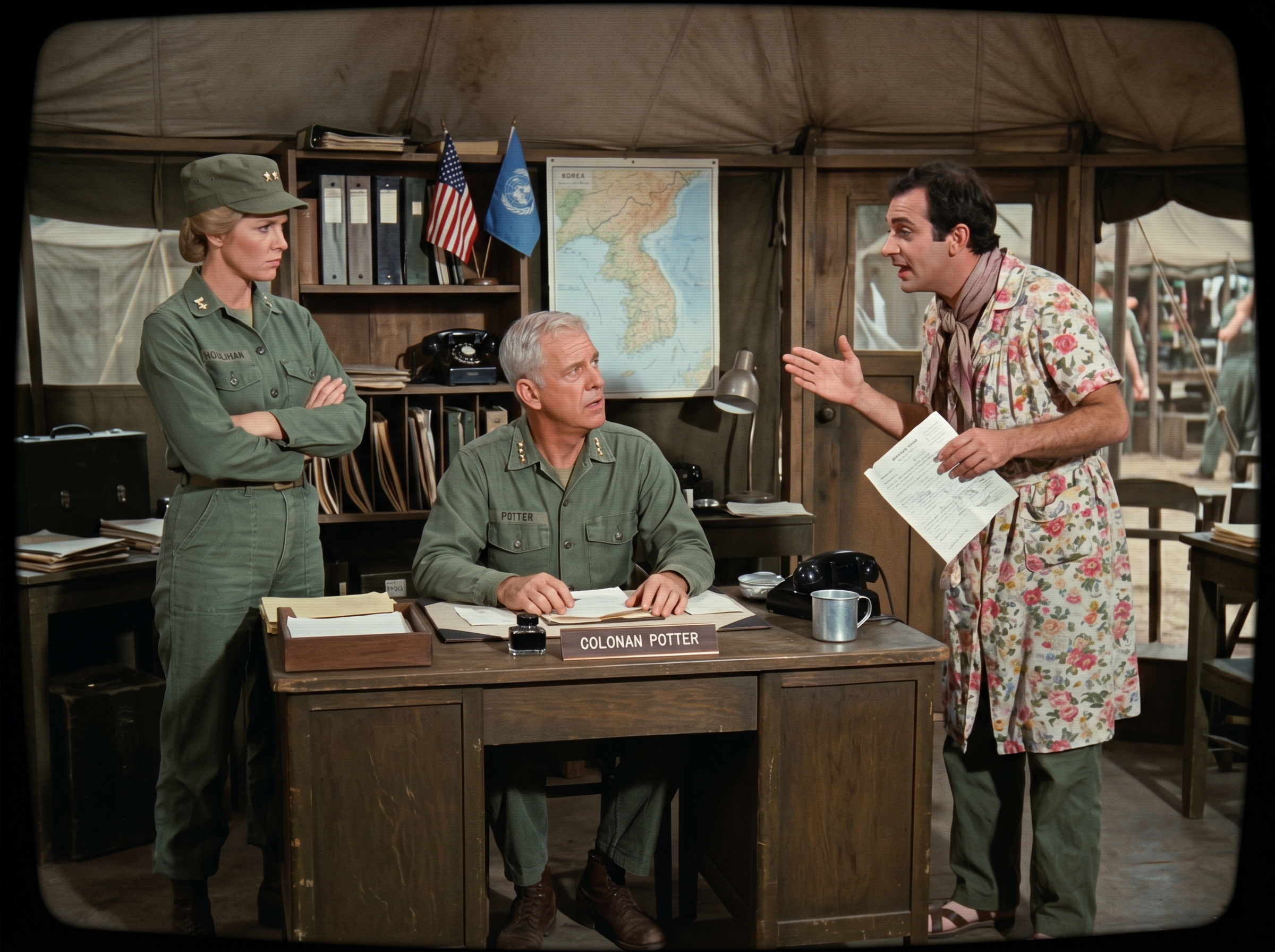
Colonel Sherman T. Potter sat at his heavy wooden desk, his hands resting flat against the worn surface. He had the distinct look of a man who had lived three lifetimes, two of them entirely within the confines of this very office.
A dented metal cup sat near his inkwell, offering no comfort. Behind him, the flags of the United States and the United Nations hung in silent, dusty vigil next to a faded map of the Korean peninsula.
Potter took a slow, measured breath. He didn’t need to look at the map to know where he was. The circus currently unfolding in front of his desk was a constant reminder.
Standing to Potter’s right, radiating a quiet, magnificent outrage, was Major Margaret Houlihan. She was dressed in her crisp, practical green fatigues, her cap perfectly angled, her arms folded so tightly across her chest they looked practically fused together.
Margaret’s expression was a masterpiece of controlled frustration. She was a professional military nurse, a woman of fierce discipline, and she was currently burning a hole through the floorboards with her eyes.
The source of her irritation was standing dead center in the room, holding court like a Shakespearean actor who had wandered onto the wrong stage.
Corporal Maxwell Klinger was making his morning appeal.
Today’s ensemble was a bold, unapologetic floral print dress, worn brazenly over his standard-issue olive drab trousers. He had accessorized with a dusty pink scarf draped elegantly around his neck and a pair of open-toed sandals that defied every known military regulation.
Klinger’s face was a mask of wounded dignity. He stood upright, gesturing grandly with his right hand, while his left hand clutched a crumpled piece of faded paper.
“I’m telling you, Colonel, it’s a matter of basic human survival!” Klinger cried, his voice carrying the theatrical desperation of a man fighting for his life. “The fabric! The pattern! It’s a recognized medical condition!”
Margaret let out a sharp, exasperated breath. “Colonel, if you don’t confine this man to quarters immediately, I am going to requisition a straitjacket myself. He tried to wear this… this upholstery into the mess tent.”
“Major, please,” Klinger said, pressing a hand to his chest as if physically struck by her words. “This is not upholstery. It is a genuine rayon-blend spring collection piece. And according to Army Regulation 40-501, paragraph three, subsection B…”
Klinger waved the crumpled paper in the air, his eyes wide and pleading. “…a soldier can be granted an immediate Section 8 discharge if he is found to be chronically, psychologically allergic to the color olive drab!”
Potter didn’t blink. He just stared at Klinger, his face a portrait of dry, fatherly exhaustion.
He had seen men try to eat Jeeps, he had seen men claim to be from Mars, and he had seen Klinger in outfits that would make a peacock feel underdressed. But there was something in Klinger’s voice today—a slight, frantic edge—that made Potter pause.
“Let me see that paper, son,” Potter said quietly.
Klinger stopped mid-gesture. He looked at the paper, then at Potter, suddenly hesitating. “It’s… it’s highly technical, sir. Lots of legal jargon.”
“Hand it over, Corporal,” Margaret snapped, her professional patience entirely evaporated. “Before I have you court-martialed for impersonating a garden.”
The comic tension in the room thickened. Klinger reluctantly stepped forward and placed the crumpled paper onto the wooden desk, right next to the brass nameplate that bore Potter’s name.
Potter picked it up, expecting to see a fabricated military form filled with Klinger’s usual creative spelling. He adjusted his glasses and began to read.
The room went completely silent.
Margaret shifted her weight, sensing a change in the atmosphere. Klinger dropped his theatrical posture, his shoulders slumping just a fraction of an inch beneath the floral print.
Potter didn’t laugh. He didn’t yell. Instead, his eyes softened, tracing the lines of ink on the page, and the quiet weight of the war seemed to settle back over the room.
The silence in the office stretched out, heavy and undeniable. The faint, rhythmic thumping of chopper blades echoed somewhere in the distant valley, a ghost of a sound that no one in the 4077th could ever truly ignore.
Potter kept his eyes glued to the paper. It wasn’t a fake military regulation at all. It was a letter.
More specifically, it was a letter written on the back of a rationing notice from Toledo, Ohio. The handwriting was neat, looping, and distinctly maternal.
Margaret, sensing the shift in the Colonel’s demeanor, let her arms drop to her sides. Her sharp glare softened into a look of hesitant curiosity. “Colonel? Is it a forgery?”
Potter sighed, a low, rumbling sound that seemed to come from the very bottom of his boots. He took off his reading glasses and let them dangle from his fingers.
“No, Major,” Potter said, his voice surprisingly gentle. “It’s not a forgery. It’s a letter from Mrs. Klinger.”
Klinger looked at his sandals. The grand, eccentric performer had vanished, leaving behind a very tired, very young man thousands of miles away from home.
“She sent the dress, sir,” Klinger mumbled, his voice devoid of its usual theatrical flair. “She said it was from my Aunt Shireen. She thought… she thought if I wore it, they’d send me home to help at the deli. Uncle Mustafa threw his back out.”
Margaret stared at Klinger. The rigid posture of the Army nurse melted away, revealing the deeply human woman underneath. She knew exactly what it felt like to receive a letter from home that made the distance feel impossible to bear.
She looked at the ridiculous floral dress, and for the first time all morning, she didn’t see a violation of uniform code. She saw a lifeline.
“Corporal,” Margaret said, her voice dropping to a quiet, almost tender register. “Your mother sent you a dress to get you out of a war zone?”
“She’s a very practical woman, Major,” Klinger replied, offering a weak, sad smile. “She figured the army couldn’t possibly keep a soldier who clashes with the tents.”
Potter looked at the letter again, reading the last few lines. We miss you, my beautiful boy. Keep your head down, eat your vegetables, and come back to us.
The Colonel carefully folded the paper and slid it across the desk.
“It’s a nice dress, Max,” Potter said warmly. “Your Aunt Shireen has excellent taste in floral arrangements. But I’m afraid the Army doesn’t recognize textile allergies as a valid reason for discharge. Not even for rayon blends.”
Klinger picked up the letter, his fingers brushing against the worn paper. “I know, Colonel. I just… I saw the handwriting, and I thought maybe if I yelled loud enough, someone in Washington would hear me.”
Potter leaned forward, resting his elbows on the desk. He looked at Klinger, not as a commanding officer looking at a subordinate, but as a father looking at a son.
“They can’t hear us, son,” Potter said quietly. “Washington is deaf, dumb, and blind on the best of days. But we hear you. Right here. In this camp.”
Margaret took a step forward, placing a firm, surprisingly gentle hand on Klinger’s shoulder. It was a rare gesture of physical comfort from the Major, and it spoke volumes.
“You’re part of this unit, Klinger,” Margaret said softly. “As infuriating as you can be. We need you here.”
Klinger looked up at Margaret, his eyes shining just a little, before turning back to Potter. He took a deep breath, pulling his shoulders back and restoring a fraction of his usual dignity.
“Well,” Klinger said, his voice finding a bit of its old bounce. “If I have to stay, I request permission to at least wear the scarf. It brings out my cheekbones, sir.”
Potter smiled, a genuine, crinkling warmth around his eyes. He picked up his pen and pulled a fresh stack of requisition forms toward him.
“Permission denied, Corporal,” Potter said smoothly, the dry authority returning to his voice. “However, I do need someone to run these supply requests down to I-Corps. And I suppose if a man is traveling, he needs to be comfortable.”
Klinger’s face lit up. A trip to I-Corps meant a Jeep ride, a change of scenery, and maybe a chance to scrounge up some decent salami from the quartermaster.
“Thank you, sir,” Klinger beamed.
“Just keep a coat over it,” Margaret added, offering a small, concessionary smile. “If General Hammond sees you in that print, he’ll have us all shot.”
“Major, please,” Klinger scoffed, turning toward the door with a dramatic sweep of his arm. “The General wishes he had my calves.”
As Klinger swept out of the office, the canvas flap falling shut behind him, the quiet of the room returned.
Margaret looked at Potter. “He really does miss them, doesn’t he?”
“We all do, Margaret,” Potter said, staring at the empty space where Klinger had just been standing. “Every single one of us.”
Potter picked up his metal cup, taking a sip of the cold, terrible coffee. It tasted like mud, and ink, and war. But as he looked around his cluttered, modest office, surrounded by the people who had become his strange, exasperating family, it didn’t taste quite so bitter.
In a place where the world felt entirely broken, it was the ridiculous, colorful threads of home that held them all together.