The Quiet Magic of the 4077th
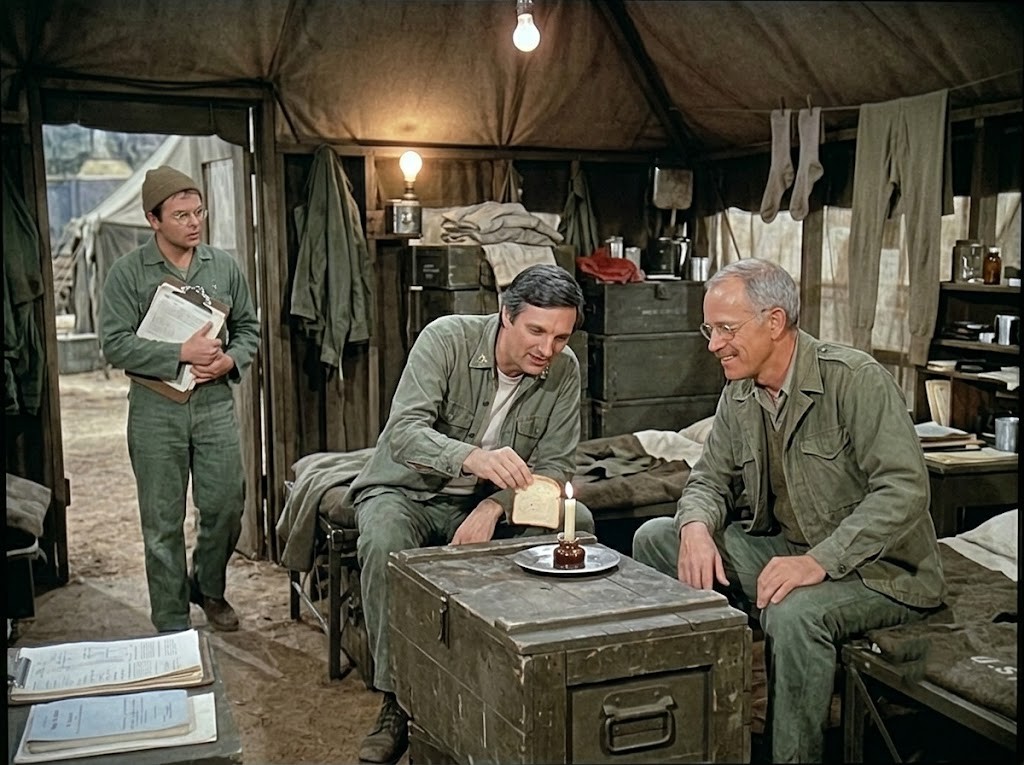
The chopper blades always leave a specific kind of silence in their wake. It is a heavy, ringing quiet that settles over the compound like dust, a brief intermission between the chaos of the choppers and the exhausting marathon of the operating room.
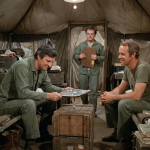
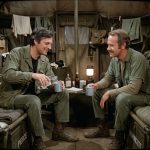
In the sudden stillness of the Swamp, Hawkeye sat on the edge of his cot, staring at a single, crumpled letter from Maine. He wasn’t cracking jokes, and he hadn’t reached for the still yet. He just sat there, his shoulders slumped under the weight of a war that seemed to have no end date, his eyes fixed on words written a world away.
B.J. watched him from across the room, polishing a pair of scuffed boots with a rag that had seen better days. He didn’t say anything at first because in the 4077th, you learned to read the silence before you read the room.
“Peg says the weather back home is turning cold,” B.J. said softly, breaking the quiet just enough to let Hawkeye know he wasn’t alone. “Says she had to pull the heavy blankets out of the trunk.”
Hawkeye didn’t look up, his thumb just tracing the edge of the paper. “My dad says the old maple by the driveway finally lost its branches in a storm. The one I used to climb when I was eight. Said it looked naked.”
Before B.J. could answer, the door to the Swamp creaked open, and Radar stepped in, holding a clipboard like a shield. His large glasses reflected the dim light of the tent, and his face carried that familiar look of earnest worry.
“Sirs?” Radar squeaked, his voice dropping an octave as he noticed the heavy mood. “Colonel Potter wants an inventory of the medical supplies by 1800 hours. And… and he looks like he’s about to start throwing things.”
Just then, the canvas door flapped again, and Charles Emerson Winchester III strode in, his posture rigid, his nose slightly in the air despite the layer of dust on his boots. “If anyone has stolen my Mozart recording, I shall personally see to it that you are reassigned to a geographic location where the primary language is spoken entirely in grunts.”
The contrast in the room was sharp—Hawkeye’s quiet grief, B.J.’s steady warmth, Radar’s nervous energy, and Charles’s defensive arrogance. It was the delicate, fragile ecosystem of the 4077th, where everyone used whatever armor they had just to get through the day.
Suddenly, a loud, metallic crash echoed from just outside the tent, followed by a sharp, collective intake of breath from the entire camp.
The crash wasn’t artillery; it was Klinger, who had dropped a massive tray of sterilized surgical instruments right outside the door. He stood frozen in a vibrant floral dress that looked entirely wrong for the mud, his hands raised in mock surrender as Colonel Potter marched toward him from the office.
“Klinger!” Potter bellowed, his voice like dry timber catching fire. “If those scalpels are dulled, I’ll have you wearing a GI uniform until the turn of the century!”
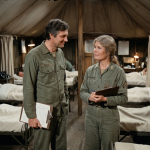
Margaret Houlihan appeared right behind the Colonel, her nurse’s cap perfectly pinned, though her face showed the deep lines of fatigue that no amount of military discipline could hide. “Colonel, the shift is already exhausted. We’ve been on our feet for fourteen hours.”
Father Mulcahy stepped up quietly between them, his gentle demeanor acting as a natural buffer. “Now, now, let us remember that accidents happen under the weight of exhaustion. A little patience goes a long way in purgatory.”
Inside the Swamp, the tension broke. Hawkeye finally looked up from his letter, a faint, tired smile touching the corner of his mouth. He stood up, folding the paper carefully and sliding it into his breast pocket, right over his heart.
“Well, Charles,” Hawkeye said, his voice regaining that familiar, dry cadence. “It seems the symphony outside is much louder than your Mozart.”
B.J. tossed his polishing rag aside and stood up, clapping a hand on Hawkeye’s shoulder. “Let’s go save Klinger from a court-martial. Or worse, from Margaret’s bad side.”
The men stepped out of the tent into the late afternoon sun. The camp was a mess of olive drab, mud, and makeshift clotheslines, but as the group gathered around the spilled tray, the anger evaporated.
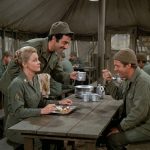
Potter sighed, his fatherly gaze softening as he looked at his tired crew. “Alright, clear it up. Let’s get some coffee in the mess tent. That’s an order.”
They walked together toward the mess tent—the surgeon from Boston, the boy from Iowa, the father from Missouri, and the wisecracking doctor from Maine. They were a family forged in the worst place on earth, bound together not by choice, but by a shared, beautiful humanity.
In the middle of nowhere, they found a way to bring each other home.