The Weight of the Wardrobe
The war had a way of wearing you down to the threads, but at the 4077th, those threads usually came in floral print and fringed boots.
It was mid-afternoon in Colonel Potter’s office, and the heavy canvas of the tent seemed to trap the heat, the dust, and the exhaustion of a grueling three-day session in the O.R.
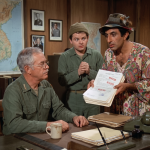
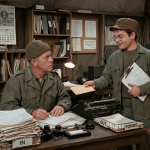
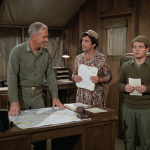
Sherman T. Potter sat behind his wooden desk, wearing his green fatigues and his soft cap, looking like a man who just wanted five uninterrupted minutes with a good cigar. Instead, he had Corporal Maxwell Q. Klinger.
Klinger stood front and center, dressed in what could only be described as a masterpiece of desperation. He wore a faded, knee-length floral housecoat over his olive-drab trousers. Draped over his shoulders was a thick, brown knitted shawl. On his head sat a crushed canvas bucket hat, and his feet were stuffed into a pair of fuzzy, feathered snow boots.
He looked entirely ridiculous. And he knew it.
Standing beside him, radiating pure military disapproval, was Major Margaret Houlihan. She held her clipboard tightly against the crisp, tailored front of her Class-A uniform. Her blonde hair was perfectly pinned, her posture rigid, and her face was set in a mask of absolute irritation.
“Colonel, I caught him trying to hand this to the motor pool dispatcher,” Margaret said, her voice sharp enough to cut through tent canvas. “He was trying to commandeer a jeep to Seoul.”
Klinger didn’t flinch. With the theatrical flair of a seasoned Broadway star, he held up a piece of standard military requisition paper. He gripped it with both hands, presenting it to Potter as if it were the Declaration of Independence.
“It is a fully authorized, legally binding, incontrovertible pass, Colonel!” Klinger announced, his eyes wide and earnest beneath the brim of his bucket hat. “Signed, sealed, and delivered by the highest echelons of command.”
Potter didn’t even reach for the paper. He just stared at the Corporal, resting his hands on the desk near his green rotary phone and the framed photo of Mildred.
“Klinger,” Potter sighed, the sound carrying the weight of thirty years in the Army. “You and I both know that General MacArthur did not sign a three-week furlough authorizing you to return to Toledo for a ‘mandatory consultation regarding severe wardrobe incompatibility.'”
“It’s a known medical condition, sir!” Klinger protested, shaking the paper. “My ankles are swelling! I’m breaking out in hives from the khaki! The General understands the plight of a fashion-conscious soldier!”
Margaret rolled her eyes to the canvas ceiling. “Colonel, I request permission to put him on garbage detail for a month. The forgery is in blue crayon.”
“It’s aquamarine, Major,” Klinger corrected, sounding deeply offended. “It’s a very soothing color for the mentally disturbed. Which I am. Clearly.”
Potter leaned forward to finally take the piece of paper. He fully intended to tear it up, assign Klinger to latrine duty, and go back to his paperwork.
But as Potter reached out, his hand brushed Klinger’s.
The Corporal’s hands were shaking.
It wasn’t a theatrical, exaggerated shiver. It was a fine, rapid tremor. A bone-deep vibration. Potter looked up from the paper and really looked at Klinger’s face.
Beneath the silly bucket hat, Klinger’s dark eyes were bloodshot. The goofy, pleading smile didn’t reach his cheeks. There were dark, bruised-looking bags under his eyes, and the line of his jaw was tight with a tension that had nothing to do with getting a Section 8.
Potter stopped. The annoyance drained right out of the old cavalry officer. He looked down at the paper in his hands. It was an old requisition form, filled with Klinger’s messy handwriting. But underneath the blue crayon, Potter could see the faint indentations of something else. Something typed.
Potter turned the paper over. Pinned neatly to the back of the fake pass was a yellow Western Union telegram slip.
The room suddenly felt very small, and very quiet.
“Major Houlihan,” Potter said, his voice dropping to a low, quiet rumble. “Close the door.”
Margaret blinked, surprised by the sudden shift in Potter’s tone. She looked at the Colonel, then turned and pushed the wooden office door shut. The sounds of the camp—the distant hum of generators, the shout of a corpsman—were instantly muffled.
Potter kept his eyes on the yellow telegram. He read it twice. He didn’t speak for a long time.
Klinger lowered his hands. The theatrical energy vanished, leaving him looking smaller, entirely swallowed by the oversized floral housecoat and the heavy brown shawl. He stared down at the toes of his fuzzy boots.
“Max,” Potter said softly. It was rare for the Colonel to use Klinger’s first name.
Margaret stepped closer to the desk, her military bearing softening as she sensed the shift in the room. She glanced down at the telegram in Potter’s hand.
It was from Klinger’s mother in Toledo. It was short. Just a few lines stating that Klinger’s Uncle Mustapha—the man who had practically raised him, the man who had bought Klinger his first suit and taught him how to laugh off a bad hand in poker—had suffered a massive heart attack. He had passed away on Tuesday.
Margaret’s breath hitched in her throat. She looked at Klinger.
The Corporal was staring at the floor, his jaw working as he tried to swallow down the emotion. A single, silent tear slipped out from beneath the brim of his bucket hat and rolled down his cheek, catching in the heavy stubble on his chin.
“I got it at mail call, Colonel,” Klinger whispered. His voice was cracked and hollow. “Yesterday morning.”
“Yesterday?” Margaret asked, her voice losing every ounce of its usual sharp edge. “Corporal, why didn’t you say something? Why didn’t you come to me, or Father Mulcahy?”
Klinger shrugged helplessly, the thick shawl slipping slightly off his shoulder. “Because… because if I tell the Padre, or if I tell the guys in the Swamp, then it’s real.”
He looked up, his eyes swimming with grief. “If I’m just crazy Klinger in a dress, trying to pull a fast one with a fake pass, then I’m just doing my routine. But if I take the dress off…” He swallowed hard. “…if I put on my uniform and stand at attention and say my uncle died, then I’m just a guy stuck 7,000 miles away from home, and I can’t even go to the funeral.”
The heartbreaking logic of it hung in the air. He wasn’t wearing the dress to get out of the Army today. He was wearing it to hide from the reality of the war, and the reality of the world spinning on without him.
Potter sighed, rubbing his forehead. He knew this pain. He had seen a thousand young men receive terrible news from home while trapped in a combat zone. It was a specific kind of helplessness that ate away at the soul.
“Max,” Potter said gently, leaning back in his chair. “You know I can’t authorize a compassionate furlough for an uncle. The Army doesn’t bend that far. I can’t send you to Toledo.”
“I know, sir,” Klinger whispered, wiping his nose with the back of his hand. “I just… I needed to pretend for a little while. I’m sorry to waste your time.”
Klinger reached out to take the paper back, ready to retreat in his fuzzy boots and his broken heart.
But Margaret moved first.
She stepped up to Klinger. Major Houlihan, the strict disciplinarian, the stickler for military code, reached out with both hands. Gently, with a tenderness she rarely let anyone see, she pulled the slipping brown shawl back up over Klinger’s shoulders. She smoothed the knitted fabric against his chest, her touch maternal and incredibly kind.
“It’s a little drafty in this tent, Max,” Margaret said softly, looking him right in the eye. “You keep wrapped up. We don’t want you catching a chill.”
Klinger stared at her, deeply moved by the unexpected grace. He nodded slowly. “Thank you, Major.”
Potter picked up his pen. He pulled a fresh, official requisition form from his drawer. He began to write, his handwriting bold and decisive.
“I can’t send you to Toledo,” Potter said without looking up. “But I have a friend down in Seoul. He runs the long-distance radio relay for the top brass. Sometimes, if a fella has a bottle of good scotch and a 48-hour pass, he can get a clear line straight to Ohio.”
Potter stamped the paper, signed his name, and held it out.
“You’re off duty, Corporal,” Potter said firmly. “Take a jeep. Go to Seoul. Call your mother. Cry with your family. And when you get back… we’ll be here.”
Klinger took the real pass. His hands were still shaking, but a tiny, fragile spark of gratitude lit up his dark eyes. He looked at the pass, then at Margaret, and finally at Potter. He didn’t offer a theatrical salute. He didn’t make a joke.
“Thank you, Colonel,” Klinger choked out. “Thank you both.”
He turned and walked out of the office, the screen door clicking gently shut behind him.
Potter sat in the quiet tent, looking at the maps of Korea on his wall. Margaret stood beside the desk, her arms crossed, her eyes still fixed on the door.
They were half a world away from everything they loved, but in that small, dusty office, they were taking care of their own.
At the 4077th, the greatest medicine they ever dispensed didn’t come from a bottle; it came from a shared understanding that nobody should have to carry the weight of the world alone.