The Letter that Mattered Most
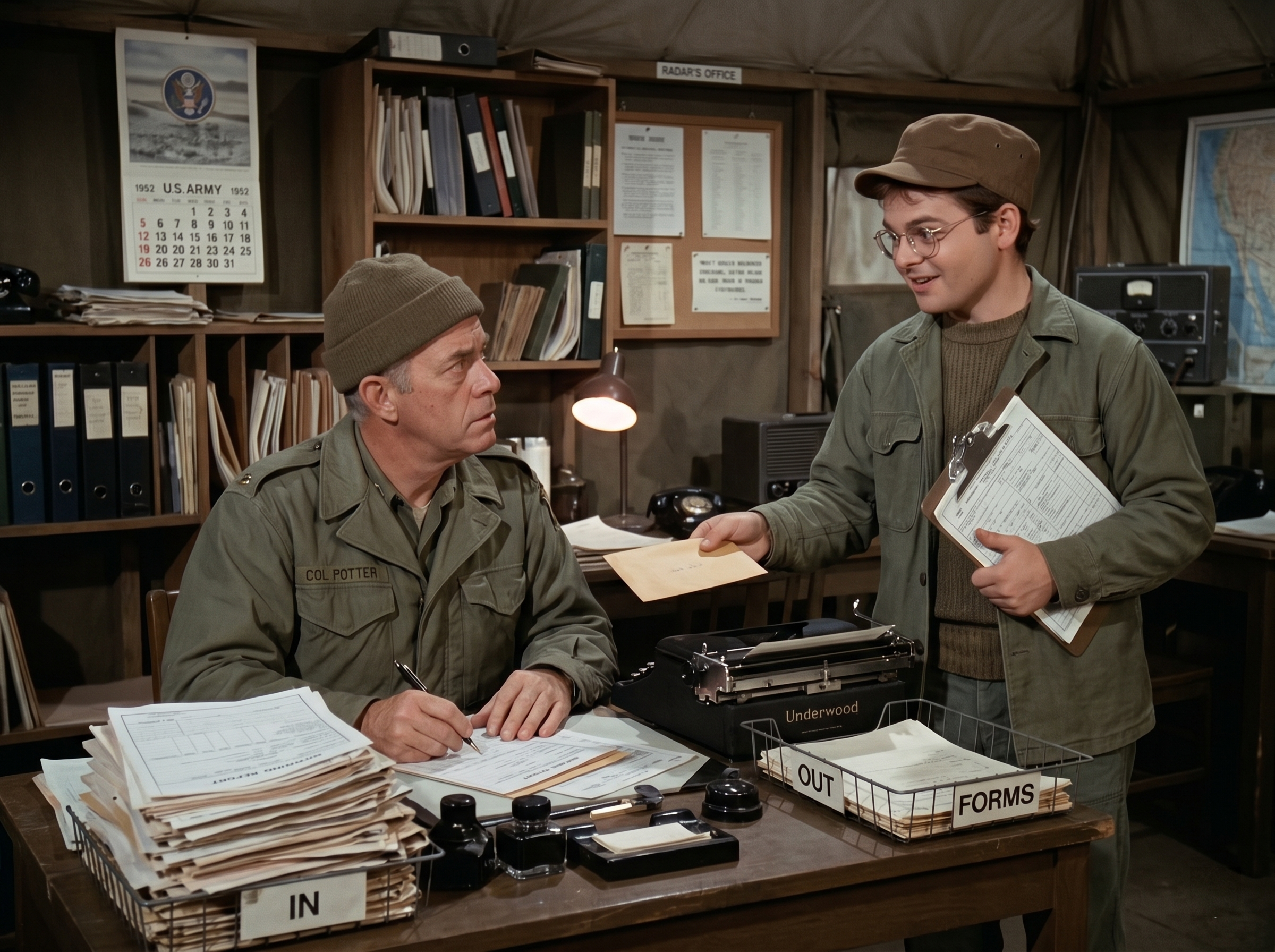
If the 4077th ran on blood, sweat, and coffee, it truly ran on mountains of paper.
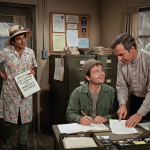
In the small, cluttered canvas office, Colonel Sherman Potter was fighting the unending war against Army forms.
The IN-basket on his desk was stacked so high with official requests and reclamation orders, it was practically its own topographical feature.
He was sitting with his head down, the green knitted beanie a small comfort against the damp air.
His pen was moving with the tired precision of a man who could sign his name and rank in his sleep.
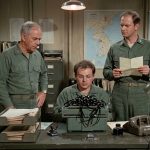
The only other sounds were the faint crackle of the radio and the steady tick-tick-tick of the Underwood typewriter, now momentarily silent.
Potter’s face was etched with a familiar fatigue. Every signature was another man, another mistake, another supply shortage.
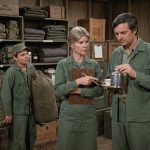
Enter Radar. The heart of the office. The clerk who seemed to conjure efficiency out of thin air and could file a request faster than a MASH surgeon could stitch a laceration.
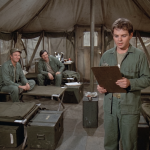
He approached the desk, his clipboard and a single, innocuous brown envelope clutched in his hands.
Radar’s signature round glasses were perched on his nose, and his brown cap was set at its usual, slightly hopeful angle.
He saw the mountain of forms. He saw the Old Man’s tired shoulders.
Instead of adding to the stack, Radar held the single envelope out.
Potter stopped. His pen, poised above the next form on the smaller ‘signed’ pile, hovered in mid-air.
He looked up from the bureaucratic sea, directly at the single piece of mail, and then at the clerk.
There was something in Radar’s face that stopped him. It wasn’t just a delivery; it was a special delivery.
Radar wasn’t looking at the forms; he was looking at the man behind the desk.
Potter saw a look in Radar’s eye—a simple, innocent gravity that the kid rarely showed.
The single envelope seemed to have a weight that eclipsed the entire ‘IN’ basket.
Potter raised an eyebrow, his fatherly gaze searching. “What have you got there, Walter?”
Radar swallowed. His earnest smile was small and private.
“I was sorting the ‘Irrelevant Request’ files, sir. The pile that we keep ‘misplacing’ from Seoul.”
He held the envelope just a little closer to Potter’s hand.
“And, well… I didn’t think this belonged in there. It’s for you, Colonel.”
A hush fell over the small office, deeper than any combat lull.
Potter paused, his hand reaching not to take the official form, but to receive the one, single, simple truth.
Colonel Sherman Potter hesitated.
The paper felt different than the countless forms he’d handled over the last four years.
It was heavier, more worn, like a promise kept for a long time.
He took the envelope gently. It wasn’t sealed, just tucked in.
Radar didn’t move. He stood, his expression frozen between a broad, hopeful smile and nervous expectation.
Potter, with a deliberate motion, opened the flap. He didn’t rush. He had learned that the most important things in Korea were worth the patience.
Instead of a letter or an order, he pulled out a small, slightly faded photograph.
The silence in the tent grew. It wasn’t the kind of silence that precedes an attack; it was a quiet, deep, reverent still.
Potter ran a calloused finger over the picture, and the weariness of a thousand surgical shifts seemed to melt from his face.
He saw the grassy hill, and the sturdy white house. But more importantly, he saw the mare.
“My word,” he whispered, his voice cracking ever so slightly. “Sophie.”
The name escaped him as a simple prayer of recognition and relief.
It was an old photo, one his wife must have tucked into a letter months, or perhaps even years, ago. A piece of peace that had been lost and finally found.
He could practically smell the hay and feel the cool wind of his Missouri farm.
He looked at the image, then looked up at Radar, who was practically vibrating with pride, a wide, true grin spreading across his face.
“How on earth did you get this, son?” Potter asked, showing more sentimentality than his rank allowed.
Radar shifted his feet, looking down. “I told you, sir. I found it when I was cleaning out the ‘Dead Letter’ files. It was stuck in a stack of outdated field guides to… indigenous grasses of Korea.”
He raised his head, eyes shining behind his glasses. “I didn’t think it belonged on the pile.”
They shared a long moment that was more meaningful than any commendation.
The endless stream of forms was the war. It was the grind that could break your spirit.
This photograph was the reason they were still fighting the forms—to protect the world where things like this still existed.
Potter knew Radar could have just put it in a ‘personal mail’ folder and delivered it on schedule.
But he also knew that Radar had recognized that *this specific moment* was exactly when a lonely, tired colonel needed it the most.
Potter took a slow breath, absorbing the comfort and the simple kindness of the delivery.
He gently placed the faded photograph into his shirt pocket, right against his chest, next to his heart.
He picked up his pen again. The mountain of official forms was still there, but it didn’t look quite so oppressive now.
He looked at the next document, a requisition form for whole blood that was six weeks overdue.
He signed his name, but this time, he was signing it as a man who knew what he was protecting.
He glanced up at Radar. The young clerk, his mission complete, turned back to file something in the shelves behind him, a small spring in his step.
The Underwood typewriter clicked into life again.
The work continued, but for a few precious seconds, the small, canvas tent had contained everything that truly mattered.
It was just one lost photograph and one observant clerk, but in a world of endless gray, it was the only light that was shining that night.