The Exact Measurements of Missing Home
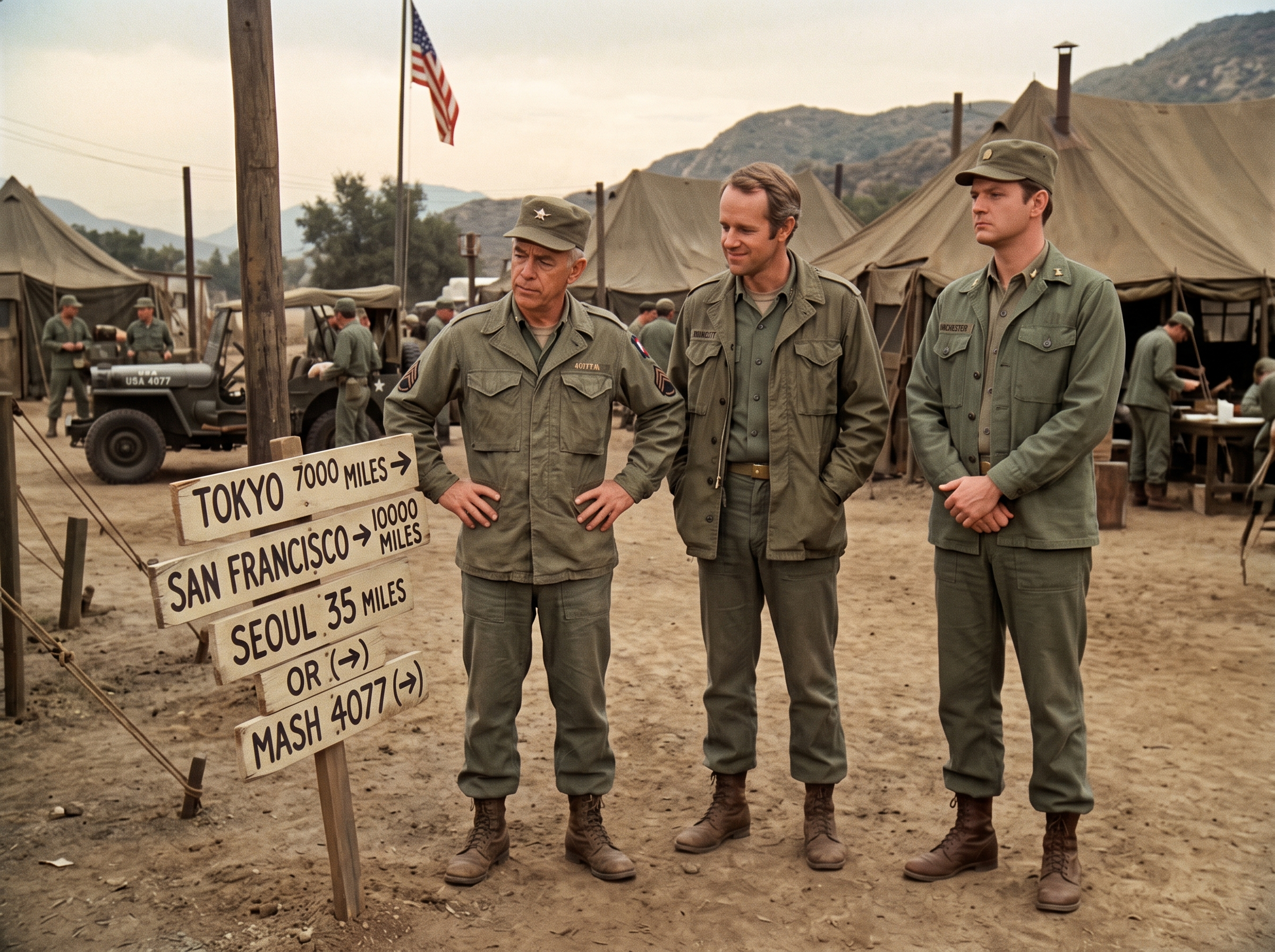
The war had a funny way of making the smallest things feel like a matter of life and death.
On a quiet Tuesday afternoon at the 4077th, the crisis wasn’t a sudden rush of incoming wounded or a critical shortage of surgical gauze. It was a piece of scrap wood, a can of leftover yellow paint, and a deeply offended surgeon.
The soft, slightly warm daylight washed over the outdoor compound, baking the endless Korean dirt into a fine, powdery dust that clung to everything.
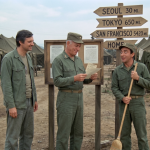
In the center of the camp stood the famous wooden directional signpost. It was a splintered monument to homesickness, pointing the way to places none of them had seen in months.
Today, a new addition had been nailed near the top.
Colonel Sherman Potter stood before it, his feet planted firmly in the dirt. His hands rested on his hips in a stance of calm, unyielding authority.
Beneath his faded olive-drab hat, Potter’s face projected a dry, fatherly exasperation. He squinted at the newly attached board, which leaned aggressively downward at a comical, defeated angle.
Beside him, Captain B.J. Hunnicutt stood with his hands buried deep in his pockets.
B.J. looked perfectly worn in, his posture relaxed and his eyes crinkling at the corners. He offered an understated, knowing smile, entirely amused by the minor absurdity unfolding in front of them.
“I’m no surveyor, mind you,” Potter drawled, his voice carrying that familiar, gravelly Midwest cadence. “But I’m fairly certain this new sign is pointing directly into the enlisted men’s latrine.”
B.J. chuckled softly, his mustache twitching with a supportive, dry reaction. “Well, Colonel, depending on who you ask, that might be a highly accurate representation of the destination.”
Standing slightly apart from the two of them was Major Charles Emerson Winchester III.
Charles was not amused. His posture was upright, rigid, and intensely controlled.
Even in his standard-issue fatigues, Charles managed to look as though he were wearing a three-piece suit that had been profoundly insulted by the weather.
His expression was a masterpiece of wounded pride and refined irritation. He glared at the dusty environment, and then at the crooked wooden sign that read: BOSTON – 7,934 MILES.
“It is not a joke, Hunnicutt,” Charles snapped, his aristocratic baritone tight with indignation. “I explicitly instructed the motor pool to measure the trajectory with absolute precision. This… this leaning abomination is an insult.”
“It’s just gravity, Charles,” B.J. offered mildly. “The wood is heavy. The nails are old. It’s the 4077th. Nothing around here stands perfectly straight.”
“I do,” Charles replied instantly, his chin lifting a fraction of an inch.
Potter sighed, shaking his head. “Major, the sign is up. You’ll just have to tilt your head a little to the left when you get homesick.”
But Charles didn’t soften. He stared at the crooked lettering, the yellow paint dripping slightly at the edges, and the sheer indignity of it all seemed to suddenly crash down on his shoulders.
The humor bled out of the moment, leaving only the exhaustion of a man who was thousands of miles away from everything he loved.
“It is not about the tilt, Colonel,” Charles said, his voice dropping into a quiet, raw register that made B.J.’s smile fade. “It is the principle. I have surrendered my practice, my symphony, and my basic human comforts to this godforsaken dirt path.”
Charles took a breath, his hands trembling faintly at his sides.
“Is it so much to ask,” Charles whispered, his eyes locked on the crooked wooden board, “that for one brief, fleeting moment, the direction to my home might be treated with a modicum of dignity?”
Without waiting for an answer, Charles turned sharply on his heel. He walked away toward the Swamp, leaving Potter and B.J. standing in a heavy, unexpected silence.
The dust settled slowly over Charles’s footprints.
For a long minute, neither Potter nor B.J. said a word. The distant, rhythmic thud of an artillery battery echoed from over the hills, a constant reminder of why they were all trapped in this canvas purgatory.
Potter kept his hands on his hips, his jaw working thoughtfully as he stared at the crooked sign.
B.J. pulled his hands from his pockets and ran a hand through his hair, the easy amusement completely gone from his eyes.
“Well,” Potter murmured quietly, shifting his weight. “That boy’s string is wound just about as tight as it can go.”
“He’s hurting, Colonel,” B.J. said softly. “We all are. He just hides it behind a thicker wall of vocabulary than the rest of us.”
Potter nodded slowly. He looked at the signpost. There was Toledo. There was San Francisco. There was Coney Island.
Every single piece of scrap wood on that post was a desperate little prayer wrapped in a joke.
“Hunnicutt,” Potter said, turning his head. “Go find me a hammer. And see if Klinger has a level in that bottomless pit of a supply tent.”
B.J. smiled, a genuine, warm expression this time. “Yes, sir.”
Ten minutes later, the two men were back at the post.
The afternoon sun was beginning to dip lower, casting long, golden shadows across the compound. The camp was quiet, trapped in that heavy, lethargic stillness that always came before the helicopters returned.
Potter stepped up to the post, bracing one hand against the weathered timber.
B.J. held the Boston sign steady, lifting the drooping edge until the bubble in the rusted metal level sat perfectly between the lines.
“Hold her right there, son,” Potter said gently.
With a few sharp, decisive strikes of the hammer, Potter drove a pair of heavy nails into the wood, securing the sign firmly in place.
They both stepped back, wiping the sweat and dust from their foreheads.
The board no longer drooped toward the dirt. It pointed straight and true, slicing through the warm air like an arrow aimed directly at the horizon.
“Looks good, Colonel,” B.J. said, his voice quiet in the fading light. “Precision engineering.”
“My grandfather was a carpenter in Missouri,” Potter said, staring at the sign. “He always told me that if you’re going to build a bridge back home, you’d better make sure the foundation is level.”
B.J. nodded, his mind briefly wandering to a little house in Mill Valley, and a little girl growing up without him. He swallowed hard, pushing the thought back down.
“You think he’ll notice?” B.J. asked.
“He’s Winchester,” Potter said with a dry, affectionate scoff. “He notices everything. He just won’t ever admit it.”
They turned and walked away, heading toward the mess tent as the smell of powdered eggs and burnt coffee began to drift through the camp.
An hour later, the sun dropped behind the Korean mountains, painting the sky in deep shades of bruised purple and fiery orange.
The door to the Swamp opened with a faint squeak.
Charles stepped out into the cool evening air. He had washed his face, combed his thinning hair flawlessly into place, and buttoned his jacket to the collar.
He looked exhausted, carrying the heavy, invisible weight of another day lost to the war.
He began to walk toward the officer’s club, keeping his eyes firmly fixed on the ground to avoid looking at the dust.
As he passed the center of the compound, he stopped.
He slowly looked up at the signpost.
There, near the top, the Boston sign sat perfectly, wonderfully horizontal. The crooked, defeated angle was gone. It was resolute. It was dignified.
Charles stood alone in the dimming light, staring at the painted yellow letters.
Across the compound, sitting on a wooden crate near the mess tent, B.J. was quietly whittling a stick. Colonel Potter was leaning against a tent pole, calmly puffing on a cigar.
Neither man looked in Charles’s direction. They just sat in the quiet, giving him the space he needed.
Charles’s rigid posture slowly began to soften. The tight, wounded line of his mouth relaxed into something resembling peace.
He didn’t call out to them. He didn’t march over to offer a grand, eloquent speech of gratitude. He knew, and they knew, that some things in this place were too fragile to be spoken aloud.
Instead, Charles simply reached up, adjusted the lapels of his jacket, and stood just a little bit taller.
He gave the perfectly straight sign one last, lingering look of deep affection, then turned and walked toward the mess tent, his footsteps steady on the dusty ground.
He was still thousands of miles away from everything he loved.
But for tonight, at least, he knew exactly which way to look.
In the 4077th, the most important surgery they performed never happened in the O.R.—it was the quiet, daily work of keeping each other’s hearts stitched together.