Late-Night Rations and the Cost of Saving Lives
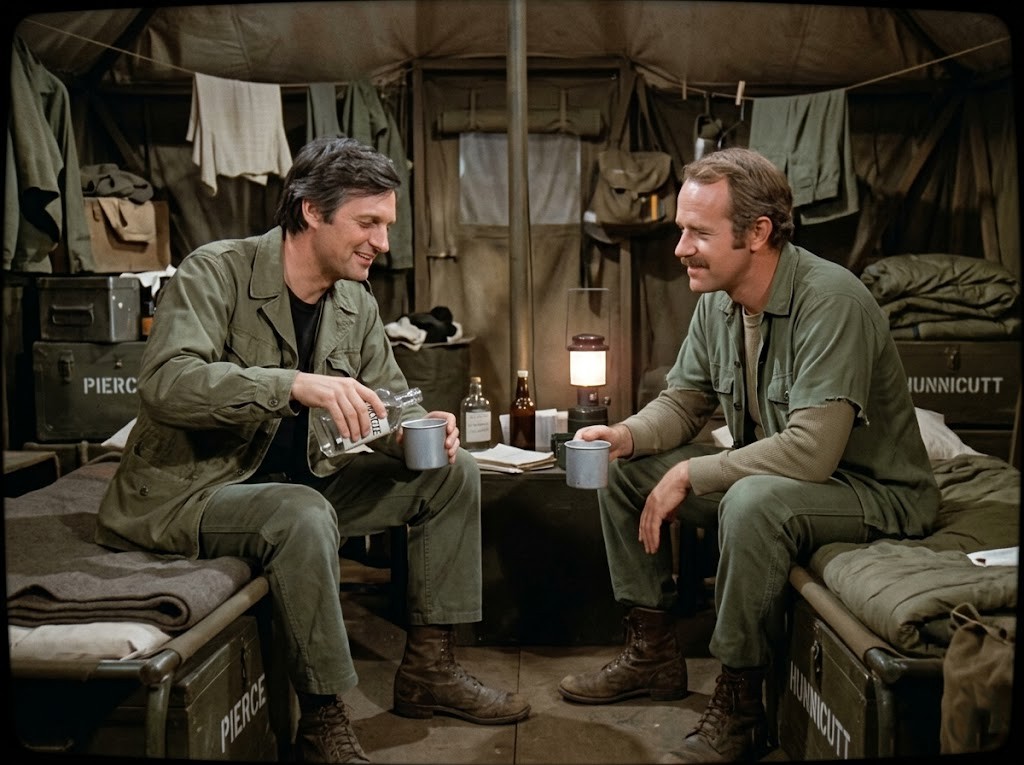
The Swamp always smelled of three things after a forty-eight-hour session in O.R.: stale sweat, cheap gin, and the damp, heavy mud of Uijeongbu clinging to the floorboards.
Tonight, the silence in the tent was so loud it made Hawkeye Pierce’s ears ring.
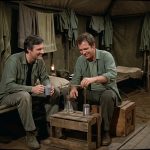
He sat on the edge of his cot, still wearing his olive-drab fatigues, his boots caked in Korean clay that refused to dry. His shoulders slumped forward under a weight that didn’t stop pressing down just because the chopper blades had finally stopped spinning. Across from him, on the twin cot labeled ‘HUNNICUTT’, B.J. sat in exactly the same posture, his sleeves rolled back, his mustache twitching slightly as he let out a long, shuddering breath.
Between them stood the small wooden crate they used as a table, holding a half-empty bottle of homemade gin and two battered, grey army-issue metal mugs.
“I counted eleven,” Hawkeye said, his voice scratchy and rough, like someone had rubbed sandpaper over his vocal cords. He lifted the glass bottle, his fingers slightly unsteady, and began pouring a stream of clear, pungent liquid into B.J.’s cup. “Eleven times I thought the lights were going to cut out completely while I had my hand inside that kid from Ohio.”
B.J. didn’t reach for the mug right away; he just watched the gin rise, his eyes dark with a kind of exhaustion that sleep couldn’t fix. “The lights stayed on, Hawk. Barely. But they stayed on.”
“It’s a design flaw in the universe,” Hawkeye muttered, moving the bottle over to his own mug, pouring with the practiced precision of a surgeon who could find a bleeder in the dark but couldn’t stop his own hands from shaking at 3:00 AM. “They give us these hands to patch up nineteen-year-olds, but they don’t give us a reset button for when the stitches don’t hold.”
A faint hum from the single lantern hanging near the tent pole filled the gap between them, casting long, soft shadows across the canvas walls. Out in the compound, a jeep backfired, and both men flinched—just a fraction of an inch—before settling back into their stillness. It was a reflex they’d both given up trying to cure.
Hawkeye set the bottle down with a soft click against the wood. He looked across at his friend, trying to find a joke, a piece of dry New England wit, anything to break the heavy grey fog that had settled over the Swamp.
“You know,” Hawkeye said, a small, tired smile tugging at the corner of his mouth, “if we drank this stuff back in Maine, they’d arrest us for operating an unlicensed chemical plant. Here, it’s considered an essential medical supply.”
B.J. finally looked up, his eyes softening as he picked up his metal cup. “To the chemical plant,” he murmured, raising it an inch. “And to the kid from Ohio.”
They clinked the mugs together—a dull, metallic sound that felt terribly small in the middle of a war zone.
Hawkeye took a swallow, the heat of the gin burning its way down his throat, providing a brief, welcome distraction from the cold ache in his lower back. He stared down into his mug, his expression suddenly shifting from exhausted amusement to something much sharper, much darker. The smile vanished completely.
“B.J.,” Hawkeye whispered, his voice dropping an octave, his fingers tightening around the metal handle until his knuckles turned white. “The last one. The sergeant with the green sweater under his jacket. When I was closing… I found a letter in his pocket. It fell out onto the floor.”
B.J. stopped his mug halfway to his lips, sensing the sudden shift in the air. “Hawk. Don’t. You know you shouldn’t read them.”
“I didn’t mean to,” Hawkeye said, his eyes fixed on the floorboards between their boots, his face pale under the lantern light. “It was open. It was from his daughter. She’s seven. She drew a picture of a house with a chimney and a big yellow sun. And B.J… I don’t think he’s going to make it through the night.”
The confession hung in the warm, dim air of the tent like a physical weight, heavier than the artillery fire that rumbled miles away over the hills.
B.J. slowly set his mug back down on the crate. The quiet warmth that usually defined him seemed to solidify into a steady, protective shield. He didn’t offer a hollow platitude; he knew Hawkeye didn’t want comfort that wasn’t true.
“We did everything we could, Hawk,” B.J. said softly, his voice grounded, a calm anchor against the storm brewing behind Hawkeye’s eyes. “You spent three hours on him. I watched you. You didn’t leave a single millimeter of tissue unexamined.”
“It wasn’t enough,” Hawkeye said, his voice cracking slightly as he stared at his boots. “It’s never enough. We fix the skin, we patch the holes, but we can’t sew the family back together if the heart stops ticking in the recovery tent.”
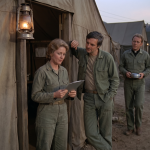
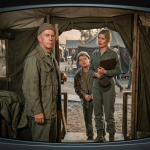
Suddenly, the canvas door flap rustled, and a small, familiar figure stepped into the Swamp, holding a clipboard against his chest like a shield. Radar O’Reilly looked smaller than usual in his oversized olive jacket, his cap pulled low, his eyes wide behind his spectacles. He looked between the two surgeons, his radar-like intuition instantly registering the temperature of the room.
“Sirs?” Radar squeaked, his voice hesitant. “Colonel Potter wanted me to check… he saw the light on. He wanted to make sure you guys weren’t… well, you know. Setting fire to the place with the still again.”
Hawkeye didn’t look up, but his tone softened just a fraction. “Come on in, Radar. Grab a mug. We’re just evaluating the quality of our latest batch of industrial solvent.”
Radar took a step closer, looking at the bottle, then at the heavy silence sitting between the cots. He didn’t take a drink; instead, he set the clipboard down on the corner of Hawkeye’s foot-locker.
“The sergeant, sir,” Radar said quietly, his voice carrying that innocent, earnest weight that always seemed to cut through the cynicism of the camp. “The one from the 8th Cavalry. Post-op just called. His fever broke about ten minutes ago. Nurse Able says his pulse is steadying out.”
Hawkeye’s head snapped up. The lines of tension around his eyes didn’t vanish, but they loosened, just a little. “Steadying? Are you sure, Radar? He was bleeding from three different places when we rolled him out.”
“Yes, sir,” Radar nodded, a small, genuine smile appearing on his round face. “He asked for water. And… he asked if anyone found his letter. I told them I’d look for it.”
Radar reached into his pocket, pulled out a slightly crumpled piece of paper with a colorful crayon drawing visible on the back, and placed it gently next to the bottle of gin. He gave a small, respectful nod, turned on his heel, and slipped back out into the night before either man could say another word.
The tent fell silent again, but the quality of the silence had changed. The grey fog had lifted, replaced by the quiet, fragile return of hope.
B.J. looked at the letter, then looked across at Hawkeye. A slow, gentle grin spread across his face, his mustache lifting. “A house with a chimney, huh?”
Hawkeye let out a long breath, a sound that was half-laugh, half-sob. He picked up his metal mug again, his hand notably steadier than it had been five minutes prior. The cynical mask he wore to protect himself from the reality of the 4077th slipped away, leaving only the tired, deeply human man underneath.
“A house with a chimney,” Hawkeye agreed, his eyes shining in the lantern light. “And a very poorly drawn dog, if I remember correctly.”
He extended his cup across the crate. B.J. met it with his own, the metallic click sounding much louder this time, resonant and clear in the small canvas sanctuary.
They drank, not to forget the pain of the last forty-eight hours, but to celebrate the one life that had slipped through the fingers of the war and stayed with them. Outside, the Korean wind swept through the camp, rattling the ropes of the tents, but inside the Swamp, beside a glowing lantern and a bottle of terrible gin, two friends found the strength to face whatever the morning choppers would bring.
Sometimes, the best medicine in Korea didn’t come in a vial; it came in a metal cup shared with a brother who understood the weight of the world.