That Old Familiar Script
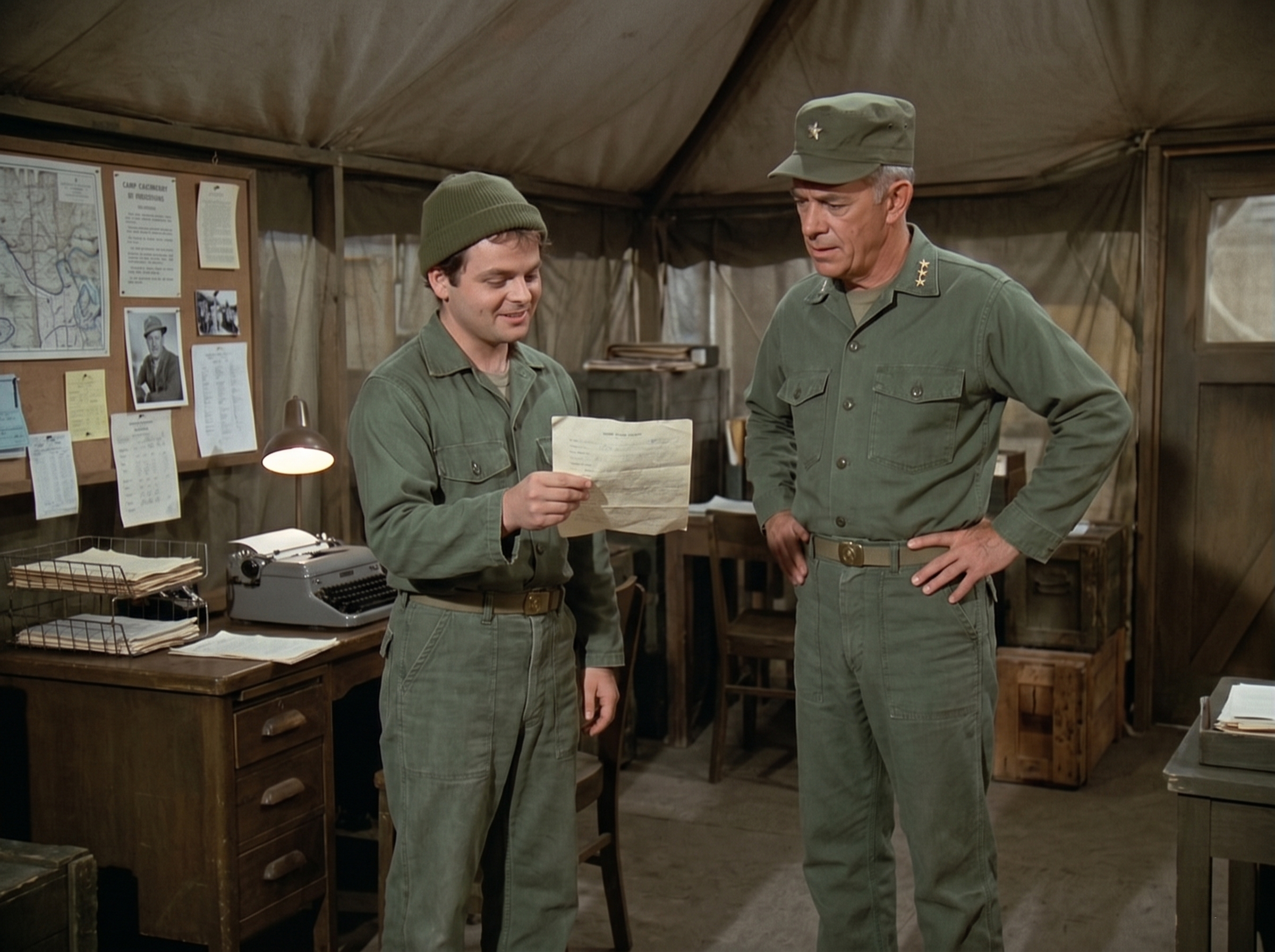
If there was one sound that summed up life at the 4077th, it was the clatter of a typewriter.
It was the heartbeat of the administration tent, the tireless rhythm of Radar O’Reilly translating chaos into carbon copies. He lived in that little patch of canvas, his World War II issue wool cap practically glued to his head, keeping the brass in Seoul slightly less annoyed.
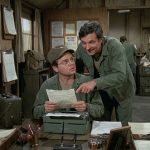
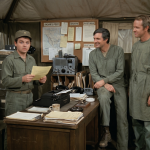
Outside, the air was still and warm. The noise of a few trucks was all that broke the afternoon lull. Inside, however, a critical event was unfolding, witnessed by a weary Colonel Potter standing just a step away.
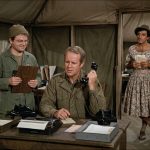
Potter had his hands on his hips, a pose he used when he was either ready to discipline someone or trying very hard not to. Today, it was the latter.
He was watching Radar hold a piece of paper, and the expression on Radar’s face, partially obscured, had the Colonel holding his breath. It was a nervous, expectant smile, a flicker of genuine hope shining through the fatigue that lived permanently under that wool cap.
It wasn’t an incoming requisition for plasma, and it wasn’t another directive from I-Corps about properly labeled latrine trenches. It was personal mail.
Specifically, it was *his* personal mail. In fact, it was a letter.
“Well, Radar?” Potter’s voice was uncharacteristically quiet. The dry rattle from his throat was gone, replaced by a strange, gentle tension. He glanced toward the bulletin board with the maps and rosters, avoiding Radar’s eyes directly. “Are you going to read it, or just stare at it until it turns to confetti?”
Radar’s fingers, stained with ink from endless ribbons, slightly trembled. He was holding the cream-colored sheet up, his gaze locked onto the handwritten cursive.
“It’s from her, sir,” Radar whispered, his nervous smile broadening just enough to show. “From… from back home.”
“Yes, I gathered that,” Potter replied, still resisting the urge to pace. The silence in the tent felt heavy, a counterpoint to the busy camp life continuing just outside the door.
Potter had seen thousands of soldiers get letters. He knew the drill. Most were messy, grease-stained, tear-soaked missives. This one, however, seemed different. It was on quality stock. The handwriting was perfect. It felt important.
Radar continued to stare at the first line, the words blurring as his eyes welled up. He’d waited months for this. Ever since he’d worked up the courage to send her that nervously composed letter from the Swamp late one night, when Hawkeye and BJ were safely asleep (or unconscious), his heart had been a knot of anticipation.
He’d asked for permission, a simple request to *write* to her. It was a terrifying, delicate first step for a farm boy in a war zone who felt invisible.
Now, the response was here. It was a three-page letter, and as the Colonel knew, the first three pages of *any* letter from *that* particular kind of correspondence were usually just the warm-up act for the real purpose.
The next few lines, the ones Radar was struggling to read, held the answer.
Potter watched Radar’s throat move. He saw the grip on the paper tighten. He knew exactly what was happening. Radar was terrified to read the words that could crush everything or start something wonderful.
The tension in the admin tent was thicker than any fog from the Yellow Sea. Radar took a deep, shaky breath, and the tent, for one fragile moment, seemed completely silent.
He started to read the first full sentence aloud, his voice cracked.
“…*my dearest Walter,*…” Radar managed to choke out. He stopped, looking up at the Colonel, his nervous smile now completely frozen, a mask of sheer panic beginning to show in his eyes, just slightly wider than normal. He looked at the paper again, but the words were a jumble. “I… I can’t do it, sir. My hands are shaking too much.”
Potter didn’t hesitate. He took one step closer, a move that carried all the authority and empathy he possessed. He looked at the paper, and then he made his move. It was a silent, understanding action. He gently reached out and slipped the sheet from Radar’s grasp.
Radar resisted for a microsecond before surrendering it, his eyes dropping to the floor. The nervous smile was gone, replaced by a look of sheer vulnerability. He was the efficient clerk who could predict helicopter landings and negotiate impossible logistics, but he was also a homesick young man who missed everything about Iowa, and right now, he felt more the latter than the former.
“Hand it over, son,” Potter said gently, the fatherly authority smooth and confident. He took a single breath and turned his attention to the letter, adjusting his cap slightly as he prepared to perform a duty that wasn’t in any official manual.
The scene, captured perfectly, shows Radar’s nervous, expectant smile frozen, a silent plea hanging in the air. He is looking at the paper as if it contains the secret of the universe, and right at this precise moment, for him, it does. Colonel Potter, his hands still on his hips, is locked onto the paper, a picture of steady command that masks his own genuine emotion. It’s the face of a man who is about to read the fate of someone he considers family.
The light from the desk lamp spills across the desk, illuminating the typewriter, the in-and-out trays overflowing with papers, and the bulletin board, a stark reminder of the bureaucratic machinery of war. But here, in this instant, the only machine running is human.
“Right,” Potter stated, clearing his throat, his eyes scanning the first paragraph. He wanted to make sure he was reading it correctly, for both their sakes. He paused, making Radar wait, which was cruel but necessary.
“Colonel?” Radar prompted, his voice barely a mouse squeak.
“She says…” Potter began, his voice surprisingly deep and clear, a dramatic reading of life. “…she says that my last letter was the most ‘unusually thoughtful and remarkably composed’ correspondence she has ever received. And she appreciates my asking.”
Radar’s smile cracked open slightly more. A true smile, not the nervous mask. He looked at the paper again.
Potter continued. “She goes on, ‘Walter, you are… an exceptionally dedicated young man, and I have always admired your resilience.’” Potter paused, letting that sit. He stole a look at Radar. The boy’s eyes were glistening. He looked away, embarrassed, focusing on the typewriter as if he were trying to find an *’R’* on the keyboard.
“RESILIENCE?” Radar repeated, incredulous. “Is that good?”
“I’d say that is *exceptionally* good, son,” Potter said, continuing. “And she says, ‘I look forward to hearing more from you, Walter. In the meantime, I am enclosing…’ Hmm.”
Potter trailed off, flipping the single page over. “Enclosing what?”
“What’s enclosed?” Radar’s panic returned. He started moving towards the sheet as if he wanted to tear it out of Potter’s hands. “Did she enclose anything? There was nothing in the envelope!”
Potter didn’t answer right away. He was scanning the reverse side, and then he finally broke into a gentle, genuine grin. “No, nothing in the envelope. But I see what she means. She says, ‘I am enclosing my permission, of course. Please do continue to write, as often as you like.’”
Radar stopped moving. The entire admin tent seemed to exhale. The maps didn’t seem so intimidating, the maps of battles they weren’t winning. The typewriter wasn’t so noisy. For that small, singular moment, the 4077th felt far away from everything. It just felt like home.
Radar let out a sound that was half-laugh, half-sob. He snatched the paper back from Potter, holding it like a precious, delicate thing. He looked at it again, his thumb gently smoothing out the edge where he had held it. He read the permission sentence silently.
“She wants me to write,” he whispered. “More letters.”
“Looks that way, son,” Potter replied, finally turning away and heading back to his own desk. He had requisition forms to sign that actually mattered to the army, but for some reason, he didn’t feel like working on them just yet. He picked up his coffee cup. It was cold. It always was. He drank it anyway.
He sat down, and for a long moment, there was no sound of a typewriter.
Radar remained standing, still looking at the cream-colored sheet. He then moved over to the desk lamp. He adjusted the lamp neck slightly, letting the light fall directly onto the text, as if it would help him understand it better. He read it again. And again. And then, he didn’t read it. He just held it.
The nervous, expectant smile was back, but now it was a private, confident one. It was the smile of a soldier who had won a battle he never thought he could even fight. The admin tent, usually the center of bureaucracy, was now, for one person, the center of hope.
And as the sun began to dip outside, casting long shadows across the canvas, the first keys of the typewriter finally began to clatter. It was a familiar, rhythmic sound, but today, it seemed a little lighter, a little faster, and a whole lot more meaningful.
It was just another piece of paper moving through the system, but this one was the most important document in the entire Korean theater.
And for a few beautiful moments, the admin tent was simply the heart of a home.