The Heavy Weight of a Thin Wire
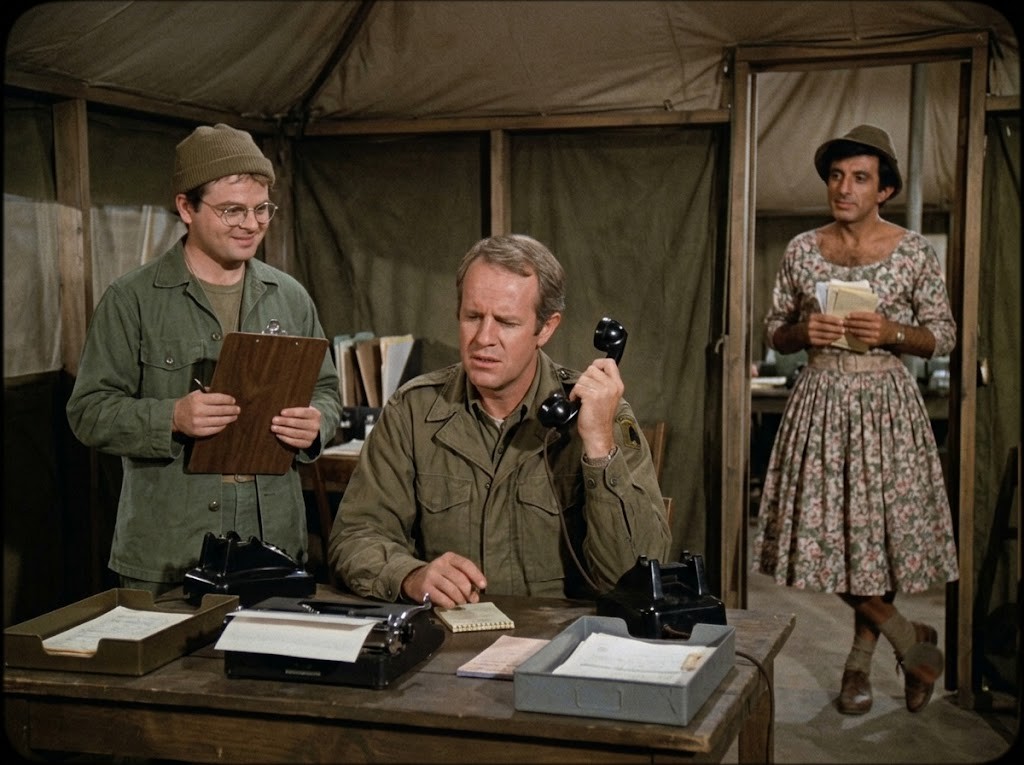
The line to Seoul was always held together by tape, prayer, and the absolute refusal of the 4077th to let the rest of the world fade away.
In the corner of the clerk’s office, the steady, rhythmic *clack-clack-clack* of Radar’s typewriter usually provided the background heartbeat of the camp. But today, the keys were silent, replaced by a heavy, suffocating silence that felt far larger than the canvas tent itself.
Colonel Potter sat behind the wooden desk, the black telephone receiver pressed tightly against his ear, his face etched with a sudden, devastating gravity.
Radar stood frozen at his shoulder, a wooden clipboard hugged tightly against his chest like a shield, his eyes wide behind his spectacles as he watched his commander’s face drop. He didn’t need to hear the voice on the other end of the line; he could feel the shift in the air, the way the ambient noise of the Korean peninsula seemed to vanish into the mud outside.
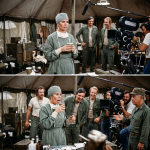
In the doorway, Klinger stopped dead in his tracks, his latest floral-print dress hanging loose against his frame and a bundle of incoming mail forgotten in his hands. The usual theatrical flair, the grand protestations, the constant schemes for a crazy-discharge—all of it evaporated in an instant as he saw the stiff line of the Colonel’s shoulders.
Potter didn’t say a word, his jaw clenched so tightly the muscle twitched beneath his weathered skin, his eyes staring blankly at the scratch pad on the desk.
“Sir?” Radar whispered, the word barely catching the air, his young voice trembling with the instinctive terror of a boy who knew that some phone calls changed everything.
The Colonel didn’t answer right away; he just closed his eyes, took a long, slow breath through his nose, and quietly set the receiver back onto its cradle with a soft, definitive click.
“That was Tokyo,” Potter said, his voice flat, stripped of its usual cavalry bark, sounding older than the hills surrounding the compound. “They’re holding a transport at Kimpo. We’ve got an emergency compassionate leave authorization.”
Radar swallowed hard, his fingers tightening on the edge of the clipboard. “Is it… is it one of our people, Colonel?”
Potter looked up, his gaze drifting from Radar over to Klinger, who was still standing motionless by the screen door, the bright pink flowers on his skirt looking completely out of place against the drab green canvas. For a long, agonizing moment, nobody breathed, the hum of the generator outside filling the void as they waited for the name to drop like a shell.
“It’s Sergeant Maxwell,” Potter said softly, looking directly at Klinger, his eyes filled with a deep, fatherly sorrow that no manual could ever teach. “Your mother, son. She’s taken a very bad turn. They don’t think she’s going to make the week.”
Klinger’s breath hitched, the stack of letters slipping from his fingers and scattering across the dirt floor like dead leaves. The man who had spent months screaming at the top of his lungs for a ticket home to Toledo suddenly couldn’t find a single syllable to utter.
Radar moved instantly, dropping his clipboard onto the desk and stepping toward his friend, his hand reaching out to steady Klinger’s arm as the taller man’s knees seemed to give way slightly.
Just then, the screen door creaked open, and Hawkeye and B.J. walked in, their surgical gowns still stained with the faded rust of the morning’s triage, their faces lined with the profound fatigue of a twelve-hour shift. They took one look at the frozen tableau—Klinger pale under his makeup, Radar holding him up, and Potter staring at his desk—and the easy jokes died on Hawkeye’s lips.
“What’s wrong?” B.J. asked, his voice dropping into that quiet, steady tone he used when a patient’s pressure started to plunge.
“Klinger’s mother,” Potter said simply, not looking up. “He’s got a flight out of Kimpo in four hours if he can make it.”
Hawkeye didn’t hesitate; the cynical, martini-swilling wit vanished, replaced by the fierce, protective instinct of a brother. “Four hours? To Kimpo? The roads are washed out near Uijongbu. A jeep will never make it through the mud in time.”
“Then we don’t use a jeep,” B.J. said, stepping forward, his eyes locked on Potter. “Colonel, what about the chopper that just brought in the plasma? Is it still on the pad?”
Potter’s head snapped up, the old spark returning to his eyes as he grabbed the phone again. “Radar, get on the horn to the helipad. Tell that pilot he’s got a priority passenger, official orders from the commander of the 4077th.”
“Yes, sir!” Radar cried, already lunging across the desk to grab the secondary line, his fingers flying over the switches with practiced, desperate urgency.
Klinger looked around the room, his eyes brimming with tears, looking down at his dress as if realizing for the first time what he was wearing. “I… I can’t go like this. I have to change into my fatigues. My duffel bag is back in the tent…”
“There’s no time, Max,” Hawkeye said gently, stepping close and putting a firm, reassuring hand on Klinger’s shoulder. “The chopper leaves in two minutes. You go exactly as you are. Your mother won’t care about the dress, she’ll just care that her boy is home.”
“He’s right,” B.J. added, reaching into his own pockets and pulling out a wad of crumpled military scrip and a few greenbacks, stuffing them directly into Klinger’s hands. “For the train in Tokyo. Go.”
Klinger looked at the money, then at the doctors, and finally at Colonel Potter, who gave him a single, stern nod that carried more affection than a hundred embraces. “Move it, Sergeant. That’s an order.”
With a choked sob, Klinger turned and bolted out the door toward the helipad, his floral skirt billowing behind him in the wind of the spinning rotors as Radar shouted into the phone, ensuring the skies stayed clear for his friend.
Hawkeye walked over to the door, watching the small chopper lift off into the grey Korean sky, carrying a man in a dress who was finally, truly going home.
In the mud of the 4077th, we wore our armor in strange ways, but we never let each other carry the weight alone.