The Midnight Watch at the 4077th
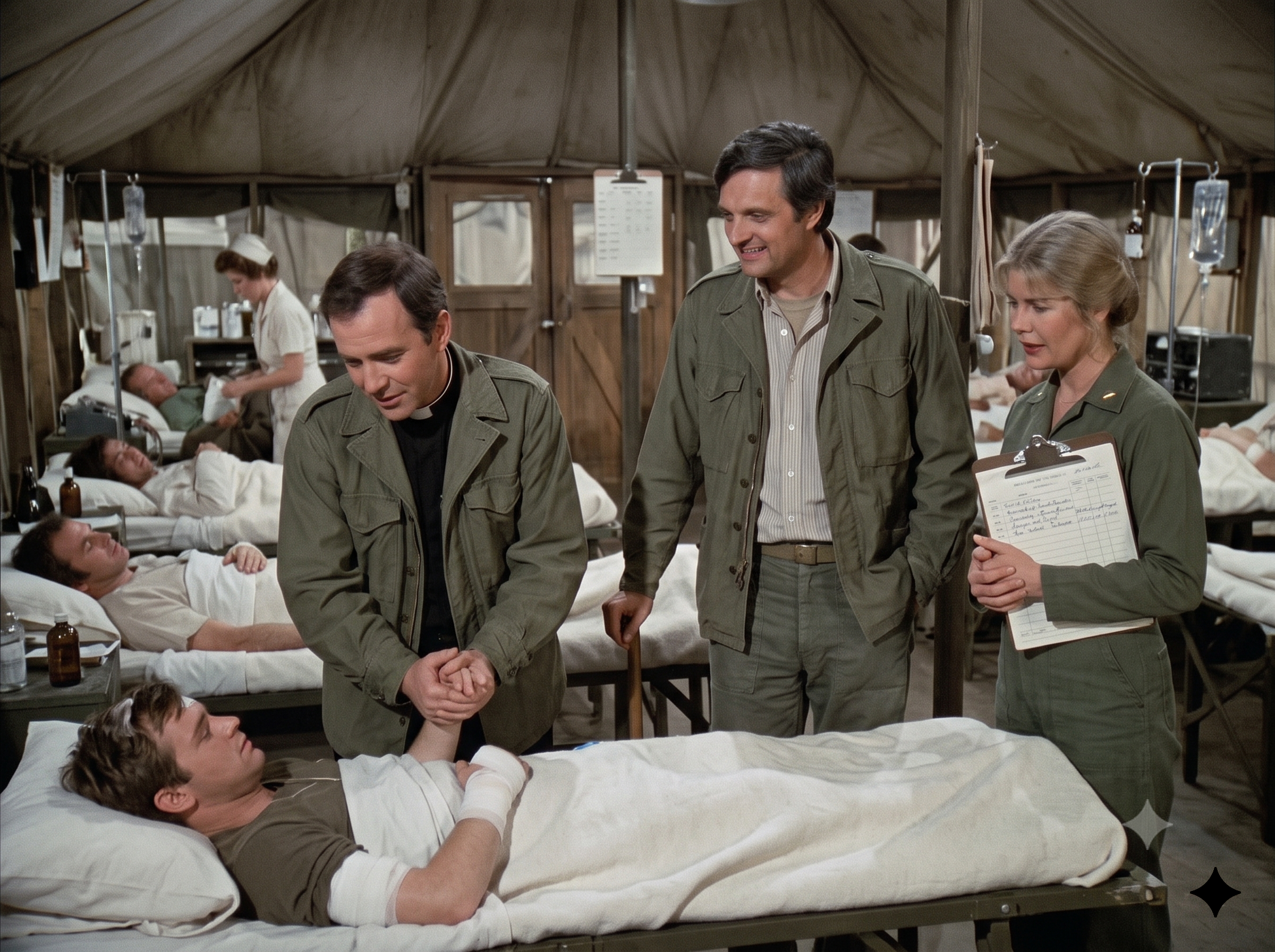
Post-Op was the only place in the 4077th that ever truly felt like a sanctuary.
After fourteen hours of relentless, mind-numbing meatball surgery, the operating room was finally dark. The harsh, blinding lights were turned off, and the chaotic symphony of clanking instruments and barked orders had faded into the Korean night.
In its place was the quiet, steady rhythm of the recovery ward. It was a canvas cathedral of whispered prayers, the soft rustle of white cotton blankets, and the slow, rhythmic drip of intravenous fluid.
Captain Benjamin Franklin “Hawkeye” Pierce leaned heavily against a wooden support pole near the center of the tent. He was wearing his standard off-duty uniform: a worn green field jacket thrown over a striped civilian shirt.
He was exhausted. The kind of bone-deep, soul-scraping exhaustion that made your teeth ache and your vision swim. Yet, as always happened after a marathon session in the OR, Hawkeye was too thoroughly wired to sleep. The adrenaline was still humming in his veins, keeping him anchored to the floorboards of the ward.
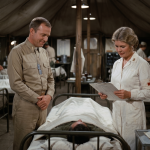
A few feet away, Major Margaret Houlihan was moving quietly down the aisle. She held a metal clipboard against her chest, her eyes scanning the medical charts with practiced precision.
In her crisp green fatigues, she was the picture of military discipline. But in the dim, soft lighting of the Post-Op tent, the rigid “Regular Army” armor seemed to melt away. Here, in the quiet hours, she wasn’t the head nurse enforcing regulations; she was a fiercely protective guardian watching over her wounded flock.
At the far end of the row, Father John Patrick Mulcahy made his rounds. The chaplain’s black shirt and white collar peeked out from beneath his own oversized army jacket.
He moved from cot to cot like a gentle ghost, his presence offering a quiet, steadying comfort to the boys who were caught somewhere between the nightmares of the front line and the hazy reality of morphine.
In cot number three lay a young private. He couldn’t have been more than nineteen years old. His head was wrapped in thick white gauze, and his right arm was heavily bandaged, resting awkwardly across his chest.
For the past hour, the boy had been sleeping peacefully. But suddenly, the quiet of the ward was broken by a sharp, panicked gasp.
The young soldier’s eyes flew open. They were wide, unfocused, and terrified. He was trapped in that disorienting, terrifying fog of anesthesia and trauma, waking up in a strange place with no memory of how he got there.
His breathing hitched, coming in rapid, shallow bursts. His good left hand began to thrash weakly against the crisp white sheets, grasping blindly at the empty air.
“Where…” the boy choked out, his voice a raw, desperate whisper. “Where is it? My arm… I can’t feel my arm!”
The sudden spike of sheer, unadulterated terror in the boy’s voice cut through the quiet hum of the tent like a siren.
Father Mulcahy, who was already standing by the adjacent bed, closed the distance in a heartbeat. He dropped to the side of the cot, leaning in close so the boy could see a friendly face.
The priest reached out, catching the boy’s thrashing left hand in both of his own. He held it firmly, trying to offer a physical anchor in the midst of the boy’s rising panic.
“I’m right here, son,” Father Mulcahy said gently, his voice a soothing baritone. “You’re safe. You’re at a hospital.”
But the boy was lost in the fog. He stared down at the massive, bulky white dressing covering his right side. The heavy nerve blocks they had used in surgery meant the limb was entirely numb. To a terrified kid waking up in a war zone, numbness meant only one thing.
“It’s gone,” the boy sobbed, his grip on the priest’s hand tightening like a vise. “They took it. Tell me the truth, Father… did I lose it?”
Hawkeye pushed himself off the wooden pole, his own heart skipping a heavy beat. Margaret stopped dead in her tracks, her clipboard lowering as she turned toward the cot.
The entire tent seemed to hold its breath. The young soldier stared desperately into Father Mulcahy’s eyes, waiting for an answer to the most terrifying question in the world, while the shadows of the 4077th pressed heavily against the canvas walls.
For a fraction of a second, the heavy silence hung in the damp air.
Father Mulcahy didn’t flinch. He didn’t offer a hollow platitude or a nervous deflection. He simply held the boy’s hand tighter, sandwiching the trembling fingers between his own warm palms.
“You haven’t lost a thing, my boy,” Father Mulcahy said, his voice radiating a quiet, absolute certainty. “It is bruised, and it is battered, but it is entirely yours.”
The boy blinked, tears gathering in the corners of his eyes. He looked up at the priest, desperate to believe him, but the phantom numbness kept the terror alive. “But I can’t feel it… it’s just gone…”
That was when Hawkeye stepped fully into the light of the bedside lamp.
He didn’t rush in with a syringe or a stethoscope. Instead, he strolled up to the foot of the cot with his hands thrust deep into his jacket pockets. A slow, charismatic, completely reassuring smile spread across his tired face.
“Of course you can’t feel it, kid,” Hawkeye said, his voice carrying that familiar, dry, lightning-quick cadence. “We pumped you so full of local anesthetic, your right arm currently thinks it’s on vacation in Miami.”
The boy’s panicked gaze shifted from the priest to the surgeon.
“I promise you,” Hawkeye continued, leaning forward slightly, his eyes locked onto the patient’s. “I spent the last three hours personally introducing every muscle and tendon in that arm to a needle and thread. It’s all there. In fact, it’s so tightly stitched, if you try to throw a baseball right now, you’ll probably pitch a perfect strike in three different directions.”
The sheer absurdity of the image caused a tiny, hesitant pause in the boy’s ragged breathing.
Margaret stepped up to the other side of the cot. She didn’t bark an order or act like the rigid disciplinarian of the camp. Instead, she looked down at her clipboard, her expression softening into a look of profound, maternal warmth.
“Captain Pierce is right, Private,” Margaret said softly. Her voice was steady, professional, but laced with a quiet, undeniable tenderness. “I have your surgical chart right here. Clean shrapnel removal. No bone damage. The numbness is just the nerve block doing its job.”
She lowered the chart and looked directly at the boy. “You’re going to be perfectly fine. You just have to give it time to wake up.”
The boy looked from Margaret’s confident, calming face, over to Hawkeye’s tired but encouraging smile.
Finally, he looked back to Father Mulcahy. The chaplain was still holding his hand, his expression a portrait of gentle compassion and quiet strength.
Slowly, Mulcahy guided the boy’s good hand across his chest, letting his trembling fingers brush against the thick, solid gauze of the bandaged arm.
“You see?” Mulcahy whispered warmly. “Just resting. Like the rest of you needs to do.”
The physical proof, combined with the presence of the three towering figures standing vigil over his bed, finally broke the spell of terror.
The young soldier let out a long, shuddering breath. The rigid tension melted out of his shoulders, and he sank deeper into the thin cotton mattress.
“Thank you,” the boy mumbled, his eyelids already beginning to droop as the exhaustion and the lingering drugs pulled him back under. “Thank you, Father. Thank you, Doc.”
“Don’t thank me,” Hawkeye quipped, his smile softening into something deeply genuine. “Thank Major Houlihan. She’s the one who insisted we use the good thread. We were going to use old shoelaces, but she’s a stickler for high fashion.”
Margaret shot Hawkeye a sidelong glance. It was a look that usually preceded a loud reprimand about military decorum, but tonight, there was no fire in it. Instead, the faintest trace of a smile tugged at the corner of her lips. She simply shook her head slightly and went back to noting the boy’s vitals on her chart.
Hawkeye let out a quiet breath, his shoulders slumping just a fraction as the adrenaline finally left his system. The joke had worked. The tension had shattered. The kid was safe.
Father Mulcahy gently patted the sleeping boy’s hand one last time before tucking it neatly under the white blanket. He stood up, adjusting his field jacket, and exchanged a look with Hawkeye across the cot.
No grand speeches were made. No medals were pinned. It was just a shared, silent glance of mutual understanding between a priest and a surgeon. They had fought back the darkness for one more night, holding onto the fragile pieces of humanity in a place that tried constantly to tear them apart.
Hawkeye gave the chaplain a small, tired nod, turned on his heel, and finally began the long, slow walk out of the tent and back toward the Swamp, leaving the quiet sanctuary of Post-Op in the gentle hands of its midnight guardians.
In a war that took so much away, the greatest victories were the quiet moments where they gave a piece of someone back.