The Long, Long Scroll of a Tuesday in Korea
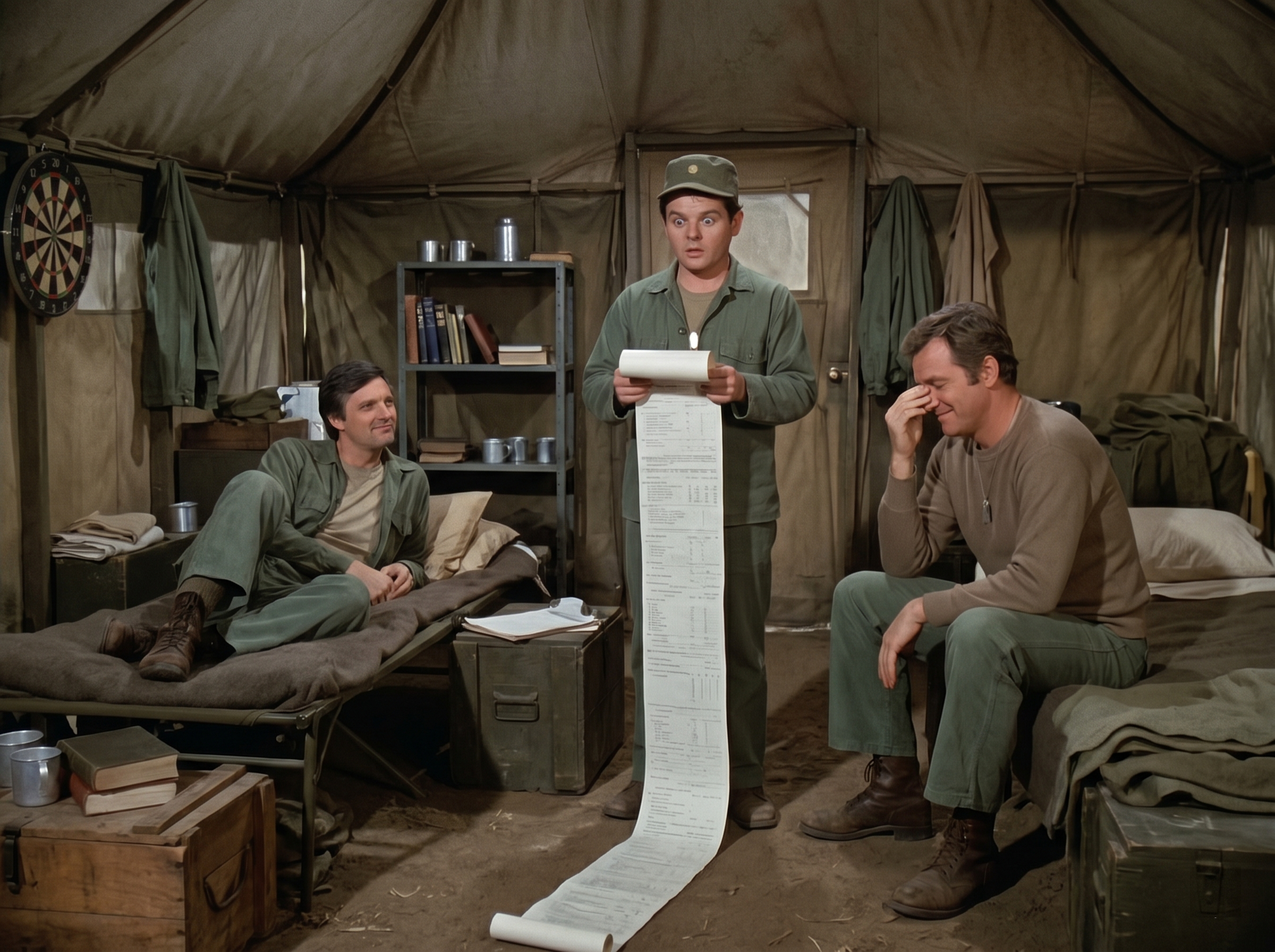
It was Tuesday, and Tuesday felt exactly like Friday, only with more dust and less sleep. Inside The Swamp, the quiet was a fragile thing, a single lightbulb fighting the encroaching evening and casting long shadows against the cluttered walls.
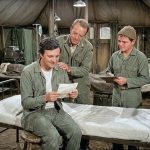
Over on his cot, Hawkeye was in his favorite pose—lounging like a slightly rumpled king on a questionable throne. B.J. sat on a footlocker, his head already buried in his hands, not so much asleep as sheltering from reality.
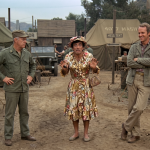
Then, the canvas door creaked, and in walked the smallest tempest in Korea. Radar looked like he’d seen a ghost, but worse: he’d seen the new Quartermaster.
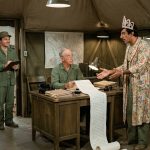
He was holding a scroll. Not a book, not a single sheet, but a scroll. It was a paper tsunami.
As he walked toward the center of the tent, the scroll unwound, cascading down like a waterfall of ink and bureaucracy until it pooled on the dirt floor, a white tail stretching halfway to the back cot.
Hawkeye stared, a slow grin spreading across his face. This was pure, unadulterated bureaucratic comedy.
Radar’s eyes were the size of dinner plates, his cap tilted precariously. “The… the new Quartermaster,” he squeaked.
B.J. just sighed, a sound that carried the weight of the entire war.
“He wants… justification,” Radar continued, looking at the first item, kilometers away on the floor. “For the lightbulbs. All of them. Since the invasion.“
Radar took a deep breath and began to read the first justification line, written in meticulous fine print: ‘Must specify illumination radius, expected filament longevity, and provide photographic proof of nocturnal functionality, witnessed by three non-commissioned officers.‘
Radar looked up, his hand trembling on the paper, the list still unrolling. B.J. closed his eyes, pinching the bridge of his nose even tighter. Hawkeye’s grin didn’t move. He just raised an eyebrow. The silence in the tent grew heavy.
“And then there’s the pencils,” Radar read, flipping a few inches of paper. “A special sub-form, triple-notarized, detailing the specific graphite hardness required for a minimum of ten tactical maps.” He paused, looking at them. “We don’t draw maps. We draw blood.“
The humor was still there, a thin layer of sugar over the medicine, but the absurdity was a physical weight. The Swamp was a sanctuary, but today, the red tape had breached its walls.
Hawkeye sat up on one elbow, his amused smirk fading into a more protective warmth. “Radar, kid,” he said, speaking to him gently, but with that Hawkeye edge. “This man isn’t looking for justification. He’s looking for submission. He wants you to surrender your sanity one line of fine print at a time.“
B.J. finally lowered his hands, a faint, tired smile on his face. “Hawkeye’s right. The first law of logistics is: if they can’t make sense of it, they’ll just make it painful.” He reached out and patted Radar’s arm reassuringly. “You don’t need a photograph of nocturnal functionality. You just need a friend to say the lightbulbs work.“
“But I already promised Colonel Potter this would be done by dawn,” Radar said, looking down at the scroll, the exhaustion in his voice clear. He was a small man with a huge burden, and right now, the paper was winning.
Hawkeye hopped off his cot. He pulled a clipboard and a pencil from a shelf. B.J. moved a footlocker closer. The unit needed a surgical intervention of the heart, and Radar was the patient.
“We don’t write justification,” Hawkeye said, his wit now focused. “We write art. Let’s make this form so profoundly brilliant, so overflowing with military rhetoric and redundant descriptions of non-functional items, that the Quartermaster will be forced to give us an entire extra footlocker just to store the paperwork for the lightbulbs.“
The atmosphere shifted from panic to quiet, focused effort. Hawkeye paced, dictating sentences about ‘luminous efficacy as a tool for moral vectoring,‘ while B.J. transcribed them into the tiny spaces on the clipboard. Radar held the scroll, occasionally chiming in about an obscure section code.
This wasn’t about solving logistics. This was three tired men in a canvas tent in the middle of a conflict, using their shared weariness and friendship to make the impossible manageable. The dartboard was a reminder of small comforts; the books, of better days. The huge scroll was the war. The three of them together? That was survival.
They spent the night filling out the long tail of red tape. The absurdity didn’t lessen, but the loneliness did. They were tired, but they were not alone. B.J. eventually fell asleep sitting up, and Hawkeye and Radar finished.
As dawn broke, Radar stood holding a completed, perfectly absurd, and impossibly long form. The smile on his face was a different kind—no longer nervous, but accomplished and relieved. He carefully began to roll the paper up, a much tighter, neat bundle.
Hawkeye, back on his cot, just watched him with that sharp, protective pride. The long Tuesday was over, and another long day had begun. They hadn’t won the war, but they had won the night against a different kind of enemy: the soul-crushing weight of senseless rules. And that, in Korea, was as close to a victory as you got.
Because sometimes, the only way to get through a war is to fill out the paperwork together.