The Quiet Watch in Post-Op
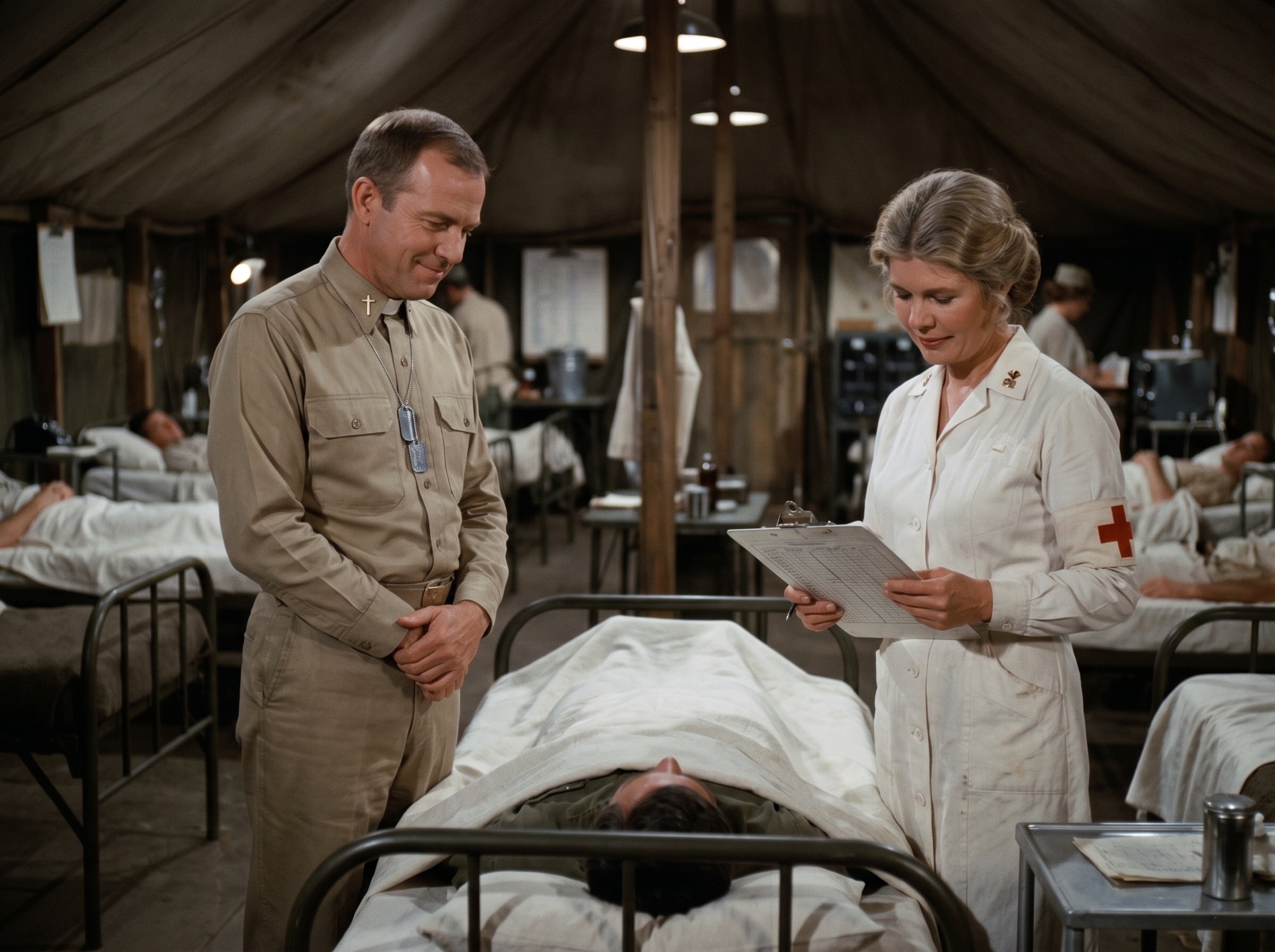
Post-Op was the only place in the 4077th that ever approached the feeling of a sanctuary.
It was never truly silent, of course. There was always the deep, rhythmic hum of the camp generators outside, the restless shifting of wounded men on narrow cots, and the wind snapping against the heavy canvas roof. But after the frantic, blood-soaked chaos of a long session in the Operating Room, the muted stillness of the recovery ward felt like a different world entirely.
Here, the war was paused. Here, there was only the slow, difficult work of healing.
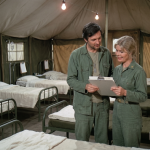
Major Margaret Houlihan stood near the foot of bed number four, her posture as rigid and correct as if she were standing for an inspection. Even after a grueling fourteen-hour shift, her white nurse’s uniform was surprisingly neat, the red cross on her armband a stark contrast against the clinical whites and soft grays of the dimly lit tent.
She held a metal clipboard in her hands, her eyes tracing the neat lines of her own handwriting on the medical chart.
But she wasn’t really reading. She was standing vigil.
Beneath the heavy wool blankets lay a young Private, barely out of his teens. His face was pale, his breathing painfully shallow. Captain Pierce had spent three hours putting him back together, a delicate surgery that had left the entire OR holding its breath. The boy had made it through the meatgrinder, but the next twenty-four hours were the real test.
Margaret had refused to go to her tent. She told herself it was simply a matter of proper post-operative protocol. A head nurse does not abandon a critical patient. But beneath her crisp military exterior, there was a deep, protective ache in her chest. She had seen too many boys like him slip away in the dark. She was determined not to let this one go.
Footsteps sounded softly against the wooden floorboards.
Father John Mulcahy moved quietly down the aisle between the rows of cots. He wore his standard khakis, rumpled and lived-in, with his silver dog tags dangling over his shirt collar right beneath his cross. His face carried the heavy fatigue of a man who had spent the entire day offering comfort in a place that desperately needed it.
He stopped beside Margaret, his hands gently folding together in front of him.
“How is our young friend faring, Major?” Mulcahy asked, his voice a soft, comforting murmur that seemed to settle the very air around them.
“His vitals are holding, Father,” Margaret replied softly, keeping her voice low. “But his fever spiked an hour ago. He hasn’t opened his eyes since they wheeled him out of recovery. I just… I don’t like how still he is.”
Mulcahy looked down at the boy, a gentle, compassionate smile touching his lips. It was a smile born of deep faith and endless patience. “Captain Pierce said it was a miracle the shrapnel missed the artery,” the priest whispered. “I suppose we just have to wait for the rest of the miracle to catch up with him.”
Margaret didn’t answer. She just tightened her grip on the clipboard. The canvas walls of the tent seemed to breathe in and out with the cold Korean night.
Then, the rhythm of the boy’s breathing hitched.
A low, jagged groan broke the quiet of the ward. The young soldier’s head turned sharply on the thin pillow, his brow knitting together in sudden agony. He let out a sharp gasp, his hands suddenly gripping the edge of the white blanket as if he were holding on for dear life.
Margaret immediately stepped closer, her professional instincts taking over in a flash. She reached out, but before she could touch his shoulder, the boy’s eyes flew wide open.
They were dilated, terrified, and staring blindly at the canvas ceiling. He took a ragged, panicked breath, his chest heaving, trapped in the terrifying limbo between a nightmare and reality.
“Easy, Private. Easy now,” Margaret said, her voice firm but laced with a surprising, velvet softness.
She placed a cool, steady hand on the boy’s forehead. It was a touch that belonged more to a mother than a military officer. “You’re safe. The fighting is over. You’re in a hospital.”
The boy thrashed slightly, fighting the heavy blankets. “My rifle,” he stammered, his voice dry and cracking. “I can’t… I dropped it. The sergeant…”
“Your sergeant knows exactly where you are,” Mulcahy leaned in gently, his hands still folded, his voice radiating a calm, absolute authority. “You did your job, son. You did it bravely. But your only duty now is to rest.”
The boy blinked, the wild terror in his eyes slowly giving way to confusion. His gaze drifted from the dark shadows of the tent ceiling down to the two figures standing beside his cot.
He looked at Father Mulcahy, taking in the collar, the cross, and the kind, tired eyes. Then he looked across the bed at Margaret. He took in her blonde hair, pinned up meticulously, and the crisp white uniform glowing softly in the overhead light.
The young soldier swallowed hard, his breathing finally beginning to slow. The tense grip he had on the blanket loosened.
“Are you…” the boy whispered, a faint, groggy smile touching his pale lips. “Are you an angel?”
Margaret froze for a fraction of a second. She had been called many things at the 4077th. Most of them behind her back, and most of them far less flattering than ‘angel’. A strict disciplinarian. A stickler for the rules. But looking down at this exhausted, wounded kid who was just grateful to be alive, her rigid defenses completely melted away.
She didn’t reprimand him for a lack of military decorum. She didn’t correct him with her rank.
Instead, a quiet, beautiful warmth bloomed across Margaret’s face. It was a soft, hidden emotion she rarely let the camp see, tucked away beneath her brass and her bluster. She looked down at her clipboard, a genuine, tender smile playing on her lips.
“Hardly, Private,” Margaret said softly, her voice thick with sudden emotion. “I’m just a nurse. And you are a very lucky young man.”
Mulcahy chuckled, a warm, rich sound that seemed to warm the chilly tent. He looked at Margaret, his eyes shining with a deep, unspoken respect.
“Don’t let the Major fool you, son,” Mulcahy said, his gentle smile widening. “She may not have wings, but there is an awful lot of grace in this tent tonight. You are in the very best of hands.”
The boy let out a long, shuddering sigh of relief. The pain was still there, etched into the lines around his eyes, but the fear was gone. He closed his eyes again, sinking back into the pillow. “Thank you, ma’am,” he mumbled sleepily. “Thank you, Father.”
Within seconds, the jagged, panicked breathing smoothed out into the deep, steady rhythm of natural, healing sleep. The crisis had passed. The miracle had caught up.
Margaret stood in silence for a long moment, just watching the steady rise and fall of the boy’s chest. She made a quick, decisive mark on the medical chart, though the numbers hardly mattered as much as what she had just seen with her own eyes.
She looked up, catching Father Mulcahy’s eye across the cot.
The priest was still standing with his hands folded together, looking at her with that same quiet, knowing smile. He saw her. He didn’t just see Major Houlihan, the strict Army lifer; he saw Margaret, the woman whose heart broke a little for every single soldier who came through those doors.
“You have a wonderful touch with them, Margaret,” Mulcahy said quietly, using her first name in the quiet sanctuary of the ward. “It takes a great deal of strength to care as much as you do.”
Margaret straightened her shoulders, instinctively trying to rebuild a tiny piece of her professional wall. But the tender smile refused to leave her face. She held the clipboard tightly against her chest like a shield.
“It’s just standard post-operative observation, Father,” she replied, keeping her tone completely even, though her eyes betrayed her. “Nothing out of the ordinary for the 4077th.”
“Of course, Major,” Mulcahy nodded, his eyes twinkling with gentle amusement. “Standard procedure.”
He reached out and gently adjusted the white blanket over the sleeping soldier’s shoulders, a silent blessing in the quiet night. Margaret stepped back, moving to check the chart at the foot of the next bed, though her step was noticeably lighter than it had been ten minutes ago.
The war would be waiting for them tomorrow. The choppers would bring more wounded, the OR would fill with noise and blood, and the endless cycle of the Mobile Army Surgical Hospital would begin all over again.
But for right now, in the dim, even light of the Post-Op ward, they had won. A boy was going to live, a priest had witnessed a tiny moment of grace, and a weary nurse found the strength to keep going.
In a place built for breaking, it was the quiet moments of mending that somehow kept them all whole.