A Michelin Star in the Mess Tent
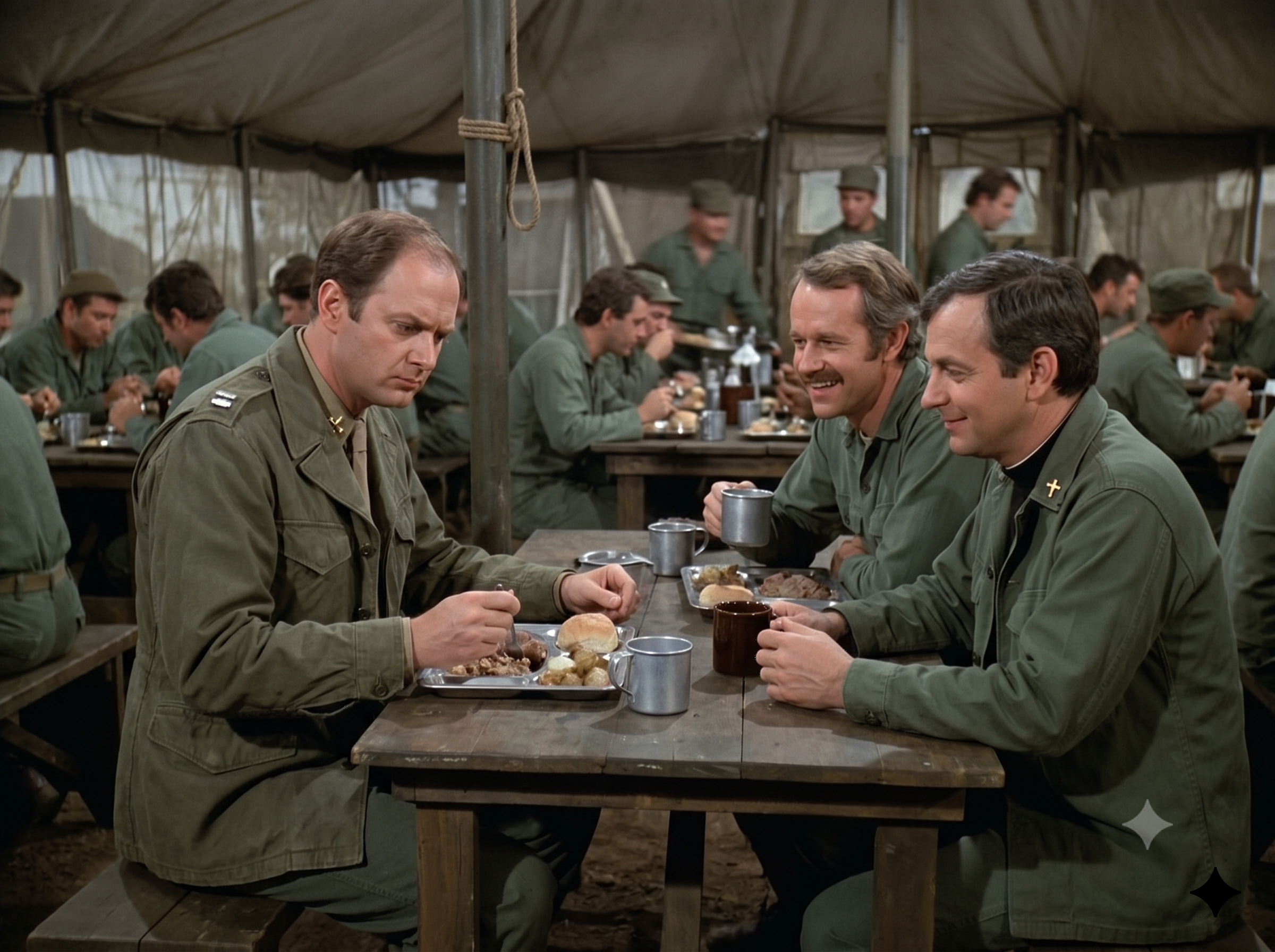
There were always two distinct battlefields at the 4077th Mobile Army Surgical Hospital.
The first was the operating room, where the brutal, exhausting reality of the Korean War demanded every ounce of their skill, stamina, and sanity. The second, arguably just as punishing but with far less dignity, was the Mess Tent.
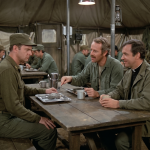
It was a Tuesday, or perhaps a Thursday—the days had long since blurred together into a continuous loop of incoming choppers, scrub sinks, and the smell of antiseptic. The mess tent was loud, filled with the clatter of tin trays and the low, steady hum of exhausted conversation.
The air smelled faintly of canvas, damp wool, and whatever culinary tragedy the cooks had decided to inflict upon the camp that afternoon.
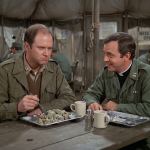
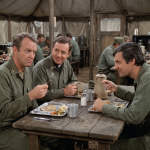
Major Charles Emerson Winchester III sat at the long wooden table, his posture impossibly upright despite the eighteen straight hours he had just spent on his feet in surgery. He wore his olive drab fatigues as if they were a tailored suit, but the illusion was entirely shattered by the dented metal tray sitting in front of him.
Charles stared down at the food.
His eyebrows were raised in an expression of profound, restrained irritation. His mouth was set in a tight line of dry superiority, a man deeply offended by the sheer existence of what he was being asked to consume.
Sitting across from him, Captain B.J. Hunnicutt leaned forward. B.J. held a metal mug of coffee that likely tasted like boiled boots, but he looked entirely at ease.
A gentle, dryly amused smile played across B.J.’s face. He lived for these moments. The Winchester breaking point was a delicate, beautiful thing to witness, and B.J. had a front-row seat.
Beside Charles sat Father Mulcahy. The gentle chaplain had both hands wrapped warmly around his own mug. He watched Charles with a soft, patient smile, his face showing a mild, almost affectionate confusion.
Mulcahy always hoped the camp food would improve, but he had long ago accepted that some miracles were simply beyond asking for.
“Gentlemen,” Charles began, his voice dripping with aristocratic disdain, “I submit to you that the Geneva Convention has strict regulations against the serving of… whatever this is.”
He poked at a grayish-brown lump on his tray with the tines of his fork. It did not yield.
“I think it’s supposed to be meatloaf, Charles,” B.J. offered mildly, his eyes crinkling at the corners. “Or possibly a surplus jeep tire. The army works in mysterious ways.”
“It is an insult to the very concept of a loaf,” Charles countered, his voice rising a fraction of an inch in volume. “And a tragedy for whatever poor, unfortunate beast gave its life to become this unrecognizable slab of despair.”
Father Mulcahy leaned in slightly. “Now, Major, I’m sure the cooks did the best they could with the rations provided.”
“Father,” Charles said, turning his piercing gaze upon the priest. “With all due respect to your divine connections, if this is the best they can do, they should surrender their aprons immediately and beg forgiveness for their sins against the culinary arts.”
Charles took a deep breath, his chest puffing out slightly. He gripped his fork tighter, preparing to launch into a full, blistering monologue about the dining establishments of Boston. He opened his mouth, his eyes locking furiously onto the offending morsel.
But then, Charles stopped.
The color seemed to drain slightly from his usually composed face. He didn’t speak. He didn’t yell.
He just sat there, frozen in the noisy tent, staring at the grey lump on his tray as if it had just whispered something terrible to him. The fork hovered dangerously in mid-air, trembling just the slightest bit in his tired hand.
B.J.’s amused smile faltered, replaced by a quiet, immediate alertness. He set his coffee mug down on the wooden table.
“Charles?” B.J. asked softly, the teasing gone from his voice. “Did it move? Because if it moved, I’m drawing the line.”
Father Mulcahy leaned forward too, his brow furrowing with genuine concern. “Major? Are you quite alright?”
Charles didn’t answer immediately. He slowly lowered the fork, letting it clatter softly against the dull metal of the tray. The aristocratic fury that had puffed up his chest just a moment ago vanished, evaporating into the stale air of the mess tent.
Suddenly, Charles Emerson Winchester III just looked incredibly, bone-deeply tired.
“Scallops,” Charles murmured. His voice was barely a whisper, completely stripped of its usual theatrical bombast.
B.J. blinked. “Excuse me?”
“Scallops,” Charles repeated, staring straight ahead at nothing in particular. “Pan-seared in sweet butter. Resting on a delicate bed of wild mushroom risotto, finished with a reduction of white wine and just a hint of fresh thyme.”
He wasn’t complaining anymore. He was remembering.
“There is a small, quiet place near the harbor,” Charles continued, his eyes unfocused, looking right through the canvas walls of the 4077th, all the way back to Massachusetts. “My father and I would go there after a long week. The maître d’ knew us by name. The lighting was low. The linen was perfectly crisp. And the food… the food was a celebration of life.”
He looked down at the dented tin tray again, and a small, quiet sigh escaped his lips.
“It seems like a very long time ago,” Charles said softly.
The noise of the mess tent—the laughing, the arguing, the clattering of spoons—seemed to fade away from their small section of the table. B.J. looked at Charles, really looked at him, and saw past the polished armor of the Boston surgeon. He just saw another exhausted man who desperately missed his home.
B.J. leaned back slowly, his eyes softening.
“Peg makes this pot roast,” B.J. said quietly. The air between them shifted, the dry humor replaced by a gentle, shared vulnerability. “It’s nothing fancy. Carrots, potatoes, onions. She cooks it all day on Sunday.”
Charles looked up, meeting B.J.’s eyes. He didn’t interrupt.
“The whole house smells like it by three in the afternoon,” B.J. smiled, a wistful, aching sort of smile. “I used to tease her that she always overcooked the carrots. I would give my left arm right now for one of those overcooked carrots.”
Father Mulcahy wrapped his hands tighter around his mug, letting the warmth soak into his skin.
“The sisters at my parish in Philadelphia,” Mulcahy added, his voice a soothing, familiar rhythm. “They baked fresh bread every Tuesday morning. You could smell the yeast rising before you even crossed the courtyard. Simple, honest bread. It was a comfort to the soul.”
For a long moment, the three men sat in silence. They were thousands of miles from pan-seared scallops, Sunday pot roasts, and fresh parish bread. They were trapped in a dirty tent, in a senseless war, eating food that barely qualified as sustenance.
But for just that brief minute, they had brought a small piece of home into the cold, dusty air of Korea.
Charles cleared his throat softly. He straightened his back, pulling his shoulders square. The vulnerability was carefully tucked away, but the angry superiority didn’t return.
“Well,” Charles said, his voice regaining a fraction of its usual crispness. “As much as I loathe to admit it, my body currently requires fuel if I am to continue saving the lives of the less fortunate.”
He picked up his fork again with a practiced, elegant grip.
“I shall pretend,” Charles announced, looking at the grey lump, “that this is a particularly rustic, poorly executed French country pâté.”
B.J. picked up his coffee mug, a warm, genuine smile returning to his face. “You do that, Charles. And I’ll pretend this coffee is a fine, aged burgundy.”
“And I,” Father Mulcahy smiled gently, raising his own mug, “shall simply pray for our digestion.”
Charles actually offered a small, barely-there smirk. He cut a piece of the mystery meat, closed his eyes, and took a bite. He didn’t gag. He just chewed steadily, surviving another day in a place he hated, surrounded by people he would never admit how much he needed.
B.J. and Mulcahy took sips of their terrible coffee, keeping him silent, steadfast company.
It wasn’t a Michelin-star restaurant, and the food was undeniably awful, but there was nowhere else in the world they were meant to be right now.
The food at the 4077th could break your spirit, but the people sitting across the table were always there to piece it back together.