The Midnight Truce in Post-Op
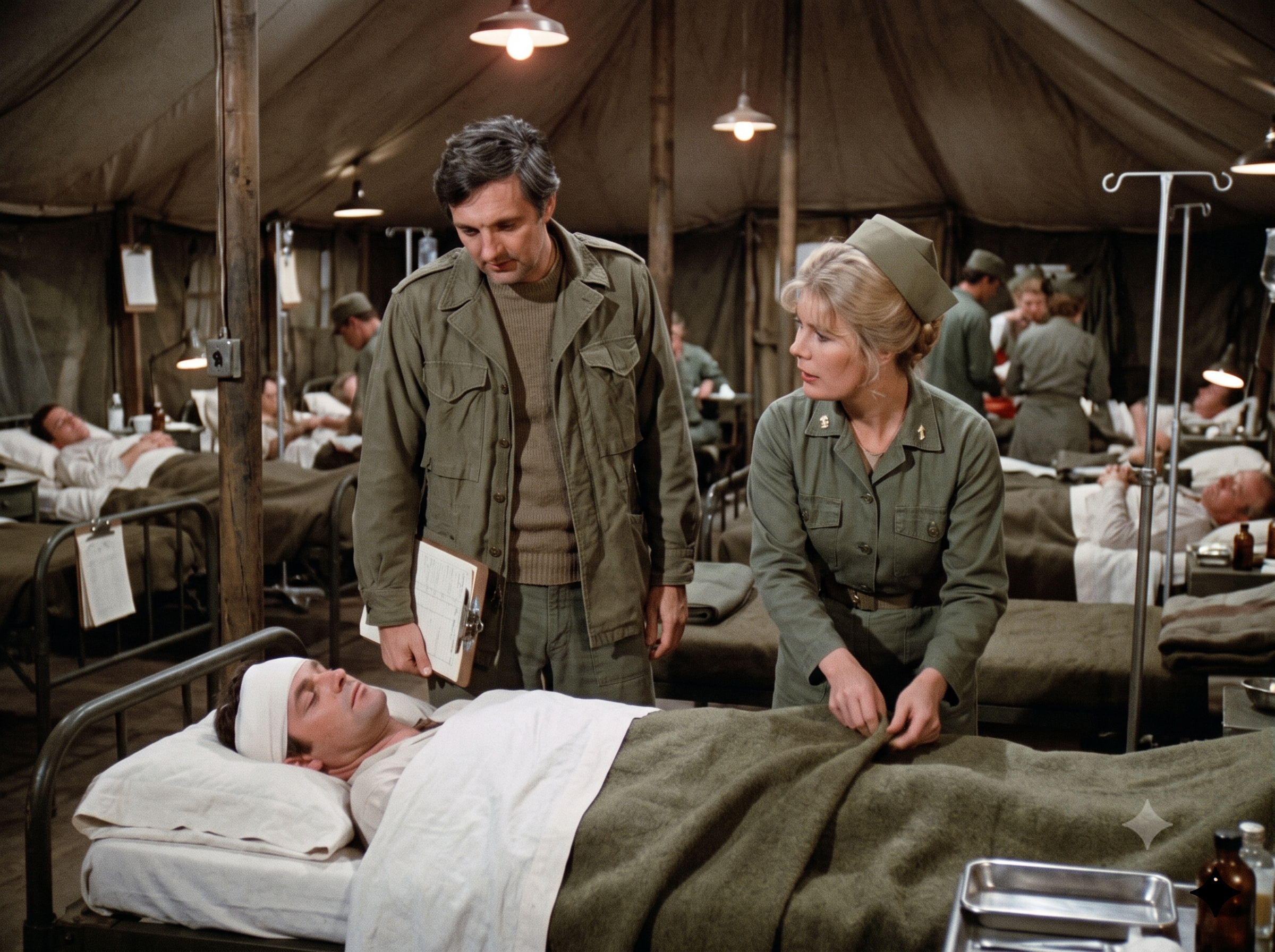
It was 3:00 AM, the hour when the 4077th finally stopped screaming and started breathing.
The meatball surgery was over, leaving behind only the low hum of the compound generators and the soft, rhythmic rustle of the Post-Op ward.
Inside the long canvas tent, the Korean cold pressed hard against the walls, but the air inside was thick with the scent of rubbing alcohol, damp wool, and exhausted survival.
Rows of simple cots stretched back into the shadows, separated by canvas partitions and the pale, muted whites of army-issue bandages.
Hanging from the wooden beams, bare bulbs beneath metal shades cast a soft, even, practical light over the sleeping forms of kids who had been entirely too close to the end of the world.
Captain Benjamin Franklin Pierce stood at the foot of bed number four, looking like a man who had forgotten how to sleep.
He wore his heavy brown sweater beneath an unbuttoned field jacket, the clothes draped over his frame like they were too tired to hold on.
Hawkeye held a metal clipboard in his left hand, his posture slightly stooped, his eyes fixed on the chart.
But he wasn’t really reading the words anymore; he was just anchoring himself to the room, desperately trying to keep his own weary heart beating in time with the quiet ward.
Across the narrow space of the cot stood Major Margaret Houlihan.
Even after fourteen grueling hours elbow-deep in the OR, her green nurse’s uniform was stubbornly orderly, her cap pinned firmly in place.
But the stiff, military perfection she usually wore like a shield had melted away in the quiet of the night watch.
She leaned over the sleeping soldier, her hands gently adjusting the rough, olive-drab blanket around his shoulders with a focused, almost maternal competence.
The patient was young—maybe nineteen, maybe less—with a thick ring of white gauze wrapped tightly around his head.
He lay perfectly still, his face pale and slack in the warm yellow light.
For a long moment, the only sound between Hawkeye and Margaret was the steady, shallow breathing of the boy between them.
It was a rare, silent truce. No sharp remarks, no pulling rank, no defensive sarcasm.
Just two impossibly tired people sharing the heavy, unspoken burden of keeping a stranger alive until the sun came up.
Margaret smoothed the edge of the blanket, her eyes darting across the cot to look at Hawkeye.
Her expression was unguarded, cracking just enough to show the deep, genuine vulnerability she usually hid behind army regulations.
“His pulse is thin, Pierce,” she said softly, her voice barely carrying over the hum of the generators.
Hawkeye didn’t look up from the chart right away. “It’s there, Margaret. That’s what counts right now.”
“He lost a lot of blood out there. Too much.”
“We gave him back what we could,” Hawkeye murmured, his voice thick with fatigue. “The rest is up to him. And whatever higher power takes the night shift in this place.”
Suddenly, the young soldier’s breath hitched.
A deep, rattling sound gathered in his chest, and his head rolled weakly to the side against the thin pillow.
His brow furrowed beneath the thick white bandages, and his hands, pale and trembling, twitched against the sheets.
Margaret froze, her hands hovering inches from the boy’s chest, her professional instincts instantly snapping to high alert.
Hawkeye dropped the clipboard to his side, the tired slump vanishing from his shoulders as he leaned forward, his eyes suddenly sharp and searching in the dim light.
The boy let out a low, pained groan, a sound that seemed to carry the entire weight of the war, and his monitor—a simple glass thermometer resting in a cup nearby—rattled against the metal tray.
The quiet peace of the ward shattered in an instant, replaced by the familiar, terrifying dread that the war had slipped past the canvas doors to finish the job.
Hawkeye reached out, his long fingers pressing gently but firmly against the pulse point on the boy’s neck.
Margaret moved simultaneously, her hand resting flat and reassuringly against the boy’s unbandaged cheek, feeling for the terrible, dry heat of a sudden infection.
The silence stretched out, tight and fragile, as they waited for the boy’s body to make a decision.
A second passed. Then another.
Slowly, the frantic twitching in the boy’s hands ceased.
The rattle in his chest smoothed out, settling back into a slow, steady, rhythmic draw of air.
Under Margaret’s hand, the boy’s skin was warm, but damp with the cool sweat of a breaking fever, not the terrifying fire of sepsis.
He murmured something incoherent, a soft, dreaming sound, and leaned his cheek slightly into the warmth of Margaret’s palm before slipping back into a deep, chemical sleep.
Hawkeye let out a long, slow breath, closing his eyes for a fraction of a second.
When he opened them again, the tension had drained out of him, leaving him looking five years older.
He slowly pulled his hand back, gripping the clipboard again like a life raft.
“Just a ghost,” Hawkeye whispered, his voice cracking slightly. “Just a nightmare trying to find its way out of his head.”
Margaret didn’t pull her hand away immediately.
She stood there, frozen in the dim, practical light, staring down at the boy’s face.
The fierce, demanding Head Nurse of the 4077th was entirely gone, replaced by a woman who looked like she wanted to wrap her arms around the kid and carry him all the way back to Iowa, or wherever it was he came from.
Slowly, carefully, she withdrew her hand and went back to adjusting his blanket.
She tucked the scratchy wool tightly around his shoulders, ensuring no cold draft from the Korean night could touch him.
It was a small, simple gesture, but in the sterile, bloody world of a mobile army surgical hospital, it was a profound act of love.
Hawkeye watched her.
He saw the gentle care in her hands, the way she lingered just a second too long near the boy’s chin to make sure he was comfortable.
He saw the humanity shining right through her crisp uniform, as clear as the lightbulb hanging above them.
“You know, Major,” Hawkeye said, his voice quiet, devoid of its usual mocking edge. “If the army knew you were out here giving first-class turn-down service, they’d start charging these kids for the room.”
Margaret paused, her hands resting on the blanket.
She looked up at him across the cot.
Usually, a comment like that would earn Hawkeye a sharp reprimand, a threat of a court-martial, or at least an eye roll.
But tonight, looking at the exhausted, humane doctor standing across from her, she just let out a small, tired breath.
“He’s freezing, Captain,” she said simply, her tone stripped of rank and armor. “They’re always so cold when they come out of the ether.”
“They’re cold because they’re kids,” Hawkeye said, his eyes drifting back down to the boy’s sleeping face. “Kids shouldn’t be wearing dog tags. They should be wearing letterman jackets. They should be shivering in the back of a Buick at a drive-in movie, not in a canvas tent in the middle of a police action.”
Margaret didn’t argue. She couldn’t.
She just nodded slowly, her eyes reflecting the pale greens and warm yellows of the quiet ward.
“He asked for his mother,” Margaret murmured, almost to herself. “Right before the anesthesia took him. He looked right at me, and he asked if his mother was in the waiting room.”
Hawkeye felt a familiar ache tighten in his throat.
He offered a sad, deeply tired smile, using his humor not as a weapon, but as a bandage for both of them.
“What did you tell him?” Hawkeye asked gently.
“I told him she had stepped out for a cup of coffee,” Margaret replied, her voice steady but thick with unshed emotion. “And that I would sit with him until she got back.”
Hawkeye looked at Margaret Houlihan.
Really looked at her.
Beyond the brass, beyond the regulations, beyond the endless, exhausting bickering that defined their waking hours.
In this intimate, bittersweet space, they were the same.
They were just two tired people standing between the darkness and a nineteen-year-old boy.
Hawkeye tapped the metal clipboard softly against the foot of the iron cot, a quiet salute to the woman standing across from him.
“Well,” Hawkeye said softly, his eyes filled with a quiet, profound respect. “You make a hell of a stand-in, Margaret.”
A tiny, fragile smile touched the corners of Margaret’s mouth.
It was a rare gift, offered only in the absolute quiet of the Post-Op ward, in the dead of the night.
“Thank you, Hawkeye,” she whispered.
Hawkeye nodded, turning his tired body toward the next bed in the endless row of cots.
The war was still waiting outside the canvas flaps, ready to start screaming again at dawn.
But for tonight, in the soft, glowing quiet of the ward, the truce held, and the kids were warm.
Some battles are fought with a scalpel, but the most important ones are won by simply standing watch in the dark.