A Small Bouquet in the Midst of the Storm
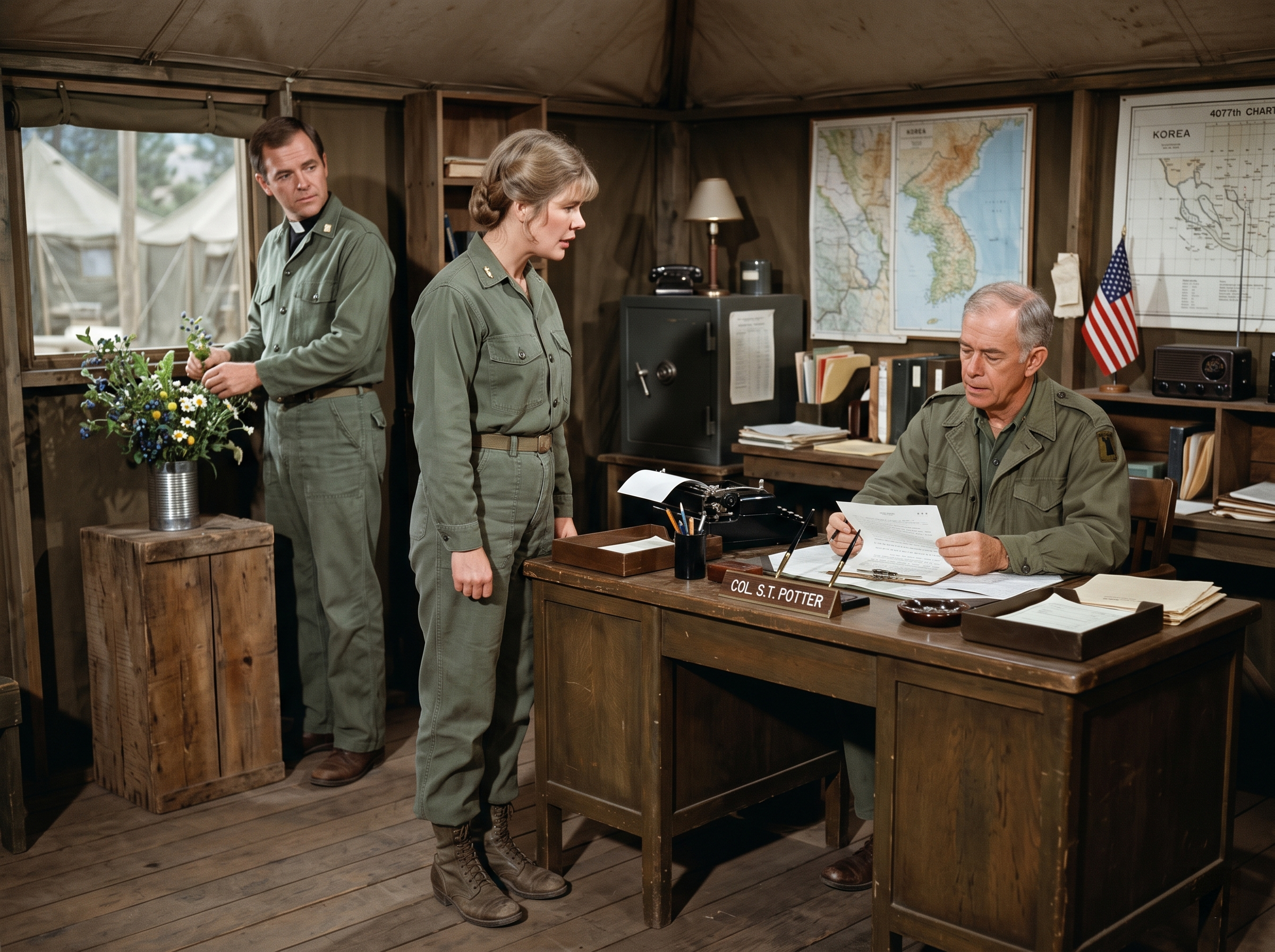
The mud outside was a constant, grey reminder of where we were, but inside Colonel Potter’s office, the air usually held a different kind of pressure. It was the weight of responsibility, of casualty reports, and the endless, aching fatigue that settled into your bones like damp insulation. Today, the office felt strangely suspended, caught in a quiet moment that felt both fragile and necessary.
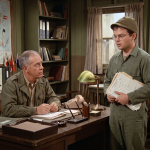
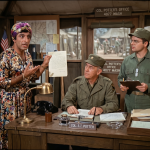
Colonel Potter sat behind his desk, peering over the top of his glasses at a document that seemed to have more lines than the map of Korea behind him. He wasn’t just reading; he was studying it as if it held the secrets to ending the war by teatime. Across from him stood Major Houlihan, her posture as rigid as a parade-ground salute, though there was a tension in her hands that betrayed her usual iron control.
In the corner, Father Mulcahy was occupied with something entirely incongruous with the room’s atmosphere. He was carefully arranging a cluster of wildflowers—daisies, bluebells, and tall, wild stems—into an empty tin can. His brow was furrowed with the kind of intense, gentle focus he usually reserved for a crisis of conscience.
“It’s not just a request, Colonel,” Margaret began, her voice tight, cutting through the silence. “It’s a matter of morale. The nurses are exhausted, and the lack of basic supplies for the mess tent—”
“I know the list, Margaret,” Potter interrupted, his voice raspy but calm, not looking up. “I’ve memorized the list. I’ve dreamt about the list. I’m currently waiting on a supply truck that, according to Seoul, is currently taking a scenic tour of the countryside.”
Father Mulcahy stepped away from the corner, holding the tin can of flowers out like a peace offering, his smile hesitant. “Colonel, I thought perhaps… just a little bit of color might—”
“Not now, Father,” Margaret snapped, her eyes never leaving Potter, her frustration clearly peaking. “We need action, not decorations! The men are at their breaking point, and I am not going to stand by while we pretend everything is just fine because of a few weeds in a tin can!”
Potter finally dropped the papers, the slap of the sheet against the desk sounding like a gavel. He looked from the flowers to Margaret, his jaw set, the weariness in his eyes suddenly sharp with a flash of impending command that made the room grow deathly still.
The silence that followed was absolute. Margaret froze, her breath hitching, realizing she had pushed past the professional boundary into something far more personal. Father Mulcahy simply stood there, the tin can looking suddenly very heavy in his hands, his expression one of quiet, pained apology.
Colonel Potter didn’t yell. He didn’t slam his fist. Instead, he leaned back, the leather of his chair creaking in the stillness. He looked at Margaret, really looked at her, seeing the shadows under her eyes that no amount of professional starch could hide. Then, he turned his gaze to the flowers—the humble, bright, defiant little things blooming in an old ration tin.
“You know, Margaret,” Potter said, his voice dropping into that low, gravelly register that always meant he was about to impart some hard-won wisdom. “When I was back in Missouri, the winters could be brutal. Sometimes, the ground would freeze so deep you thought nothing would ever grow again. You’d spend months staring at grey sky and brown mud, wondering if the color had just been a dream you had once.”
He stood up slowly, joints popping, and walked around the desk. He stopped in front of the Father and reached out, taking the tin can gently from his hands.
“My wife, Mildred, she used to keep a single geranium in the kitchen window,” Potter continued, looking at the daisies. “It wasn’t a feast. It wasn’t a warm coat. But it was a promise. It was proof that life wasn’t just holding on; it was still trying to happen.”
He walked over to the corner of his desk and placed the tin can down right next to his nameplate. The vibrant blue and white of the petals seemed to illuminate the dark, utilitarian wood of the desk.
“You’re right, Major,” Potter said, turning back to her, his voice softer now. “The supplies are a disaster. The war is a disaster. And we are all, every one of us, operating on fumes. But if we lose the ability to see a flower because we’re too busy staring at the mud, then we’ve already lost the only thing that matters.”
Margaret’s shoulders slumped, just a fraction of an inch, and the fire in her eyes dimmed into something human and tired. She looked at the flowers, then at the Colonel, and for the first time in weeks, she didn’t look like a Major. She looked like a woman who had been holding her breath for a very long time.
Father Mulcahy offered a small, knowing nod and slipped quietly out the door, leaving them to their space.
“I’ll get the report updated, Colonel,” Margaret said, her voice quiet. “I’ll find another way to handle the mess tent.”
“You do that,” Potter said, sitting back down and picking up his pen. “And Margaret? Keep an eye out for a decent vase, will you? This tin can is a bit of an eyesore.”
She allowed herself the smallest, most genuine smile I had seen in years. As she turned to leave, the office felt different. The war hadn’t ended, the supplies hadn’t arrived, and the fatigue was still there, lurking in the corners. But the room felt like a home again, a place where people were trying to protect each other from the cold, one small, beautiful, defiant gesture at a time.
In the heart of the 4077th, even the smallest bloom was a reminder that we were still us.