Signs of Home and Grace on a Dusty Hill
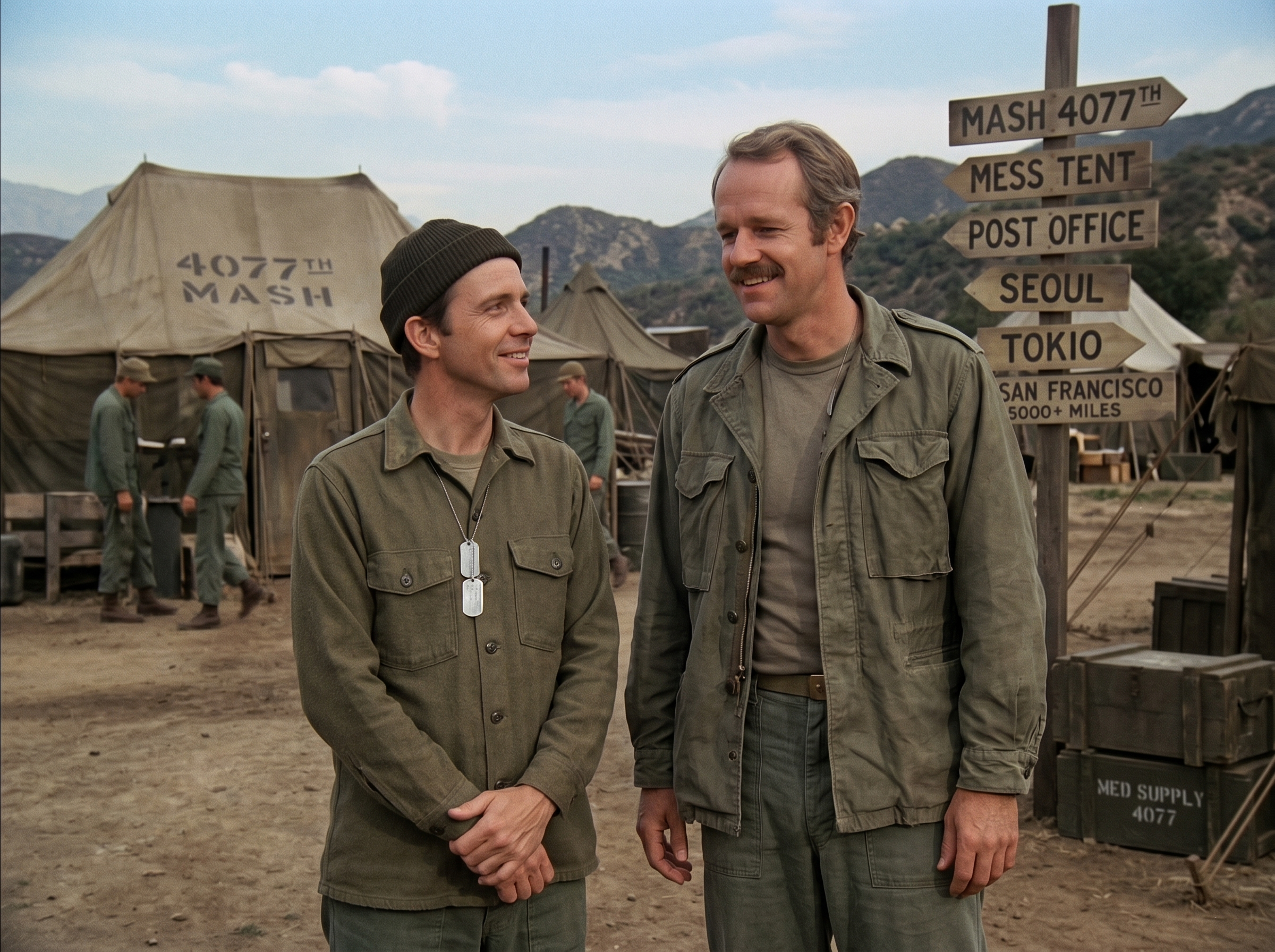
The red dust of the 4077th M*A*S*H unit never truly settled. It clung to everything: the olive drab fatigue shirts, the canvas of the tents, and, most visibly, to the iconic wooden signpost that marked the strange, impossible distances back to a world that felt increasingly like a dream.
Cpl. Walter “Radar” O’Reilly had approached Capt. B.J. Hunnicutt as B.J. was making his weary way back to his tent after a triple-shift in O.R. Radar, with his knit cap pulled low and dog tags visible, was looking up, his small hands clasped together with that familiar, earnest anticipation.
B.J., his mustache and smile both reflecting the warmth of a rare moment of levity, had stopped and turned to the young clerk. He was listening, his open posture and genuine expression offering a comforting groundedness. He wasn’t rushing off; he was present, even in his exhaustion.
The signpost, a landmark of sanity and sorrow, listed the places they all carried in their hearts. “Seoul.” “Tokio.” “San Francisco 5000+ Miles.” For a fleeting moment, by that very sign, the enormous distance and the crushing weight of the war seemed to lighten, replaced by a simple, shared human connection.
Radar had said something. It wasn’t profound, probably about mail or a new shipment of medical supplies. But his simple statement, whatever it was, had touched something tender. B.J.’s smile, a real, unforced smile, had grown. They were caught in that precious interval where the heavy burden of the operating room didn’t exist.
“Captain,” Radar began, his voice small, but sure, “Did you ever wonder… about the people back there? Back in San Francisco, looking at a sign for Seoul?” B.J.’s eyes, softening, were focused on Radar, a silent beat before the potential for a witty remark could even form. And in that quiet, shared gaze, the simple question became a potent reminder of everything they left behind.
The silence by the signpost stretched for a few moments, a fragile bubble of connection. The mountains loomed large and indifferent in the background, a stark contrast to the small, human figures standing before them. The other indistinct figures moving around the camp faded into a blur; the only clarity was the look between the tall captain from San Francisco and the young clerk from Iowa.
B.J. finally spoke, his dry humor, a practiced shield, softening around the edges. “Well, Radar, I’m not sure. Only if my wife has superhero eyes that can see past the Pacific, which I wouldn’t put past her. But I like the thought.” He was thinking of Peg and Erin, of the life he was missing, of the distance he couldn’t bridge.
Radar, always observing and interpreting, gave a small, earnest nod. “I know. It just… makes the map seem smaller. If they can look this way, too. The mail, the stories. Even a simple sign.” His clasped hands loosened a little, a sign of comfort.
B.J.’s internal thought process was simple and profound. How many times had he walked past this sign and only felt the crushing weight of that “5000+ miles”? Now, seeing it through Radar’s eyes, it wasn’t a barrier but a beacon. It was a link.
“You’re an optimistic soul, Radar,” B.J. said, his smile still broad but tinged with a quiet tenderness. He was genuinely touched. “We just have to trust that the feeling travels faster than any map. A feeling of missing, and a feeling of hope. Even when the dust gets everywhere.”
Radar’s perspective, always a lens of innocence and clarity, was simpler still. He just wanted to know that his captain from California felt the connection, that home wasn’t just a place on a sign. His internal thought was a hope that his own farm in Iowa had a sign with ‘4077th MASH’ on it, so his family could look his way.
“Do you think…” B.J. started, matching Radar’s earlier vulnerability, “Do you think we’re doing some good here, Radar? Other than fixing them up?” He was thinking of the found family, of the quiet decency, of moments like this one.
Radar didn’t hesitate. The earnestness was back. “Yes, sir. I do. We make each other remember why we’re here. To get everyone home. Even if we’re all still waiting for our turn to look at the sign that says ‘Iowa’.”
The shared solidarity deepened. A quiet laughter rippled between them, a laugh at their own small, shared human concerns in a place that tried so hard to crush them. The photo caught them in this exact grace. Not a grand event, just two men, small in the face of immense adversity, holding onto their dignity and a shared moment of simple joy by a dusty signpost. It was a found family holding its ground. They weren’t saving a life right then, but they were saving their own, and in turn, helping everyone around them.
The red dust of the 4077th M*A*S*H unit never truly settled, but in moments like this, its sting was soothed by the grace of shared human understanding, making the 5000+ miles to home feel, if not shorter, at least less impossible to bear.
In the heart of the 4077th, connections are the invisible lines on the map that no war can redraw.