A Matter of Triplicate and Tenderness
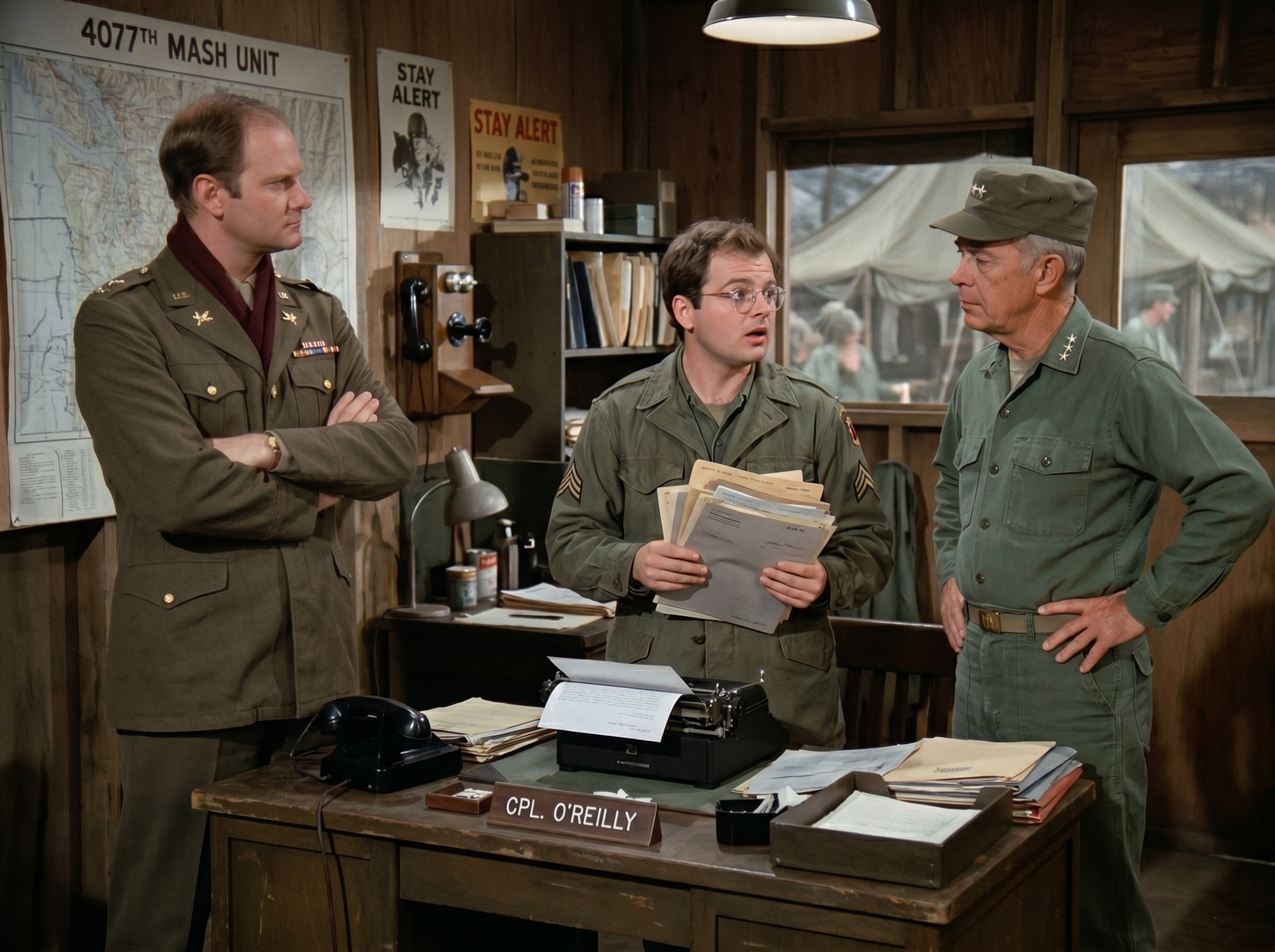
The war raged on just over the surrounding hills, but inside the clerk’s office of the 4077th MAS*H, time frequently ground to a dead, excruciating halt over carbon paper.
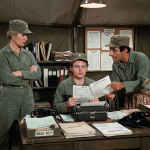
It was a Tuesday afternoon, painted in the muted gray tones and gentle analog softness of another endless week in Korea. The soft, even light filtering through the small windows fell across the cluttered surface of Corporal Walter “Radar” O’Reilly’s desk. The room was a monument to administrative chaos. Stacks of beige paper, half-typed reports, and mimeographed forms created miniature mountains around his heavy black Underwood typewriter.
Radar stood securely behind this desk, grasping a thick, messy stack of manila folders like a man holding a live hand grenade.
His wide-eyed concern was palpable. The young corporal’s mouth hung open in a frozen stutter, his shoulders hunched in an expression of profound, nervous confusion. He had just made a very innocent, but very colossal, misunderstanding.
Standing immediately to Radar’s left was Colonel Sherman T. Potter. The commanding officer’s posture was compact and stable, an anchor of weary wisdom in a sea of bureaucratic madness. Potter’s hands were planted firmly on his hips, pushing back his olive drab fatigue shirt to reveal his worn web belt. He did not look angry, merely exhausted. He observed the paperwork chaos in Radar’s trembling hands with the steady, resigned patience of a man who had survived the cavalry, the First World War, and the Second, only to be defeated by Army Form 32-A.
On the other side of the desk stood Major Charles Emerson Winchester III.
Winchester leaned away slightly, putting physical distance between himself and the Iowa farm boy’s incompetence. His arms were crossed over his chest in tightly controlled gestures, his face a perfect mask of dry superiority and reluctant participation. He wore his Class A jacket over a pristine burgundy scarf, looking entirely out of place in the dusty, lived-in reality of a mobile army surgical hospital. He tapped his index finger against his bicep, waiting for the impending disaster to finally articulate itself.
“I’m waiting, son,” Colonel Potter said gently, his gravelly voice cutting through the quiet hum of the camp generator. “We’re losing daylight, and I have a date with a canvas cot that I intend to keep.”
Radar swallowed hard, his Adam’s apple bobbing. “Well, sir. It’s about the requisition forms. The ones for the new surgical lamps we needed last week.”
“I am intimately familiar with the lamps, Corporal,” Winchester drawled, his Boston accent dripping with aristocratic impatience. “They are the only things currently standing between my peerless surgical technique and total, primitive darkness. What about them?”
“Well, sir,” Radar squeaked, looking down at the beige paper. “I Corps didn’t actually approve the lamps.”
Potter’s eyebrows lowered. “Come again? We’ve been operating under those new lamps since Friday. If I Corps didn’t send them, where the devil did they come from?”
Radar clutched the papers tighter to his chest, looking like a trapped animal. He glanced nervously at the map of the Korean peninsula on the wall, then at the “STAY ALERT” poster, as if hoping the cartoon figures would offer him a way out.
“I traded for them, sir,” Radar finally confessed. “With a supply sergeant down in Seoul. He had the lamps, but he wouldn’t give them up unless I took something off his hands that was ruining his inventory sheets.”
Winchester scoffed softly, shaking his head. “And what, pray tell, did you burden this medical unit with in exchange for adequate lighting? A crate of rubber chickens? A gross of defective harmonicas?”
“No, sir,” Radar said, his voice dropping to a terrified whisper. “A Sherman tank.”
The office fell deathly silent.
Potter’s hands slowly slipped from his hips. “A what?”
“A tank, Colonel. An M4 Sherman medium tank.” Radar frantically flipped through the stack of forms, pulling out a pink slip. “And because it’s a heavy mechanized vehicle, I couldn’t just sign for it as a corporal. I needed an officer’s authorization.”
Winchester’s posture suddenly stiffened. The dry superiority vanished from his eyes, replaced by a sudden, dawning horror. He looked at the pink slip in Radar’s shaking hand, then back to the boy’s terrified face.
“Corporal,” Winchester whispered dangerously. “Whose name did you forge on that document?”
Radar shrank back against the filing cabinet. “Well, Major… you see, you were the only officer who left your signature stamp sitting out on your footlocker.”
“I demand a court-martial!” Winchester exploded, his voice echoing off the thin wooden walls of the office. He uncrossed his arms, slamming a hand down on Radar’s desk, rattling the “CPL. O’REILLY” wooden nameplate. “I want this boy locked in the stockade! I want him shipped to a penal colony! I am a thoracic surgeon, Colonel, not a tank commander!”
“Hold your horses, Charles!” Potter barked, raising a hand to cut off the tirade. He took a slow, calming breath, his fatherly demeanor asserting control over the small room. He looked at Radar, his eyes full of complex, weary understanding.
“Radar,” Potter said quietly. “Let me get this straight. On paper, Major Winchester is currently the proud owner of thirty tons of armored artillery?”
“Yes, sir,” Radar nodded miserably. “And because of the classification, I Corps has officially reorganized the 4077th. They’re cutting our medical supply budget by forty percent to pay for the tank’s diesel fuel and armor-piercing shells. And they’re docking the Major’s pay for the transport fees.”
Winchester closed his eyes, pinching the bridge of his nose in sheer agony. “My family built Boston, Colonel. My father plays golf with senators. And I am going to die in a muddy tent in Korea, bankrupted by a boy who sleeps with a teddy bear.”
Potter didn’t laugh. He walked slowly around the desk, his boots heavy on the floorboards. He stopped next to Radar, looking down at the messy stacks of forms, the field phone, the endless, grinding machinery of army bureaucracy that threatened to crush them all every single day.
“Why’d you do it, son?” Potter asked, his voice entirely stripped of rank, sounding only like a tired grandfather. “You know the rules. You know what happens when you mess with heavy armor requisitions.”
Radar looked down at his boots. The nervous, comic energy drained out of him, leaving only the profound exhaustion of a kid who had seen too much.
“It was last week, Colonel,” Radar said softly. “During the big push from the north. The choppers wouldn’t stop coming. The OR was pitch black because the old generator blew the bulbs. You were all up to your elbows in chest wounds.”
Radar looked up, his eyes shining with unshed tears, seeking Potter’s understanding.
“I walked into the scrub room to bring you coffee, sir,” Radar continued. “And I saw Major Winchester operating in the dark. He couldn’t see what he was doing. He was yelling for light, and his hands were covered in… he was losing the kid, sir. I had to get those lamps. The guy in Seoul said it was the tank or nothing. I couldn’t wait for the paperwork. I just… I just stamped the Major’s name and sent the jeep.”
The silence in the office returned, but it was no longer comic. It was heavy, thick with the shared memory of the blood, the sweat, and the desperate, frantic hours they had all spent trying to stitch broken boys back together.
Winchester slowly lowered his hand from his face. The aristocratic fury melted away, leaving behind the quiet, guarded compassion that he fought so hard to hide from the world. He looked at Radar, really looked at him, seeing the worn fatigue shirt, the youth, the desperate loyalty to the doctors of the 4077th.
Charles remembered that operation. He remembered the blinding, terrifying darkness, and he remembered the sudden, brilliant beam of light that had cut through it just in time for him to tie off a severed artery.
Potter sighed, a long, rattling breath that seemed to carry the weight of the entire Korean peninsula. He reached out and gently took the pink slip from Radar’s hand.
“Well,” Potter said, staring at the paper. “It seems to me we have a simple clerical error. A smudge on the carbon paper. Clearly, this says ‘water tank,’ not ‘Sherman tank’.”
Radar blinked. “It does?”
“It does now,” Potter said firmly. “I know a general down at I Corps. A stubborn old mule I served with in Guam. I’ll get him on the horn. We’ll trade the tank to a mechanized infantry unit in exchange for medical blankets and plasma. We’ll balance the books.”
Radar’s shoulders dropped three inches in instant relief. “Oh, thank you, sir. Thank you.”
Potter clapped Radar gently on the shoulder. “Don’t thank me, son. Just promise me you’ll stop playing poker with the United States Army’s heavy artillery.”
Potter turned and walked toward the door, pausing with his hand on the frame. He looked back at Winchester. “Coming, Major? I believe we have afternoon rounds.”
Winchester stood frozen for a moment. He looked at the heavy black field phone, then at the cluttered desk, and finally at Radar, who was already busily reorganizing his forms with shaky hands.
Charles adjusted his burgundy scarf, lifting his chin, his posture once again immaculate and controlled.
“In a moment, Colonel,” Winchester said softly.
Potter nodded, stepping out into the hazy, gray-skied afternoon.
Winchester stepped closer to the desk. He looked down at the corporal. Radar froze, expecting a final, biting insult about his intellect or his hometown.
Instead, Charles reached into his perfectly pressed Class A jacket. He pulled out a small, heavy wooden stamp with a brass handle. He set it down gently on the edge of the typewriter, right next to the beige paper.
“Corporal,” Winchester said, his voice entirely devoid of sarcasm, carrying only a quiet, resonant sincerity. “Your methods are abhorrent. Your filing system is a crime against modern administration.”
Winchester paused, his eyes softening just a fraction.
“However,” Charles continued quietly, “the lighting in the OR has been magnificent. Should you ever find yourself requiring… leverage… for the benefit of our patients, I suggest you use the original stamp. The forgery was laughably obvious.”
Radar stared at the stamp, his mouth falling open in a small smile of total astonishment. “Yes, sir. Thank you, Major.”
“Do not thank me, Corporal,” Winchester said, turning sharply toward the door. “And if you ever requisition so much as a jeep without telling me, I will personally see you buried beneath a mountain of bedpans.”
Winchester swept out of the office, his dignity perfectly intact. Radar stood alone in the quiet hum of the room, looking down at the wooden stamp. He reached out, touching the brass handle, a small, warm smile spreading across his face. Outside, the distant, rhythmic chopping of incoming helicopters began to echo over the hills, calling them all back to the war, but inside the clerk’s office, everything was exactly where it belonged.
In a place defined by loss, their greatest victory was simply finding a way to carry each other through the dark.