The Weight of an Unwritten Letter
Some nights in Korea, the silence was louder than the artillery. After an eighteen-hour session in the Operating Room, the quiet didn’t feel like peace; it felt like a heavy blanket pressing down on the 4077th, keeping the exhaustion from escaping.
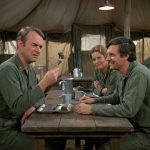
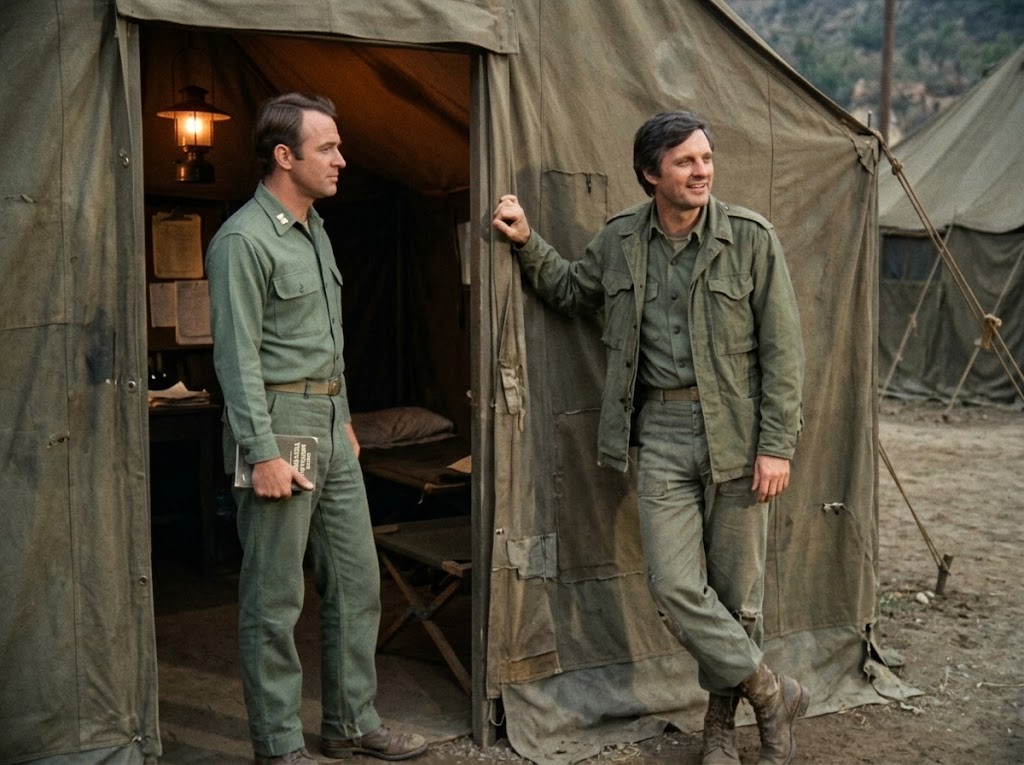
Hawkeye Pierce leaned against the worn canvas of the Swamp, his shoulders slouched under the weight of too many stitched-up lives. A faint, tired smile tugged at the corner of his mouth, the kind of smile used to keep from staring into the dark.
Beside him stood B.J. Hunnicutt, looking unusually formal with his uniform buttoned up, clutching a small, leather-bound notebook against his hip. His face was etched with a quiet, lingering anxiety that the casual stance couldn’t quite hide.
“You’ve been staring at that blank page for three days, Beej,” Hawkeye said, his voice dropping its usual theatrical edge, replaced by a soft, raspy fatigue. “If you keep gripping it that tight, the ink’s going to squeeze out through your fingers.”
B.J. didn’t laugh, though his eyes softened as he looked out across the compound toward the darkened helipad. “It’s Peg’s birthday tomorrow, Hawk. Every time I try to write down what it feels like to miss her, the words just look like standard military supply listings.”
“Tell her about the mud,” Hawkeye suggested quietly, shifting his weight against the tent frame. “Tell her how it builds character. Or how Klinger tried to trade his chiffon gown for a crate of frozen turkeys this morning.”
“I want to tell her the truth,” B.J. whispered, his knuckles whitening around the notebook. “But the truth is just a long list of things I wish she never had to imagine.”
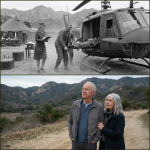
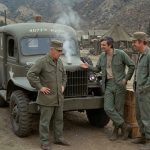
The evening breeze swept through the camp, rattling the tin chimney of the Swamp and carrying the faint, distant thud of a jeep coming up the road. It was the mail jeep, arriving hours past its usual schedule, its headlights cutting through the dust.
Radar O’Reilly stepped out of the front seat, his small frame silhouetted against the glare, clutching a solitary canvas bag. He didn’t run toward the tents with his usual enthusiastic bounce; his head was down, and his boots dragged heavily through the dirt.
As Radar approached the Swamp, he looked up, his eyes wide and anxious behind his thick glasses, completely ignoring the usual banter. He stopped right in front of B.J., holding out a single, crumpled envelope with a red stamped marking across the front.
“Captain Hunnicutt,” Radar said, his voice trembling slightly in the cool night air. “This just came back from the pouch in Seoul. It… it never made it to California.”
B.J. froze, his hand remaining glued to his notebook as he stared at the returned letter. The small, familiar handwriting of his wife’s address looked suddenly foreign beneath the bold, purple ink of the military postal rejection stamp.
Hawkeye stepped forward, his easy posture vanishing instantly as he read the tense lines around his friend’s jaw. “Radar, what is it? A routing mix-up?”
“The whole sector’s mail distribution center was reassigned last week, sir,” Radar explained, his voice dropping to an earnest, apologetic whisper. “They said anything processed during the transition got sent back to the originating unit for re-verification. I tried to intercept it before it reached the general pile, but…”
B.J. took the letter from Radar’s hand, his fingers tracing the edge of the envelope. It was the long, detailed letter he had written two weeks ago, pouring his heart out so it would arrive exactly on Peg’s birthday. Now, it was just a piece of dead paper, sitting in a dirt-floored camp thousands of miles away from San Francisco.
“She’s going to think I forgot,” B.J. said, his voice unnervingly flat, the steady, grounded captain suddenly sounding very young and very far from home. “She’s going to sit by the mailbox tomorrow, Hawk, and there won’t be anything there.”
Radar looked like he wanted to apologize for the entire United States Army, his shoulders sinking as he muttered a quiet goodnight and turned back toward the clerk’s office.
Hawkeye watched his roommate, knowing that words were usually his own shield, but right now, wit was useless. He reached out, gently taking the small notebook from B.J.’s hand and opening it to a blank page.
“Get inside,” Hawkeye said firmly, his tone shifting into that gentle, authoritative warmth he usually reserved for patients waking up from anesthesia. “We’re going to use the shortwave radio in the morning. I’ll get Radar to wake up Sparky, even if we have to bribe him with a bottle of my finest distilled medical alcohol.”
B.J. let out a short, breathy laugh, though his eyes remained fixed on the returned envelope. “You can’t just call California on a whim, Hawk. The lines are strictly for official business.”
“Then we’ll make it official business,” a dry, fatherly voice called out from the darkness.
Colonel Potter stepped into the light of the lantern hanging near the tent door, his hands tucked behind his back. He had been walking the perimeter, his usual evening routine to clear his mind before turning in.
“Sir?” B.J. turned, looking surprised.
“A soldier’s peace of mind is standard operational necessity in my command, Captain,” Potter said, his expression stern but his eyes filled with a deep, understanding compassion. “Tomorrow morning at dawn, you’ll be in my office. We’ll tell the operators we’re conducting an emergency morale check.”
Potter patted B.J. on the arm, a brief, reassuring touch that carried the weight of a man who had spent decades seeing young men miss their families. “Write down what you want to say tonight so you don’t get tongue-tied when the line connects. That’s an order.”
As the Colonel walked away toward his quarters, the heavy silence of the camp returned, but it didn’t feel quite as cold.
Hawkeye handed the notebook back to B.J., leaning his back against the canvas once more, looking up at the stars that looked exactly the same whether you were in Uijeongbu or Mill Valley.
“You heard the man,” Hawkeye said softly, a genuine, fond smile returning to his face. “Get to writing. And make sure to tell her that your roommate is a saint who deserves a medal, or at least a home-cooked meal when this whole circus packs up.”
B.J. looked down at the paper, the tension finally leaving his shoulders as he leaned against the tent post beside Hawkeye. The weight of the distance hadn’t changed, but sharing it made the ground beneath his boots feel just a little more solid.
“Thanks, Hawk,” B.J. murmured, stepping inside the tent where the warm light of the lantern cast long, steady shadows against the canvas.
In a place where time was measured by the arrival of the next chopper, a single moment of kindness was the only thing that kept the miles from breaking the heart.