Steam, Smiles, and the Steady Heart of the 4077th
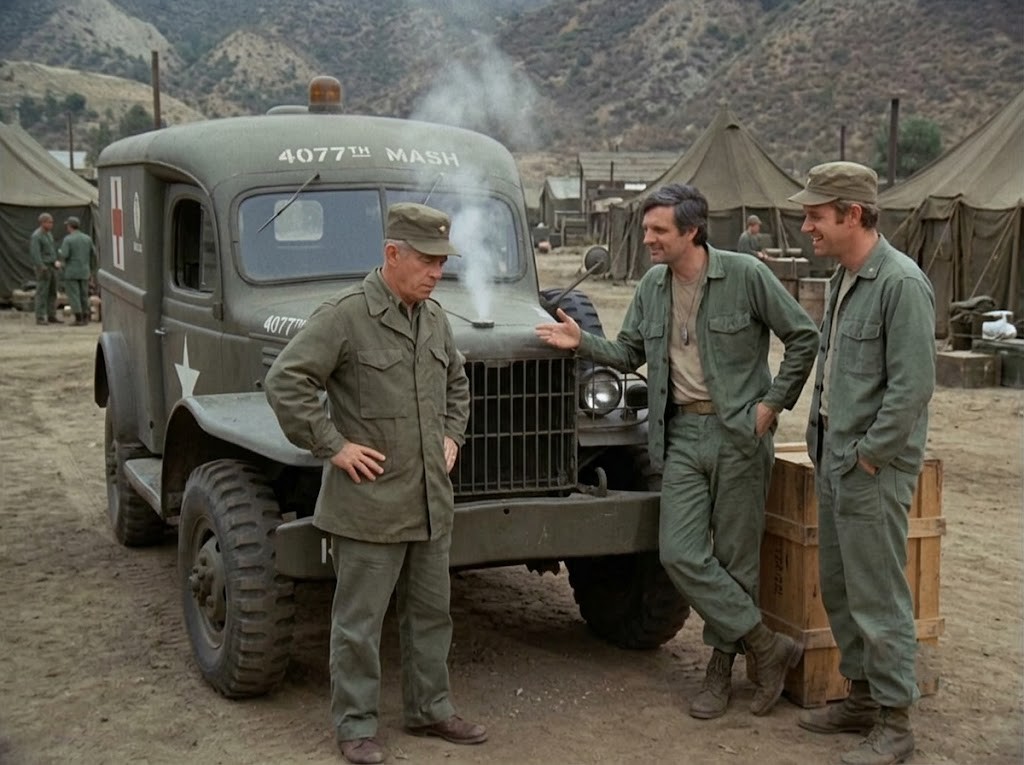
Some days in Korea don’t announce themselves with the sound of incoming choppers or the frantic shouting of the triage teams.
Sometimes, the longest days are the quiet ones, where the heat just sits on your shoulders like a wet wool blanket and the dust settles deep into the creases of your eyes.
Colonel Sherman Potter stood in the middle of the compound, his boots sinking slightly into the baked earth, staring at the front end of a battered Dodge ambulance.
From beneath the dented olive-drab hood, a thin, persistent hiss echoed through the camp, accompanied by a thick white plume of radiator steam.
It rose straight up into the stagnant air, a mockery of the cool mountain breezes everyone had been praying for since dawn.
Potter kept his hands firmly on his hips, his jaw set in a hard, straight line that usually meant someone was about to get a dressing down.
He didn’t look angry, though; he just looked tired, the kind of deep, generational fatigue that comes from commanding a unit of brilliant, fragile misfits in the middle of a forgotten war.
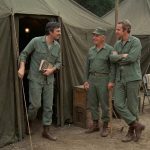
A few feet away, leaning comfortably against a rough wooden supply crate, stood Captains Hawkeye Pierce and B.J. Hunnicutt.
They looked like a pair of green-clad bookends, completely unbothered by the breakdown, their fatigue jackets loose and their caps tilted back.
“You know, Colonel,” Hawkeye said, gesturing toward the rising vapor with a lazy wave of his hand, “I’ve seen a lot of things in this camp, but I think this is the first time the motor pool has offered us a Finnish sauna.”
“It’s all about the amenities, Hawk,” B.J. chimed in, a slow, easy grin spreading across his face as he shifted his weight against the crate. “We can invite Winchester. He can bring his classical records, and we can all sweat out our sins in absolute luxury.”
Potter didn’t look up from the steaming cap, his eyes fixed on the bubbling water sizzling against the hot metal.
“If either of you two comedians has a spare radiator hose in your pockets, I’d love to see it,” the Colonel muttered, his voice a dry, gravelly rumble. “Otherwise, you’re just obstructing traffic and wasting good air.”
“Oh, come now, Sherman,” Hawkeye said, his tone softening just enough to let the genuine affection show through the sarcasm. “We’re not obstructing. We’re offering moral support to a mechanical casualty. It’s what we do.”
The ambulance had been scheduled to head down to the regular supply depot to pick up a fresh shipment of antibiotics and, more importantly, a crate of personal mail that had been delayed for three weeks.
In a place like the 4077th, mail wasn’t just paper and ink; it was oxygen, a lifeline that kept the sanity of two hundred people from completely evaporating.
Now, with the radiator blown and the motor pool already stripped of spare parts, that lifeline felt miles away, buried under a cloud of useless steam.
Potter took a deep, heavy breath, the starch in his military posture giving way to the slumped shoulders of a father watching his kids get disappointed one more time.
He looked toward the horizon, where the barren hills shimmered in the midday heat, silent and unyielding.
Then, from across the compound, Radar O’Reilly came sprinting out of the clerk’s office, his clipboard clutched tightly to his chest and a look of sheer panic stamped across his young face.
“Colonel! Colonel Potter, sir!” Radar yelled, his boots kicking up small clouds of dust as he skidded to a halt right beside the steaming truck.
Potter didn’t turn around, merely closing his eyes for a brief second. “Keep your shirt on, Radar. If the Chinese are coming, tell them to bring a mechanic.”
“No, sir, it’s not that,” Radar panted, his breath coming in short, ragged gasps as he looked from the Colonel to the two surgeons. “It’s the radio from Seoul. The supply convoy… they’re rerouting because of a washed-out bridge, and if we don’t get our vehicle down to the junction in forty-five minutes, they’re bypassing us completely.”
The easy smiles vanished from Hawkeye and B.J.’s faces in an instant.
The silence that followed Radar’s announcement was heavy, broken only by the steady, mocking hiss of the broken-down ambulance.
Forty-five minutes meant the mail, the fresh penicillin, and the small comforts of home would be carried off to another unit, leaving the 4077th stranded in their own dust for another month.
Hawkeye straightened up from the wooden crate, the joking demeanor completely gone, replaced by the sharp, focused intensity he usually reserved for the operating room.
“Forty-five minutes?” B.J. repeated, looking down at his watch and then back at the useless hunk of metal in front of them. “We couldn’t walk there in that time, let alone push this thing.”
Colonel Potter didn’t say a word; he just stared at the steam, his mind working through the bleak inventory of their options.
He knew what that mail meant to his people—he knew Hawkeye needed those letters from his father, he knew B.J. was starving for a drawing from his little girl, and he knew his own wife, Mildred, was waiting on the other side of the world.
“Radar,” Potter said quietly, his voice dangerously calm. “Get Rizzo out here. Tell him if he doesn’t find a way to patch this radiator in five minutes, I’ll have him scrubbing the latrines with a toothbrush until the next freeze.”
“Rizzo’s down with the flu, sir,” Radar whispered, looking down at his clipboard as if the bad news might disappear if he didn’t look it in the eye. “And the grease monkey from the 8063rd took the jeep to Uijongbu.”
Hawkeye looked at B.J., an unspoken understanding passing between them, the kind of silent communication that only comes from spending hundreds of hours operating side-by-side in the dark.
“Well, Beej,” Hawkeye said, stepping toward the front of the truck and tapping the hot metal of the hood. “They don’t teach radiator repair in medical school, but a leak is just a ruptured vessel, right?”
“Technically, yes,” B.J. said, walking over to join him, a faint trace of his old smile returning. “And we’ve plugged worse leaks than this with nothing but prayer and some suture thread.”
Potter watched them, his eyebrows raising slightly. “This is a combustion engine, Captains, not a human torso. You can’t just put a tourniquet on a water pump.”
“Watch us, Colonel,” Hawkeye said, already unbuttoning his cuffs. “Radar, go to the mess tent. Bring me a dozen eggs, two cans of lard, and every clean rag Igor hasn’t used to wipe the floors.”
Radar blinked, thoroughly confused. “Eggs, Captain Pierce? Are we making breakfast or fixing a truck?”
“Just do it, Radar! Speed is of the essence!” Hawkeye commanded with a theatrical wave of his hand.
As Radar scurried off, Hawkeye and B.J. began working with a frantic, coordinated energy that mirrored their performance during a heavy push in the OR.
Using a thick pair of heavy leather gloves from the truck’s cab, B.J. carefully twisted the radiator cap off, releasing a final, angry burst of steam into the sky.
Hawkeye grabbed a bucket of murky water from the wash station, pouring it slowly into the radiator while B.J. inspected the split in the rubber hose.
By the time Radar returned with a bowl of raw eggs, a small crowd had gathered around the vehicle, including Father Mulcahy, who looked on with a mixture of amusement and genuine concern.
“What exactly is the medical consensus here, Pierce?” Potter asked, leaning over the fender, his curiosity finally overriding his skepticism.
“It’s an old country trick, Colonel,” B.J. explained, taking the eggs from Radar. “You drop the egg whites into the hot radiator. The heat cooks the whites instantly, and the pressure forces them into the small cracks and holes, sealing the leak from the inside.”
“It’s beautiful, really,” Hawkeye added, cracking an egg with one hand and dropping it into the metal opening. “An organic vascular graft. If it works, we get our mail. If it doesn’t, we have an exceptionally large, very metallic omelet.”
They worked in silence for the next ten minutes, patching the exterior of the hose with tight layers of canvas rags and heavy twine, binding it with the same precision they used on a delicate artery.
Potter stood by, watching every movement of their grease-stained hands, his stern expression slowly melting into a look of quiet pride.
These men complained, they broke the rules, they drank homemade gin, and they drove him up the wall on a daily basis, but when the chips were down, there was nothing they wouldn’t do for each other.
“Alright, Colonel,” Hawkeye said, wiping a streak of black grease across his forehead, leaving him looking like a tired soldier from a completely different war. “Give her a crank.”
Potter climbed into the driver’s seat, pumped the pedal twice, and turned the key.
The engine sputtered, groaned, cleared its throat with a loud backfire that made Father Mulcahy jump, and then settled into a loud, rumbling roar.
Everyone held their breath, their eyes glued to the patched radiator hose.
A single droplet of water bubbled up at the edge of the twine, trembled for a moment, and then stopped as the cooked egg whites held the line against the pressure.
“I’ll be a monkey’s uncle,” Potter muttered, a massive, rare smile breaking through his weathered face as he leaned out of the cab window. “It’s holding.”
“Don’t sound so surprised, Colonel,” Hawkeye laughed, leaning back against the truck fender, his hands covered in a mixture of grease and egg yolk. “We’re doctors. We specialize in keeping things running long after they should have quit.”
“Get moving, you two,” Potter ordered, though his voice was full of warmth. “Take the ambulance, get down to that junction, and don’t come back without every scrap of paper with our names on it.”
B.J. hopped into the passenger side, giving a quick salute to the small crowd that had gathered to cheer them on.
As the ambulance rattled out of the compound, kicking up a massive cloud of dust, Hawkeye hung out of the window, waving a greasy rag like a victory flag.
Potter stood in the clearing, watching the vehicle disappear into the distant hills, the dust slowly settling back onto his boots.
Father Mulcahy walked up beside him, his hands clasped gently in front of his robes. “A minor miracle, wouldn’t you say, Sherman?”
Potter took off his cap, wiped his brow with the back of his sleeve, and looked out at the empty road.
“No, Father,” Potter said softly, his voice full of a quiet, enduring gratitude. “Just two very good boys who know how much a letter from home means to a lonely camp.”
In the dust of the 4077th, it was never the machines that kept them going, but the fragile, stubborn beauty of the human heart.