The Weight of the Paperwork
The war was usually measured in mud, blood, and the distant, rhythmic thumping of chopper blades. But on a quiet Tuesday afternoon in the 4077th, the war was measured entirely in triplicate.
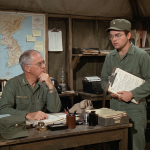
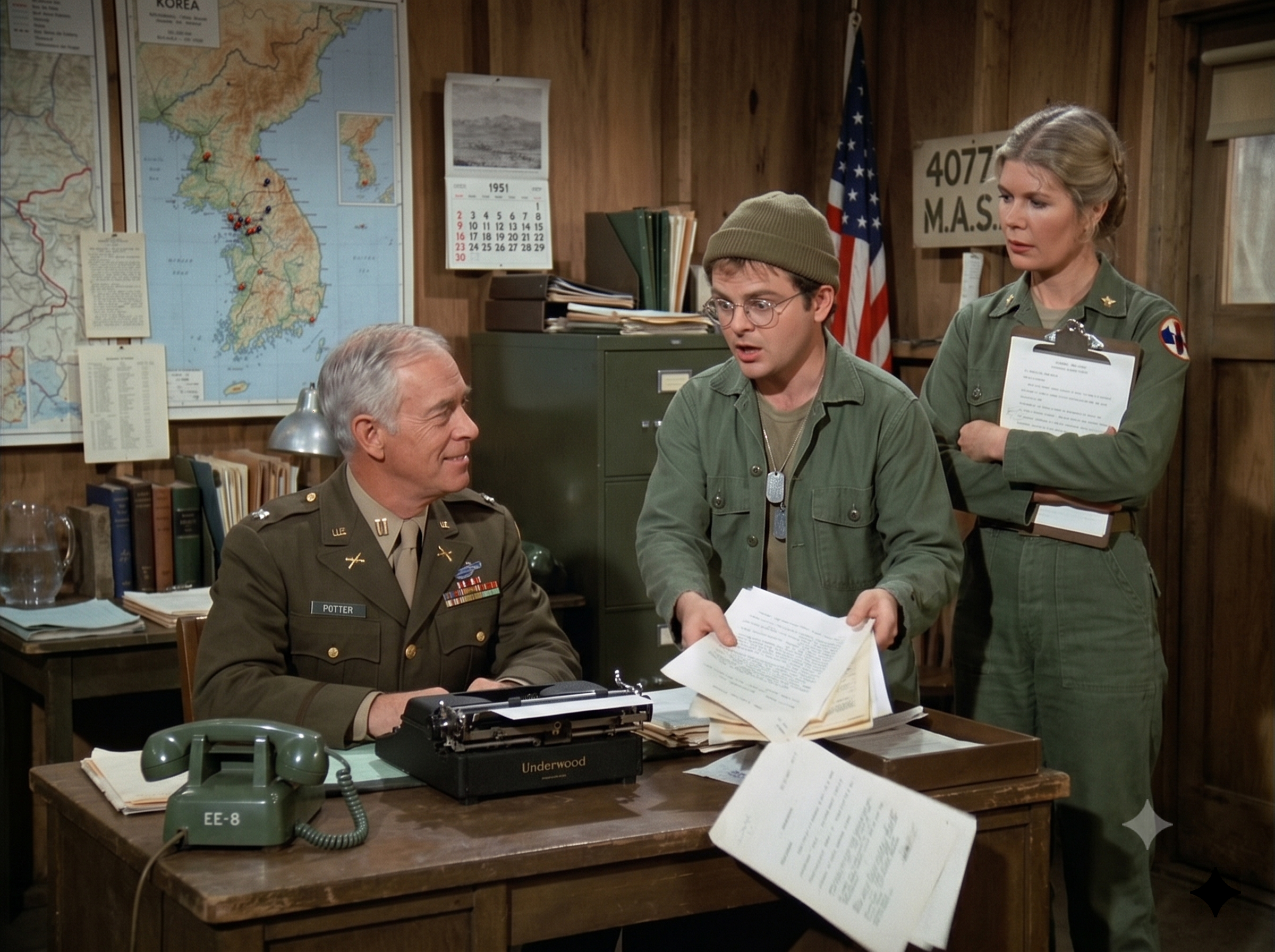
Inside Colonel Potter’s office, the air was thick with the familiar smell of stale coffee, canvas, and canvas dust. It was a modest, practical space, far removed from the grand mahogany offices of Seoul or Tokyo. A faded map of Korea hung stubbornly on the wooden plank wall, alongside a calendar that seemed to taunt them with the slow passage of 1951.
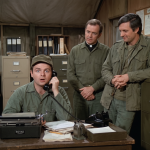
Colonel Sherman T. Potter sat behind his wooden desk, looking entirely in his element. He wore his commanding officer’s uniform—crisp, decorated, and dignified—a sharp contrast to the exhausted, rumpled reality of the camp outside his door. His hands rested near his heavy green field phone and his sturdy Underwood typewriter. He wasn’t yelling. He wasn’t barking orders. He was just watching, a gentle, crinkly smile playing at the corners of his eyes.
Standing to his left was Major Margaret Houlihan. She was a vision of absolute military discipline in a camp that actively rejected the concept. Wearing her practical green fatigues, her hair pinned back perfectly, she clutched her wooden clipboard like a shield. She stood upright, her posture radiating a mixture of professional pride and the controlled frustration she usually reserved for the camp’s civilian draftees.
And then, there was Radar.
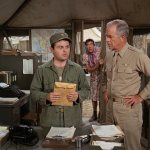
Corporal Walter Eugene O’Reilly had entered the office a few moments earlier, carrying a stack of requisition forms so tall it practically required air traffic clearance. He wore his usual knit cap, his round glasses slightly askew, his dog tags dangling over his olive drab shirt. He was mid-sentence, nervously delivering the morning report, when the delicate balance of his paperwork ecosystem completely failed him.
“And then, sir, the quartermaster said that if we wanted the extra blankets we had to file a Form 409-G, but Captain Pierce already used the 409-Gs to make a papier-mâché cast for a fractured femur, so I had to improvise with a 409-H, which technically is for requesting mule feed…”
Radar shifted his weight. The stack wobbled.
Margaret sighed, a sharp, exasperated sound escaping her lips. “Corporal, for heaven’s sake, just hand the Colonel the summary before you bury us all in carbon paper.”
The sudden sharpness of Margaret’s voice, combined with his own frantic internal calculations, was too much for Radar’s nervous system. He jumped slightly. The top half of the stack began to slide.
Radar’s eyes went wide with pure, unadulterated panic. He scrambled to catch the sliding cascade of military bureaucracy. His hands flew out, his mouth forming a perfect ‘O’ of dismay.
But he was a second too late. The forms slipped from his grasp, fluttering down toward the colonel’s desk like giant, depressing snowflakes. And right in the middle of the falling chaos, drifting in slow motion toward Colonel Potter’s pristine blotter, was the one piece of paper Radar had explicitly promised Hawkeye and B.J. he would keep entirely out of the Colonel’s sight.
The office fell completely silent. The only sound was the soft shhhk of the paper landing face-up right next to Colonel Potter’s right hand.
Radar froze. He looked as if he had just accidentally stepped on a landmine made entirely of court-martial offenses. He didn’t breathe. He didn’t blink. He just stared at the offending document, waiting for the inevitable explosion.
Margaret leaned forward, her professional posture breaking just enough to read the heading on the paper. Her eyes narrowed. “Corporal,” she said, her voice dangerously quiet. “Is that a requisition form for fifty gallons of high-grade surgical alcohol, signed by a… General MacArthur?”
Radar swallowed hard. The sound was audible over the hum of the camp generator. “Well, ma’am… you see… the thing about General MacArthur is… he’s a very busy man… and sometimes…”
“Sometimes he personally orders surgical alcohol for a mobile hospital from a theater command he was fired from months ago?” Margaret countered, her clipboard tapping against her hip. She looked at Potter, fully expecting the Colonel to turn the color of a ripe tomato and unleash a torrent of cavalry-inspired profanity.
Instead, Potter just reached out and picked up the paper.
He adjusted his glasses, holding the forged document up to the warm, practical light of the office. He studied it with the critical eye of a man who had spent forty years surviving both enemy fire and army red tape. He didn’t shout. The gentle, fatherly amusement never left his face.
“General MacArthur, eh?” Potter mused, his gravelly voice calm and steady. “I have to admit, the signature is a masterpiece. The flourishes on the ‘M’ are spot on. Pierce’s work, I assume?”
“Uh… yes, sir,” Radar squeaked, his shoulders slumping in defeat. “But it’s not what you think, sir! I mean, it is what you think, but it’s not for the still! Not this time! I swear on my Uncle Ed’s glass eye, sir.”
Potter lowered the paper and looked at the terrified clerk. “Then enlighten me, son. What exactly is the former Supreme Commander requisitioning fifty gallons of alcohol for?”
Radar wrung his hands, the rest of the dropped papers completely forgotten on the floor. “It’s for the orphanage, sir. The Sisters of Theresa. The local well got contaminated by runoff from the motor pool. They can’t boil enough water to keep the medical instruments clean for the kids. Hawkeye—Captain Pierce, sir—he figured if we got the high-grade alcohol, we could trade it to the Greek battalion for two of their portable water purification units. They have extras, sir. I already checked.”
Margaret, who had been gearing up to deliver a scathing lecture on military regulations, suddenly stopped. Her grip on her clipboard softened. She looked from Radar to the forged paper, her expression shifting from controlled frustration to something quiet, tender, and deeply vulnerable. She had just spent her morning stitching up civilian children in pre-op.
“Two purification units?” Margaret asked softly, the strict major momentarily replaced by the fiercely protective head nurse.
“Yes, ma’am,” Radar said earnestly. “It’ll give them clean water for a year.”
Potter sat back in his wooden chair. He looked at Margaret, reading the unspoken plea in her eyes. He looked at Radar, seeing the sweet, earnest kid from Iowa who spent half his time terrified of the army and the other half brilliantly subverting it to save lives.
The Colonel sighed, a heavy, tired sound that carried the weight of too many wars. But when he picked up his pen, his eyes were still shining with that calm, gentle pride.
“Corporal,” Potter said, setting the paper down on his desk. “I am a Regular Army man. I believe in rules. I believe in the chain of command. And I certainly do not believe in forging the signature of a five-star general.”
Radar winced. “Yes, sir.”
“However,” Potter continued, uncapping his pen. “It seems General MacArthur forgot to initial the secondary authorization line. An amateur mistake. Good thing I’m here to catch it.”
With a swift, practiced motion, Potter scrawled his own initials across the bottom of the form, cementing the illegal trade with his own commanding authority.
Radar’s jaw dropped. Margaret closed her eyes for a brief second, a tiny, genuine smile breaking through her rigid composure before she quickly hid it behind her professional mask.
Potter handed the paper back to Radar. “Take this to the quartermaster, son. Tell him if he gives you any guff about the General’s signature, he can take it up with me. And Walter?”
Radar, clutching the paper to his chest like a holy relic, snapped to attention. “Yes, sir?”
“Pick up the rest of this mess before you trip and break your neck,” Potter said, gesturing to the scattered forms on the floor. “We’ve got enough casualties in this camp without my company clerk drowning in 409-Gs.”
“Yes, sir! Right away, sir! Thank you, sir!” Radar dropped to his knees, frantically gathering the papers, his panic completely replaced by a wide, glowing relief.
Margaret watched him scramble for a moment before stepping forward. She gracefully knelt down, her green fatigues pooling on the dusty floor, and began helping him gather the scattered requisition forms. Radar looked up at her in shock, but she just offered him a small, almost imperceptible nod.
Colonel Potter watched them from his desk. He leaned back, the hum of the camp continuing outside his window. It was a miserable place, filled with mud, blood, and endless fatigue. But as he watched his head nurse and his company clerk quietly working together on the floor of his office, the old cavalryman couldn’t help but smile.
They were surrounded by a war, but inside this small wooden room, they were just a family trying to keep each other whole.
Some days, the bravest thing you could do in a war zone was just look the other way for the right reasons.