The Consistency of Grey Mystery
The artillery had finally gone quiet around dawn, leaving behind a silence so heavy it made your ears ring. For forty-eight straight hours, the Operating Room at the 4077th had been a blur of green gowns, hissing sterilizers, and the exhausting cadence of survival. Now, with the sun hanging low and pale over the Uijeongbu mountains, the camp was settling into that peculiar, bone-deep fatigue where sleep feels both desperately urgent and entirely impossible.
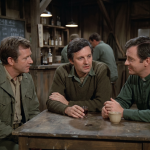
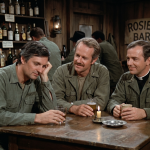
Hawkeye Pierce sat at the end of the rough wooden mess tent table, his chin resting heavily in the palm of his hand. His eyes were rimmed with red, his hair a tangled mess, and his mind felt like it was stuffed with wet cotton. Next to him, B.J. Hunnicutt stared quietly into his metal coffee mug, tracing the rim with a thumb that still bore the faint, stubborn stains of surgical scrub.
They hadn’t spoken a word in twenty minutes. There was simply nothing left to say that hadn’t already been written in the charts or muttered over an open incision.
Then came Major Charles Emerson Winchester III.
Even when exhausted, Charles carried himself with the rigid dignity of a man who believed the Boston aristocracy was personally relying on him to maintain standards in the wilderness. He slid onto the bench opposite them, his dress shirt and tie impeccably aligned despite the heat, his jaw set in a look of profound, preemptive grievance.
With a slow, deliberate movement, Charles looked down at his metal tray.
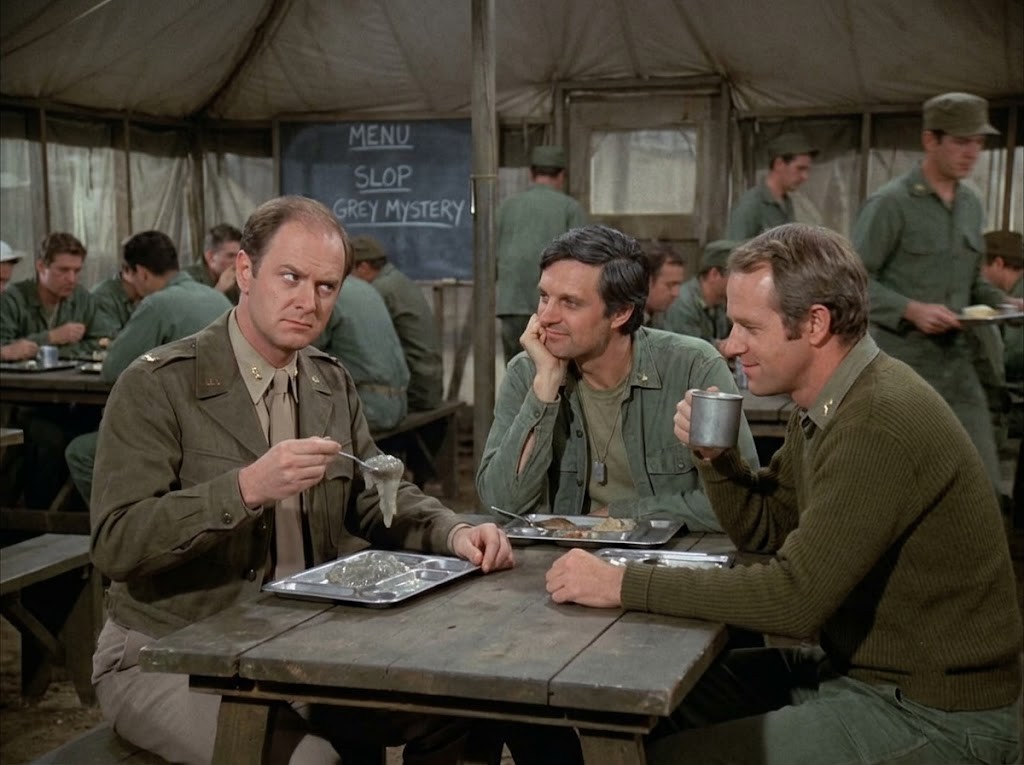
In the center of the compartment lay a trembling, translucent dollop of something that defied the laws of both nature and culinary science. Behind them, the camp chalkboard proudly announced the day’s options: *MENU – SLOP – GREY MYSTERY.*
“I have seen things in this wilderness that would stagger the imagination of a medieval torturer,” Charles began, his voice dropping into that rich, theatrical baritone that could fill a concert hall. “But this… this represents a new low, even for our culinary executioner, Igor.”
Using his spoon, Charles carefully lifted a glob of the shimmering, gelatinous mass. It stretched, dangling precariously from the metal rim like a tragic, lukewarm teardrop. He turned his head sideways, his brow furrowing into a mask of pure, unadulterated skepticism, staring at the substance as if it might suddenly develop a pulse and demand an apology.
Hawkeye didn’t move his hand from his chin, but a slow, tired smile crept onto his face. It was the first time his muscles had formed a smile in two days. Beside him, B.J. let out a soft huff of a laugh, raising his mug to his lips but keeping his eyes locked on Charles’s performance.
“What’s the matter, Charles?” Hawkeye murmured, his voice scratchy from lack of use. “Don’t you recognize vintage 1953 Army nectar? I believe it’s aged in old fuel drums to give it that distinct, industrial bouquet.”
“It is not nectar, Pierce. It is an affront to the senses,” Charles snapped, still holding the spoon aloft as the grey mystery quivered in the morning light. “It possesses neither form nor flavor, yet somehow manages to look aggressively hostile. Back in Boston, if one were to serve something of this consistency, it would be used to wallpaper the library, not sustain human life.”
“Come on, Charles, give it a chance,” B.J. offered mildly, his eyes crinkling at the corners. “It might have a wonderful personality. Maybe it’s just shy.”
“It is mutated starch, Hunnicutt,” Charles declared, his voice rising just enough to catch the attention of a few tired corpsmen at the next table. “And I refuse to subject my digestive tract to a substance that looks like it was harvested from the bottom of an abandoned radiator.”
For a moment, the bickering felt normal. It felt like the comfortable, predictable rhythm of the Swamp, a shield they used to block out the memory of the helicopters and the red mud. But as Charles continued to stare at the spoon, the theatrical disgust in his eyes suddenly shifted.
The anger didn’t fade, but it changed. It grew heavier. His hand began to tremble slightly—not from the weight of the spoon, but from a sudden, sharp wave of the exhaustion they were all fighting to keep at bay.
The spoon shook. The grey mystery fell back onto the tray with a dull, hollow thud. Charles didn’t make another joke. He just sat there, looking at his tray, his breathing suddenly shallow as the silence of the tent closed back in around them.
—
Hawkeye’s smile faded instantly. He straightened up, his hand dropping from his chin as he exchanged a quick, knowing look with B.J.
In the 4077th, you learned to read the precise moment a man’s defense mechanism broke. Charles could complain about the food, the climate, and the lack of opera for hours without breaking a sweat. But when the complaining stopped before the punchline, it meant the wall had cracked.
“Charles?” B.J. asked softly, setting his metal mug down on the table with a quiet clink.
Winchester didn’t look up. His eyes remained fixed on the tray, his shoulders tightening under his jacket. He reached into his pocket, his fingers searching for a moment before pulling out a crumpled piece of paper—a letter that had arrived in the morning mail while they were still trapped in the post-op ward.
“It’s from my father,” Charles said, his voice stripped of its usual pomposity, leaving only a raw, tired flatness. “He writes to inform me that the family has secured a box for the upcoming season at the Symphony. He notes, quite casually, that he expects me to be home in time for the opening night in October.”
Charles let out a short, bitter laugh that sounded more like a cough. He looked out the window of the mess tent, toward the helipad where the red dirt was still settling from the last departure.
“October,” Charles repeated, the word tasting heavier than the food on his tray. “He writes from a world where people worry about the seating arrangements in a concert hall. He has no concept of this. None. He does not know what it smells like when the generator fails. He does not know what it feels like to watch a boy from Iowa fade away while you are holding his heart in your hand.”
He looked back at the tray, his eyes bright with a sudden, fierce frustration. “And I am sitting here, arguing with a bowl of grey gelatin, because if I don’t focus on how dreadful the food is, I might have to think about the fact that I may never see Boston again.”
The mess tent seemed to grow even quieter. In the background, the soft clatter of trays and the low murmur of other soldiers continued, but at their table, the air was perfectly still.
Hawkeye reached across the table, his hand hovering for a second before he gently nudged Charles’s tray.
“You know, Charles,” Hawkeye said, his voice dropping its sarcastic edge, replacing it with the quiet warmth he usually kept reserved for patients in the dead of night. “When I first got here, I thought the worst part was going to be the mud. Then I thought it was the cold. But it’s not. It’s the distance. It’s the way home feels like a movie you watched a long time ago, and you can’t quite remember if the ending was happy or not.”
B.J. nodded, leaning forward. “We all have those letters, Charles. My daughter Erin is growing up in photographs. Every time I get a new one, I have to spend an hour remembering what her laugh sounds like. It tears you apart if you let it.”
Charles looked at them, his pride fighting a brief, losing battle against the sheer comfort of not being alone in his misery. He swallowed hard, adjusting his tie with a quick, nervous movement of his fingers.
“It is… profoundly unfair,” Charles muttered, though the sharpness was gone from his words.
“Of course it is,” Hawkeye said, offering a small, tired grin. “The army doesn’t promise fair, Charles. They just promise three square meals of unidentified gray matter and a front-row seat to the craziest show on earth. But look on the bright side.”
Charles raised an eyebrow, his classic skepticism returning, if only by a fraction. “And what, pray tell, is the bright side, Pierce?”
“The bright side,” Hawkeye said, pointing a finger at the tray, “is that if Igor ever tries to poison us, we’ll never know the difference. We’re completely immune.”
B.J. let out a genuine chuckle, nudging Charles’s arm. “And besides, if you don’t eat your grey mystery, Radar is going to come over here and claim it for his guinea pigs. Do you really want that on your conscience?”
Charles looked down at the quivering mass on his tray one last time. The disgust was still there, but the heavy, suffocating despair had lifted, chased away by the familiar, stubborn survival instinct of the 4077th.
With a deep, theatrical sigh, Charles picked up his fork instead of his spoon, prodding the substance with a renewed sense of purpose.
“Very well,” Charles sighed, his baritone voice regaining a hint of its aristocratic luster. “For the sake of the local fauna, I shall attempt to consume a portion of this… culinary catastrophe. But if I perish before the evening shift, Pierce, I leave you my collection of Mozart sonatas. Though I highly doubt your uncultivated ears will appreciate them.”
“I’ll play them on the still, Charles,” Hawkeye smiled, leaning back into his seat as the warmth of the coffee and the safety of the moment finally began to soothe his tired mind. “They’ll make the gin taste higher class.”
The three of them sat together as the morning sun finally broke through the canvas windows, casting a long, golden light across the scratched wooden table, a small island of sanity in a world that made no sense at all.
—
Sometimes the only way to survive the weight of the world was to share a laugh over a tray of grey mystery with the only family you had left.