A Package from Home, A Piece of the Heart
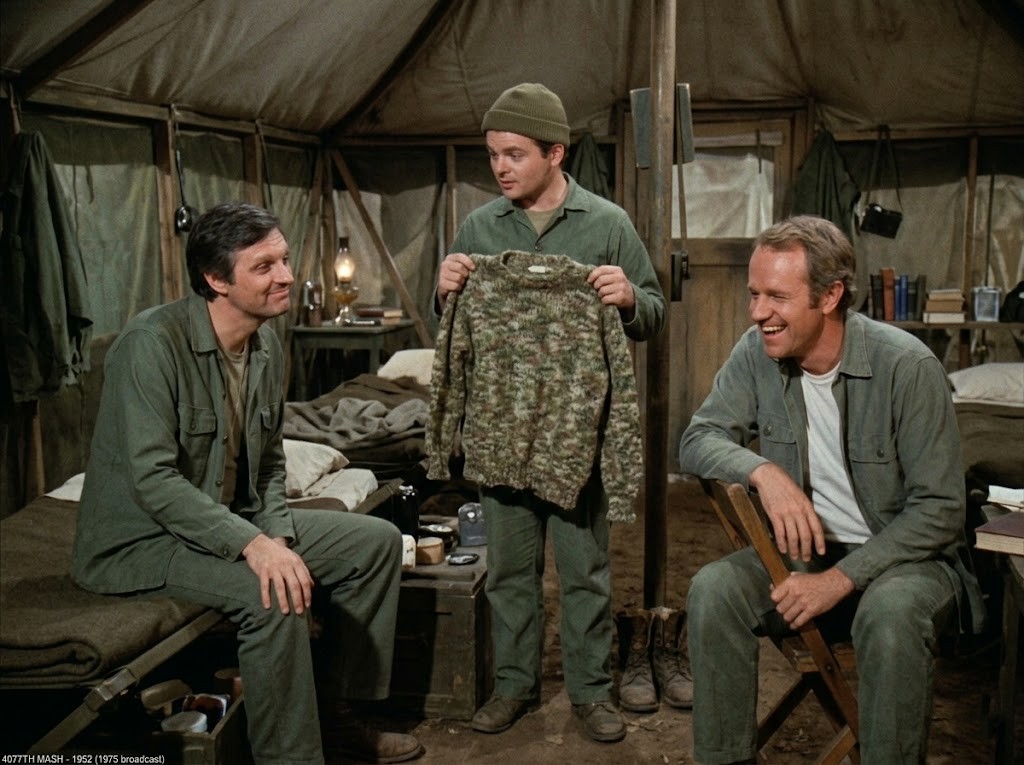
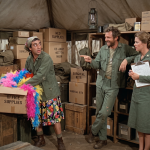
The late afternoon sun had already surrendered to the biting chill of the Korean evening, casting long, bruised shadows across the compound of the 4077th. Inside the supply tent, the air was thick with the smell of canvas, dust, and the sharp, metallic tang of kerosene from a single, glowing lantern.
Corporal Walter “Radar” O’Reilly stood near a stack of wooden crates, shivering slightly. His olive-drab knit cap was pulled down low over his ears. He gripped a heavy clipboard to his chest like a wooden shield, a yellow pencil poised carefully in his right hand.
Beside him stood Major Charles Emerson Winchester III.
Even in the dreary confines of a military storage tent, Charles managed to look as though he were inspecting a lesser wing of a grand family estate. He wore his heavy green field jacket buttoned perfectly, his hands encased in immaculate brown leather gloves to ward off the damp chill.
“Well, Corporal?” Charles sighed, his breath forming a faint white cloud in the freezing air. “Do we have a package or not? I have a sudden and desperate need for something that does not taste of iodine, powdered eggs, or despair.”
Radar blinked, looking down at his manifest. “Yes, sir. It came in on the afternoon chopper with the plasma and the bandages.”
Charles shuddered elegantly. “Please, Radar. Do not mention medical supplies in the same breath as my mail.”
Radar reached over to a dark stack of folded wool blankets and retrieved a small, plain cardboard box. He held it out with both hands, his earnest face looking up at the towering surgeon.
Charles took it, instantly testing its weight. His brow furrowed in immediate suspicion.
He turned the box over in his gloved hands, holding it up toward the warm, amber light of the lantern. It was quite small. Too small for a tin of imported pheasant. Far too light to hold a bottle of fine cognac.
“This lacks the customary heft of a care package from Beacon Hill,” Charles murmured, his voice laced with aristocratic disappointment. “Are you quite certain this is for me, Corporal?”
“Yes, sir,” Radar said quickly, tapping his pencil against the paper on his clipboard. “Winchester, Charles E. Major. Serial number ending in…”
“Yes, yes, I know my own number,” Charles interrupted softly.
He narrowed his eyes, squinting at the smudged black ink on the shipping label. The return address was not the familiar, flowing, elegant script of his mother. Nor was it the typed, mechanical precision of his father’s secretary.
It was a slightly shaky, uneven handwriting that Charles had not seen in a very long time.
Suddenly, his hands went perfectly still. The haughty posture seemed to melt away, leaving the Major frozen in the dim, golden light of the tent.
Radar noticed the sudden drop in temperature that had nothing to do with the Korean winter. He looked up, his wide, innocent eyes studying the Major’s suddenly pale face.
“Sir?” Radar asked quietly, his voice full of genuine concern. “Is everything okay? Did they send the wrong thing?”
Charles didn’t look at him. His eyes remained locked on the small cardboard box, his gloved thumbs resting gently against the rough edges. The silence in the tent stretched out, heavy and tight with a sudden, unspoken emotion.
“No, Corporal,” Charles finally whispered, his voice trembling just a fraction. “It is not the wrong thing. In fact… I believe it is something I never knew I was waiting for.”
Radar shifted his weight from one foot to the other, his clipboard lowering slightly. He was used to the officers getting emotional over mail from home, but Major Winchester usually only got emotional over bruised fruit or a scratched classical record.
This was different. The Major looked as though he were holding something incredibly fragile, something made of spun glass rather than cheap brown cardboard.
“Would you like me to open it for you, sir?” Radar offered gently, stepping a little closer. “My fingers are pretty cold, but I’ve got a pocket knife right here in my trousers.”
Charles shook his head slowly, finally tearing his gaze away from the label. “Thank you, Walter. But no. I must do this myself.”
He didn’t take off his leather gloves. Instead, with surprising delicacy, Charles wedged his thick thumb under the heavy paper tape sealing the box. He broke the seal with a soft, tearing sound that seemed unnaturally loud in the quiet supply tent.
Radar watched intently, rising slightly onto his toes to peer over the wooden crates.
Charles folded back the cardboard flaps. Inside, wrapped in a simple layer of plain white tissue paper, was a bundle. He lifted it out, holding it up to the hissing lantern light.
It was a scarf.
But it was not a scarf of fine Scottish cashmere or elegant, imported silk. It was, without a doubt, the ugliest, lumpiest, most aggressively handmade article of clothing Radar had ever laid eyes on.
The yarn was a garish, bright mustard yellow. The stitches were incredibly uneven—some tight enough to strangle a mouse, others loose enough to let the Korean wind blow right through. It looked less like a proper winter garment and more like a tragic woolen casualty of war.
Radar swallowed hard, trying to find a polite way to describe it. “Wow. That’s… well, sir, that’s very… yellow.”
For a brief second, the old Winchester surfaced. Charles stared at the monstrosity in his gloved hands, his upper lip curling into an expression of profound aesthetic horror.
“It is an abomination,” Charles breathed. “It is an affront to the very concept of textiles. A blind goat could have woven something with more structural integrity.”
But as he spoke, a small, folded piece of white stationery fluttered from the thick folds of the yellow yarn and landed softly on the wooden crate between them.
Charles reached down and picked it up. He unfolded it with one hand.
Radar watched as the Major’s eyes scanned the brief, handwritten lines. The irritation in Charles’s face vanished entirely, replaced by a sudden, overwhelming softness. His eyes grew bright, reflecting the amber flicker of the kerosene lamp.
“Sir?” Radar asked, his voice barely a whisper in the dusty air. “Who’s it from?”
Charles cleared his throat, trying desperately to summon back his protective dignity, but his voice betrayed him. It was thick, warm, and distinctly human.
“It is from Honoria,” Charles said softly. “My sister.”
He looked back down at the terribly knitted scarf, running his leather-clad thumb over the lumpy, uneven stitches with absolute reverence.
“She writes that she has decided to contribute directly to the war effort,” Charles continued, a faint, watery smile pulling at the corners of his mouth. “Apparently, she took up knitting specifically for this purpose. She assures me that this… this vibrant hue… will keep me highly visible should I ever become lost in the snowdrifts.”
Radar smiled, his narrow shoulders relaxing. “That’s really nice of her, Major. You can tell she put a lot of work into it. I mean, it’s got a whole lot of… personality.”
Charles let out a short, breathy laugh. He didn’t mock Radar’s country earnestness. For once, the elite surgeon entirely agreed with the farm boy from Iowa.
“Yes, Corporal. It possesses a great deal of personality.” Charles carefully draped the ugly yellow wool over his arm, treating it with more care than a priceless tapestry. “It is flawed, clumsy, and entirely inappropriate for military service. Much like its owner, I suppose.”
Radar stepped forward and held out the clipboard, pointing to the bottom line with his yellow pencil. “I just need you to sign for it, sir. So the army knows you got it safe and sound.”
Charles took the pencil. He signed his name with a quick, elegant flourish, handing the clipboard back to the young corporal.
“Thank you, Walter,” Charles said quietly.
Radar nodded, tucking the clipboard securely under his arm. “You’re welcome, Major. You know, it gets awful cold around 0300 hours. You really ought to wear it tonight.”
Charles looked at the bright yellow disaster resting against his crisp green field jacket. He imagined the relentless jokes from Pierce and Hunnicutt. He imagined the dry, raised eyebrow from Colonel Potter.
And then he imagined his sister, sitting by a roaring fire in Boston, clumsily wrestling with wooden knitting needles, thinking only of him in a war a world away.
“I believe I shall, Corporal,” Charles said, his voice ringing with a quiet, undeniable pride. “I believe I shall wear it with distinction.”
As Radar slipped out of the supply tent into the freezing night, he looked back over his shoulder one last time.
Major Winchester was still standing by the lantern, completely alone, gently wrapping the lumpy yellow scarf around his neck, finally finding a little piece of home in the dark.
Sometimes, the warmest thing in a cold war isn’t the fire, but the imperfect, beautiful reminder that someone far away loves you.