The Mystery of the Unmarked Box
In a place where everything smelled of iodine, damp canvas, and exhausted dust, a cardboard box from the outside world was practically a holy relic.
Mail call at the 4077th was usually a chaotic, joyous, and heartbreaking affair. But today, the dust had settled in the camp supply tent, leaving behind a quiet, strange little mystery.
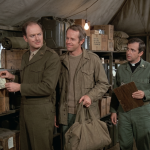
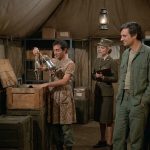
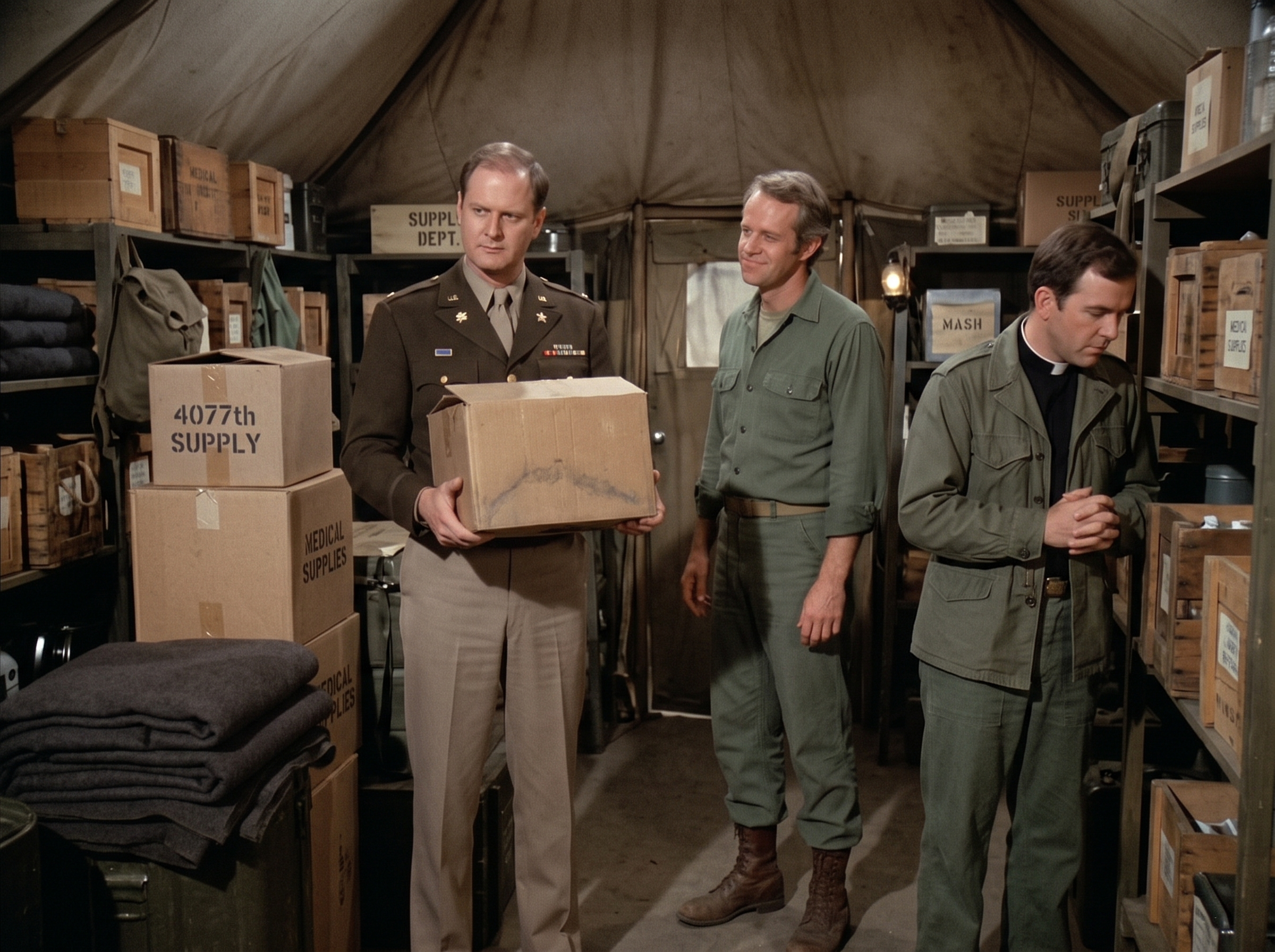
Major Charles Emerson Winchester III stood in the center of the cramped storage area. His posture was perfectly rigid, his chin tilted upward in a familiar stance of wounded pride and dry superiority.
In his hands, he held a battered, unlabelled cardboard box.
It was covered in faded tape and Korean dust. There were no customs stamps, no elegant Bostonian return addresses, and no indication of what might be inside. Charles held it out slightly in front of him, looking at it as if it were a mild but distinct insult to his very lineage.
A few feet away, B.J. Hunnicutt leaned casually against a stack of olive-drab blankets. His arms hung relaxed by his sides. He wore a faded, lived-in shirt and an understated, empathetic smile.
B.J. was thoroughly enjoying the show. There was nothing quite as entertaining as watching a Winchester forced to deal with the messy, unrefined reality of camp life.
“I don’t understand the problem, Charles,” B.J. said softly, his voice echoing lightly in the quiet supply tent. “It’s a box. You open it. That’s generally how the concept works.”
Charles shot him a withering sideways glance. “This, Hunnicutt, is not a box. This is an unmarked hazard. A Winchester does not simply open anonymous parcels that look as though they have been dragged behind a jeep from Seoul to Uijeongbu.”
“Maybe it’s the smoked oysters you’ve been whining about,” B.J. offered, the amusement crinkling the corners of his eyes.
“If my mother sent oysters in an unlabelled, grease-stained receptacle, I would disown the entire family,” Charles replied smoothly. Yet, his grip on the cardboard tightened.
Nearby, Father Francis Mulcahy was leaning over a rough wooden crate, his hands resting gently on the edge. He was radiating gentle concern and a sincere willingness to help, squinting at the faded stencils on the wood.
“Perhaps there was a shipping manifest attached, Major,” the priest offered kindly, turning his head toward Charles. “Sometimes the outer wrappers tear off during transit. I’m sure it’s nothing dangerous.”
“In this place, Father, a lack of documentation usually precedes a catastrophic disappointment,” Charles sighed heavily.
He looked down at the box again. It was small. Too light for canned goods. Too heavy for a letter. It rattled slightly when he shifted his weight.
For three weeks, Charles had been waiting for a specialized package of silk winter socks and fine tea. The bitter Korean nights had been seeping into his bones, and he had been longing for a taste of home.
Instead, the postal clerk had handed him this anonymous, battered square of cardboard. It felt like a joke played by a universe that fundamentally misunderstood him.
“Well,” B.J. said gently. “You’re never gonna know if you just stand there glaring at it.”
With a deep, theatrical sigh, Charles pulled a pocket knife from his trousers. He flipped the blade open with precise, practiced grace.
“If this contains used jeep parts or another one of Pierce’s infantile pranks,” Charles warned the room at large, “I am holding you both personally responsible.”
He sliced through the heavy packing tape. The dry sound of tearing adhesive filled the quiet canvas tent.
Charles pushed the cardboard flaps back. He paused, his nose wrinkling slightly, expecting the worst.
He leaned forward and peered inside the dark interior of the box.
Instantly, the dry superiority vanished from his face. His rigid posture completely melted away. He froze, his eyes locked on the contents, completely and utterly speechless.
The silence in the supply tent stretched on for a long, heavy moment.
B.J.’s amused smile slowly faded. In the 4077th, you learned to read people quickly. The sudden drop in Charles’s aristocratic armor wasn’t born of disgust or anger. It was shock.
“Charles?” B.J. asked, his voice dropping its teasing tone, replaced by quiet, genuine concern. “What is it?”
Father Mulcahy stepped away from the wooden crate, softly crossing the dirt floor to stand a respectful distance away.
Charles didn’t answer immediately. He stared into the box. His throat bobbed as he swallowed hard.
Slowly, almost reverently, Charles reached his large hands into the dusty cardboard.
He pulled out a thick, unevenly knitted woolen scarf. It was a chaotic mix of mismatched blue and grey yarns. The stitches were dropped in places, the edges were lumpy, and the material looked incredibly scratchy.
It was, by any Bostonian standard, an absolute atrocity of haberdashery.
Beneath the scarf lay three small, crushed packets of generic peppermint candies and a folded piece of lined school paper.
Charles picked up the paper. His hands, usually so steady with a scalpel, possessed a faint tremor as he unfolded the sheet.
B.J. and Mulcahy watched him in silence. The warm, practical light of the tent caught the sudden dampness in Charles’s eyes.
“It… it is not from Boston,” Charles finally whispered. His voice sounded thin, stripped of its usual booming resonance.
He cleared his throat, attempting to regain a shred of his customary dignity, but failed entirely. He looked at the lined paper.
“It is addressed to ‘A Brave Soldier,'” Charles read aloud, his voice remarkably quiet.
He paused, taking a breath before continuing. “‘My name is Tommy. I am nine. My class is sending boxes to Korea. I knitted this scarf myself. My mom had to help me fix the holes. I hope it keeps you warm when you are scared.'”
Charles stopped reading. He stared blindly at the crooked pencil letters of a child sitting safely in a classroom thousands of miles away.
B.J. felt a familiar, bittersweet ache in his chest. It was the same ache that came whenever he thought of his own daughter, Erin, growing up in a world so far removed from this war.
He looked at Charles. The pompous surgeon from Massachusetts was standing in a dusty supply tent, holding a lumpy, scratchy scarf like it was spun gold.
“A lovely gesture,” Father Mulcahy said softly, his voice thick with emotion. “The innocence of children back home… it is a powerful thing, Major.”
Charles quickly folded the letter. He slipped it into his breast pocket, close to his heart, before anyone could notice how much it affected him.
He looked down at the scratchy wool in his hands. His wounded pride was completely gone, replaced by the deep, unspoken exhaustion and humanity they all shared.
“Yes, well,” Charles stammered, awkwardly clearing his throat. He tried to summon his haughty tone, but it lacked all conviction. “Clearly, a clerical error in the mailroom. Sending such… rough-hewn burlap to a Winchester.”
B.J. smiled softly. It wasn’t a teasing smile anymore. It was a smile of deep, quiet brotherhood.
“You want me to take it to the orphans, Charles?” B.J. asked gently. “I’m sure Father Mulcahy could find a kid who needs a scarf.”
Charles stiffened. He pulled the lumpy blue-and-grey wool slightly closer to his chest.
“Nonsense,” Charles muttered, looking everywhere but at B.J. “The draft in the Swamp is notoriously unapologetic. And as a man of science, I feel it is my duty to test the… insulating properties of this primitive garment.”
Father Mulcahy beamed, clasping his hands together. “A very scientific approach, Major. Very practical.”
“Quite,” Charles said. He picked up the crushed peppermints and held them out to the priest. “However, I draw the line at generic confectionary. Please distribute these to the local children, Father. With my compliments.”
Mulcahy took the candies with a grateful nod.
Charles carefully draped the terrible, beautiful scarf over his forearm. He picked up the empty, unlabelled cardboard box and tucked it under his arm. He wasn’t going to throw it away.
B.J. watched him turn toward the tent flap.
“Hey, Charles,” B.J. called out softly.
Charles paused, looking back over his shoulder.
“Blue is definitely your color,” B.J. said warmly.
A ghost of a genuine, tender smile touched the corners of Charles’s mouth.
“Thank you, Hunnicutt,” he replied quietly.
Charles pushed through the canvas flap and stepped out into the cold, dusty reality of the camp, carrying a little boy’s messy stitches into the war.
B.J. and Mulcahy stood alone in the quiet supply tent. They shared a gentle look, surrounded by crates and canvas, warmed by a fleeting, beautiful moment of grace.
In the middle of nowhere, the greatest treasures didn’t come in fancy packages, but in the quiet, unexpected moments that proved they were all still human.