A Prescription for Hope
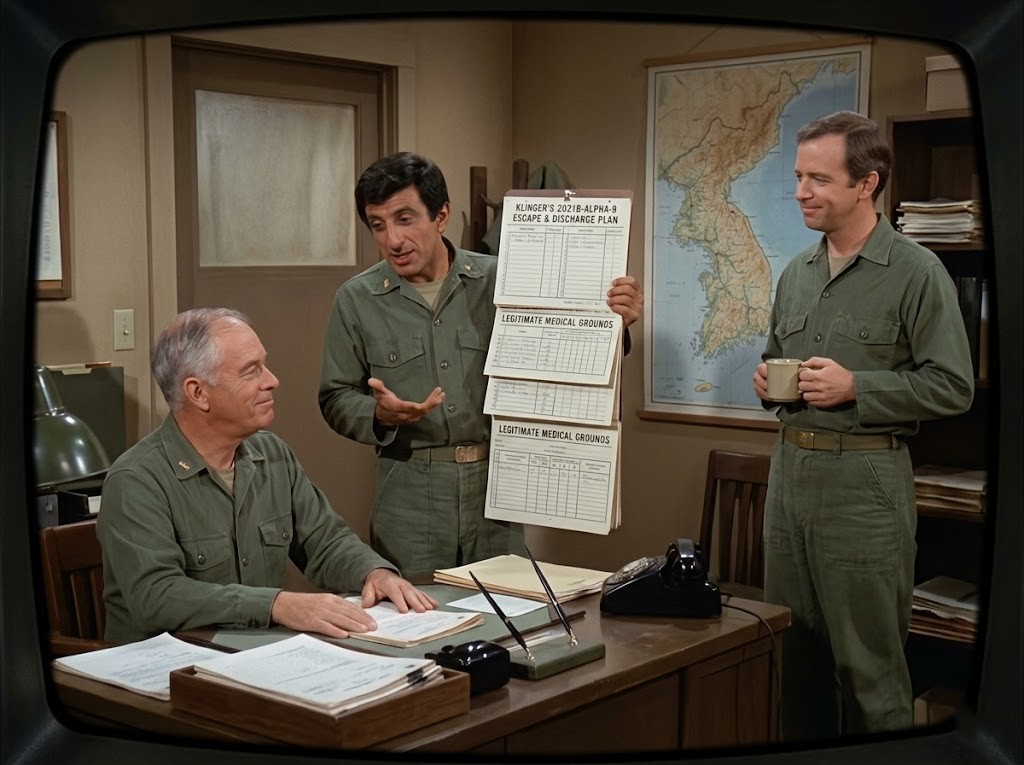
If the dust of Uijeongbu could ever be swept away, it would probably just find a different desk to settle on. That morning, Colonel Potter’s office was a fragile cocoon of sanity. It wasn’t just dust in the air; it was that quiet, collective fatigue, thicker than any morning fog. You could almost measure it in the steady rhythm of Klinger’s shifting boots.
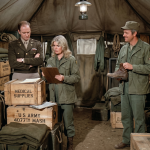
Klinger was not a subtle man. But in that moment, he was trying to be *very* thorough. He stood in the center of the office, holding an impressively thick clipboard as if it were a declaration of independence. His olive drab was pressed, his expression was entirely solemn, and his eyes had a focused, slightly worried light. He was pitching a plan. The big plan. His 202th attempt. The title, visible at the top, read: “KLINGER’S 2021B-ALPHA-9 ESCAPE & DISCHARGE PLAN.”
Below it, like sub-categories of desperate genius, were “LEGITIMATE MEDICAL GROUNDS.” He must have used the *entire* base typewriter ribbon on this. This wasn’t a joke; it was a testament to survival. He had charts. He had bullet points. He was presenting it with a theatrical flourish that seemed out of place in a room that often only hosted exhaustion.
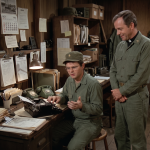
Colonel Potter was at his desk. His expression wasn’t angry; it was tired. A wise, seasoned kind of tired that comes from bearing the weight of an entire camp. His gaze, however, wasn’t on the chart. It was directed, with a familiar mix of patience and dry affection, toward Klinger himself. It was a look that said, “Oh, son, not this again,” but also “Thank you for the distraction.” Potter’s desk was neatly stacked with official documents—reports, rosters, and an old, heavy rotary phone.
Over to the side stood another figure in olive drab. B.J. Hunnicutt. He wasn’t participating, just witnessing. He held a simple beige mug, the steam barely rising from whatever lukewarm liquid it contained. A slight, gentle smile played on his lips. His posture was relaxed, a quiet island of stability. He’d seen dozens of these presentations, but he never tired of Klinger’s sheer, indefatigable ingenuity. There was a warmth in his silence. He was just glad Klinger was still trying. He was a piece of sanity in a messy world.
The maps on the wall, showing the entirety of Korea, seemed to shrink and become background noise to the small human theater unfolding. The Korean coastline, etched in blue and green, was a stark reminder of where they were, but here, in this humble room, the real fight was smaller. The real fight was for the spirit.
Klinger was just reaching his crescendo. His voice was gaining tempo, listing the *specific* psychological and physical maladies that absolutely, logically *must* disqualify him. His hand was gesticulating, his face expressive, begging for acknowledgment. He looked at Potter, waiting for the verdict, his heart, surprisingly, entirely in his hands on that clipboard. He had built this tension up with an entire stack of paper. The final ‘A-9’ plan. His last, best hope. All of it hanging in the quiet air of a busy command post.
Potter didn’t speak. He just sat. The silent weight of his decision—to indulge, to correct, or simply to acknowledge—became the only thing moving in the room. Klinger stood still, the theatrical energy suspended, the silence between them swelling until it felt too heavy to bear. The maps seemed to lean in. The only noise was the distant, faint rumble of artillary that was always, always there. The room held its breath, waiting for Potter to break the stillness.
Potter finally did move. It wasn’t a reach for a stamp of approval or a sigh of denial. He simply reached out and picked up a pen from his glass pen stand. He didn’t sign the plan. He didn’t even *touch* the plan. Instead, he made a mark on a simple, folded piece of paper already on his desk. A different piece of paper entirely.
A soft, small clatter echoed through the room as Potter set the pen down. He then finally met Klinger’s pleading, nervous eyes. “Maxwell,” Potter began, his voice like worn flannel, calm and steady. “I have read this before. Or rather, I have seen the same ink and the same paper before.” He paused, his gaze drifting to the Korea map on the wall. “The reason you aren’t leaving isn’t found in a chart.”
He looked back at Klinger, and the fatherly look deepened. “It isn’t because you’re unfit, son. And it sure isn’t because you haven’t put in the work on this clipboard.” He tapped the desk with his fingertip. “It’s because we *need* you. And you need us. Even when you’re wearing a dress, you keep this place from just being *about* uniforms. You remind us to find a laugh. Even a crazy one.”
Potter’s tone wasn’t dismissive. It was a gentle reframing. “Now, this ‘A-9’ plan? It’s creative. But I signed off on the morning duty roster five minutes ago, and you are on it. This clipboard is an excellent draft. It just isn’t the final one.”
Klinger stood, his shoulders slumping slightly. But the desperation was gone. The theatrical edge softened into a look of acceptance, and, yes, a quiet, simple understanding. He looked at B.J., who was still smiling. He knew. B.J. didn’t need to say a word. Klinger knew he was being seen, not just laughed at. He wasn’t being dismissed as a lunatic; he was being kept, almost cherished, as an essential, ridiculous part of a whole.
He held the clipboard tight, but he wasn’t begging anymore. “Yes, sir. Thank you, sir.” His response was quiet, simple, and filled with a rare gravity that often eluded his usual, bigger performances. He began to lower the plan. It was just a stack of paper now. It was no longer his grand escape; it was just… history.
He gave a small, defeated salute that felt more human than professional. “Back to work then.” He turned, and as he did, he didn’t even try for a flamboyant flourish. He just walked away, but with a different kind of dignity. He wasn’t being rejected; he was being needed. And that, in its own way, was a powerful kind of victory. He was still Klinger. He was still in the army. But he was also home.
B.J. finally took a sip from his mug. “Well,” he said softly, a small glint in his eye as Klinger passed him, “That was certainly one for the books. Maybe ‘A-10’ can involve a hot air balloon.” He gave Klinger a friendly pat on the shoulder.
Colonel Potter picked up a different stack of reports. A finality settled back over the office. The maps on the wall still showed the long, difficult road ahead for the war. But inside, for a moment, the world was small and connected, and a single, shared moment of patience, humor, and tender humanity had made all the difference. The real prescription for hope, and the only true escape, wasn’t on a chart at all; it was in the steady, familiar faces that surrounded you.
In this corner of chaos, even a silly plan was a anchor to the people they needed the most.